

Because Clausius-Duhem inequality is just a quantitative statement of the second
law of thermodynamics, it must be satisfied by every process in organic or inorganic
systems. The coordinate system assumed in derivation of the formulation in previous
pages is arbitrary; however, positive definite property of the inequality is not
arbitrary. It must be satisfied for all and any coordinate system.
3.3.2.5 Traditional Use of Entropy as a Functional in Continuum
Mechanics
The unified mechanics theory uses entropy as a linearly independent state variable.
Furthermore, entropy (thermodynamics state index) defines a new additional axis in
addition to Newtonian space-time axes. This is needed to be able to define location
of a system in space-time-thermodynamic state index coordinate system. While there
are similarities between traditional interpretation of entropy in Newtonian (continuum) mechanics and unified mechanics, there are also major differences. In Newtonian (continuum) mechanics, derivative with respect to entropy is taken as zero. In
the unified mechanics theory, derivatives with respect to entropy are not zero. When
derivatives with respect entropy are taken as zero, the unified mechanics theory
collapses to Newtonian mechanics.
Traditional use of entropy in Newtonian (continuum) mechanics is considered
extensively by Malvern (1969), Coleman (1964), and Coleman and Mizel (1964,
1967). Here, we summarize their work. In Newtonian continuum mechanics, the use
of the Clausius-Duhem inequality differs from the usual second law of thermodynamics, where the entropy is a state function determined by the instantaneous values
of the other state variables. In Newtonian continuum mechanics, entropy is not
explicitly postulated to be a state function. As a result, in Newtonian continuum
mechanics, entropy maximization (and minimization of entropy generation rate) has
no effect on system state variables or system properties. In simple terms, in Newtonian continuum mechanics, degradation of the system is not possible. Traditionally,
Attractive energy
Net EnergyE
N
Repulsive energy
Interatomic disctancer r
r0
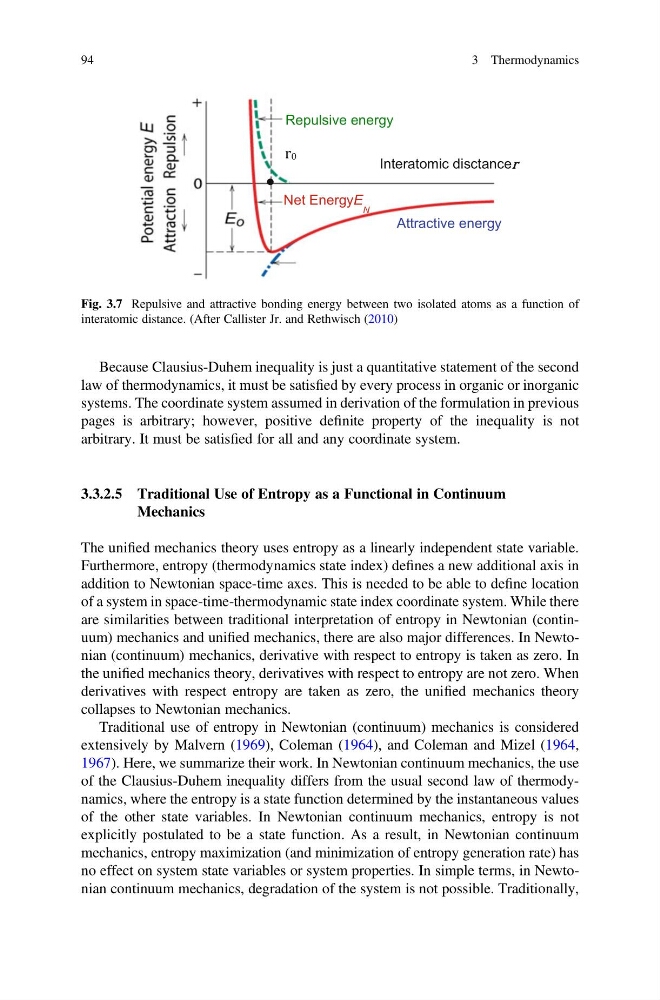
Fig. 3.7 Repulsive and attractive bonding energy between two isolated atoms as a function of
interatomic distance. (After Callister Jr. and Rethwisch (2010)
94
3 Thermodynamics
law of thermodynamics, it must be satisfied by every process in organic or inorganic
systems. The coordinate system assumed in derivation of the formulation in previous
pages is arbitrary; however, positive definite property of the inequality is not
arbitrary. It must be satisfied for all and any coordinate system.
3.3.2.5 Traditional Use of Entropy as a Functional in Continuum
Mechanics
The unified mechanics theory uses entropy as a linearly independent state variable.
Furthermore, entropy (thermodynamics state index) defines a new additional axis in
addition to Newtonian space-time axes. This is needed to be able to define location
of a system in space-time-thermodynamic state index coordinate system. While there
are similarities between traditional interpretation of entropy in Newtonian (continuum) mechanics and unified mechanics, there are also major differences. In Newtonian (continuum) mechanics, derivative with respect to entropy is taken as zero. In
the unified mechanics theory, derivatives with respect to entropy are not zero. When
derivatives with respect entropy are taken as zero, the unified mechanics theory
collapses to Newtonian mechanics.
Traditional use of entropy in Newtonian (continuum) mechanics is considered
extensively by Malvern (1969), Coleman (1964), and Coleman and Mizel (1964,
1967). Here, we summarize their work. In Newtonian continuum mechanics, the use
of the Clausius-Duhem inequality differs from the usual second law of thermodynamics, where the entropy is a state function determined by the instantaneous values
of the other state variables. In Newtonian continuum mechanics, entropy is not
explicitly postulated to be a state function. As a result, in Newtonian continuum
mechanics, entropy maximization (and minimization of entropy generation rate) has
no effect on system state variables or system properties. In simple terms, in Newtonian continuum mechanics, degradation of the system is not possible. Traditionally,
Attractive energy
Net EnergyE
N
Repulsive energy
Interatomic disctancer r
r0
Fig. 3.7 Repulsive and attractive bonding energy between two isolated atoms as a function of
interatomic distance. (After Callister Jr. and Rethwisch (2010)
94
3 Thermodynamics