

A stronger assumption of the inequality was proposed by Truesdell and Noll
(1985):
ds
dt
À
r
T
þ
1
ρT
div q ! 0 À
1
ρT
2
q Á grad T ! 0
ð3:64Þ
where the first inequality represents the local entropy production by the system and
the second inequality represents the entropy production by heat conduction.
The Truesdell and Noll (1985) interpretation of the second law of thermodynamics is important for unified mechanics theory, because we will see that the disorder in
the system increases only due to internal entropy production.
Entropy production by heat conduction in a free (unconstrained) system cannot
lead to irreversible disorder because the system travels between stress-free states.
The interatomic equilibrium distance is a function of temperature; therefore, due to
heat conduction, the temperature of the system increases (atoms have higher vibrational energy), and the equilibrium interatomic distance also increases. However,
there will be no strain (or stress) exerted on the atoms. Therefore, internal work will
be zero; as a result, internal entropy production will be zero. If the atoms move from
one thermal equilibrium to another thermal equilibrium, it is assumed that there will
be no internal entropy generation. Of course, this assumption is not 100% true.
When there is a heat transport in a lattice, there is always scattering of phonons. We
are assuming this scattering-induced internal entropy generation is so small that we
can ignore it.
When there are no external constraint blocking atoms moving freely at each
temperature, they have a stress-free equilibrium interatomic separation distance r 0 .
When the interatomic distance is r 0 , the attraction potential energy is at maximum
and the force acting on the atoms is zero (Fig. 3.7). Therefore, internal work is not
possible, because internal work and internal entropy production are proportional to
dislocation of an atom from equilibrium, lattice site, and force acting on the atom. Of
course, when a system is at equilibrium and the force acting on the atom is zero, the
work done must be zero. However, this argument assumes that the system is free to
move and the boundary conditions do not impose any constraint on the system that
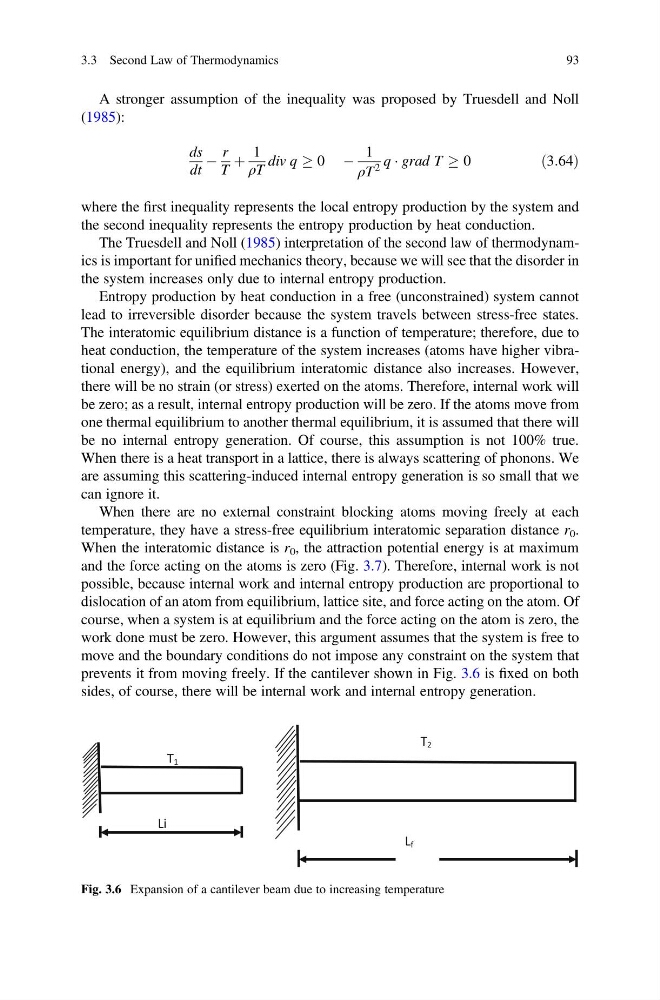
prevents it from moving freely. If the cantilever shown in Fig. 3.6 is fixed on both
sides, of course, there will be internal work and internal entropy generation.
T 1
Li
T 2
L f
Fig. 3.6 Expansion of a cantilever beam due to increasing temperature
3.3 Second Law of Thermodynamics
93
(1985):
ds
dt
À
r
T
þ
1
ρT
div q ! 0 À
1
ρT
2
q Á grad T ! 0
ð3:64Þ
where the first inequality represents the local entropy production by the system and
the second inequality represents the entropy production by heat conduction.
The Truesdell and Noll (1985) interpretation of the second law of thermodynamics is important for unified mechanics theory, because we will see that the disorder in
the system increases only due to internal entropy production.
Entropy production by heat conduction in a free (unconstrained) system cannot
lead to irreversible disorder because the system travels between stress-free states.
The interatomic equilibrium distance is a function of temperature; therefore, due to
heat conduction, the temperature of the system increases (atoms have higher vibrational energy), and the equilibrium interatomic distance also increases. However,
there will be no strain (or stress) exerted on the atoms. Therefore, internal work will
be zero; as a result, internal entropy production will be zero. If the atoms move from
one thermal equilibrium to another thermal equilibrium, it is assumed that there will
be no internal entropy generation. Of course, this assumption is not 100% true.
When there is a heat transport in a lattice, there is always scattering of phonons. We
are assuming this scattering-induced internal entropy generation is so small that we
can ignore it.
When there are no external constraint blocking atoms moving freely at each
temperature, they have a stress-free equilibrium interatomic separation distance r 0 .
When the interatomic distance is r 0 , the attraction potential energy is at maximum
and the force acting on the atoms is zero (Fig. 3.7). Therefore, internal work is not
possible, because internal work and internal entropy production are proportional to
dislocation of an atom from equilibrium, lattice site, and force acting on the atom. Of
course, when a system is at equilibrium and the force acting on the atom is zero, the
work done must be zero. However, this argument assumes that the system is free to
move and the boundary conditions do not impose any constraint on the system that
prevents it from moving freely. If the cantilever shown in Fig. 3.6 is fixed on both
sides, of course, there will be internal work and internal entropy generation.
T 1
Li
T 2
L f
Fig. 3.6 Expansion of a cantilever beam due to increasing temperature
3.3 Second Law of Thermodynamics
93