

atoms in any system just takes one of the possible disordered states. Of course,
because of very large number of possible disordered states, the system cannot get
into every possible disordered configuration before entropy becomes maximum,
because of the closed-isolated system requirement. This is easier to explain with
an example. Assume we have a box with 26 baseballs marked A to Z. Initially, they
are all in alphabetical order. Say the box is 10 kg. We are allowed to spend 100 Joules
of energy to shake the box. Assume we have probably ten chances to shake the box.
Of course, for our closed system when 100 Joule is consumed, the maximum entropy
is reached. However, we could not discover all possible disorder states that 26 baseballs could take. In the same fashion, when a material fails in a fatigue loading or
monotonic loading, the failure is always through a different path. Yet the maximum
entropy value to reach the failure is always the same (Naderi et al. 2009 Yun and
Modarres 2019 Tu and Gusak 2019). Failure or increase in disorder in a system can
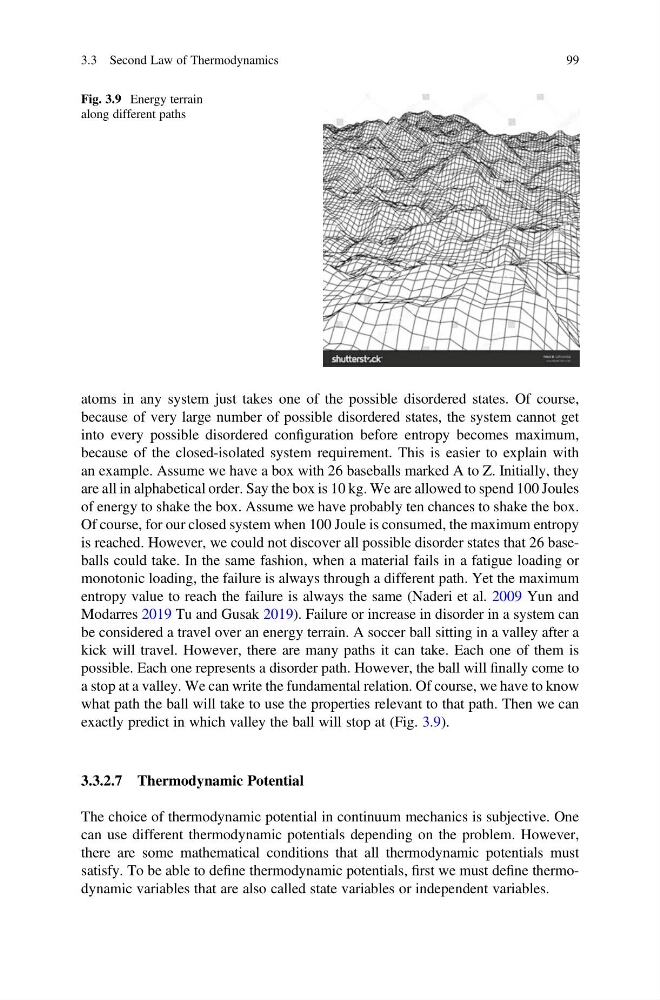
be considered a travel over an energy terrain. A soccer ball sitting in a valley after a
kick will travel. However, there are many paths it can take. Each one of them is
possible. Each one represents a disorder path. However, the ball will finally come to
a stop at a valley. We can write the fundamental relation. Of course, we have to know
what path the ball will take to use the properties relevant to that path. Then we can
exactly predict in which valley the ball will stop at (Fig. 3.9).
3.3.2.7 Thermodynamic Potential
The choice of thermodynamic potential in continuum mechanics is subjective. One
can use different thermodynamic potentials depending on the problem. However,
there are some mathematical conditions that all thermodynamic potentials must
satisfy. To be able to define thermodynamic potentials, first we must define thermodynamic variables that are also called state variables or independent variables.
Fig. 3.9 Energy terrain
along different paths
3.3 Second Law of Thermodynamics
99
because of very large number of possible disordered states, the system cannot get
into every possible disordered configuration before entropy becomes maximum,
because of the closed-isolated system requirement. This is easier to explain with
an example. Assume we have a box with 26 baseballs marked A to Z. Initially, they
are all in alphabetical order. Say the box is 10 kg. We are allowed to spend 100 Joules
of energy to shake the box. Assume we have probably ten chances to shake the box.
Of course, for our closed system when 100 Joule is consumed, the maximum entropy
is reached. However, we could not discover all possible disorder states that 26 baseballs could take. In the same fashion, when a material fails in a fatigue loading or
monotonic loading, the failure is always through a different path. Yet the maximum
entropy value to reach the failure is always the same (Naderi et al. 2009 Yun and
Modarres 2019 Tu and Gusak 2019). Failure or increase in disorder in a system can
be considered a travel over an energy terrain. A soccer ball sitting in a valley after a
kick will travel. However, there are many paths it can take. Each one of them is
possible. Each one represents a disorder path. However, the ball will finally come to
a stop at a valley. We can write the fundamental relation. Of course, we have to know
what path the ball will take to use the properties relevant to that path. Then we can
exactly predict in which valley the ball will stop at (Fig. 3.9).
3.3.2.7 Thermodynamic Potential
The choice of thermodynamic potential in continuum mechanics is subjective. One
can use different thermodynamic potentials depending on the problem. However,
there are some mathematical conditions that all thermodynamic potentials must
satisfy. To be able to define thermodynamic potentials, first we must define thermodynamic variables that are also called state variables or independent variables.
Fig. 3.9 Energy terrain
along different paths
3.3 Second Law of Thermodynamics
99