

As pointed out by Callen (1985), it is possible to express internal energy
U without the term entropy S. However, such a total energy equation is not a
fundamental relation and does not contain all thermodynamic information about
the system.
3.3.2.3 Entropy Production in Irreversible Process
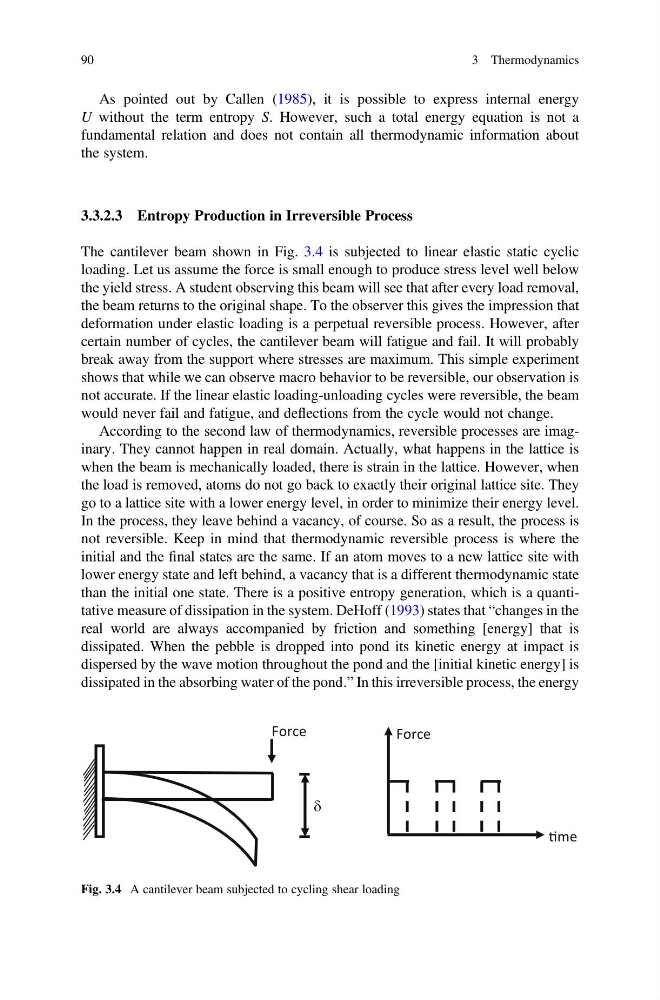
The cantilever beam shown in Fig. 3.4 is subjected to linear elastic static cyclic
loading. Let us assume the force is small enough to produce stress level well below
the yield stress. A student observing this beam will see that after every load removal,
the beam returns to the original shape. To the observer this gives the impression that
deformation under elastic loading is a perpetual reversible process. However, after
certain number of cycles, the cantilever beam will fatigue and fail. It will probably
break away from the support where stresses are maximum. This simple experiment
shows that while we can observe macro behavior to be reversible, our observation is
not accurate. If the linear elastic loading-unloading cycles were reversible, the beam
would never fail and fatigue, and deflections from the cycle would not change.
According to the second law of thermodynamics, reversible processes are imaginary. They cannot happen in real domain. Actually, what happens in the lattice is
when the beam is mechanically loaded, there is strain in the lattice. However, when
the load is removed, atoms do not go back to exactly their original lattice site. They
go to a lattice site with a lower energy level, in order to minimize their energy level.
In the process, they leave behind a vacancy, of course. So as a result, the process is
not reversible. Keep in mind that thermodynamic reversible process is where the
initial and the final states are the same. If an atom moves to a new lattice site with
lower energy state and left behind, a vacancy that is a different thermodynamic state
than the initial one state. There is a positive entropy generation, which is a quantitative measure of dissipation in the system. DeHoff (1993) states that “changes in the
real world are always accompanied by friction and something [energy] that is
dissipated. When the pebble is dropped into pond its kinetic energy at impact is
dispersed by the wave motion throughout the pond and the [initial kinetic energy] is
dissipated in the absorbing water of the pond.” In this irreversible process, the energy
Force
δ
Ɵme
Force
Fig. 3.4 A cantilever beam subjected to cycling shear loading
90
3 Thermodynamics
U without the term entropy S. However, such a total energy equation is not a
fundamental relation and does not contain all thermodynamic information about
the system.
3.3.2.3 Entropy Production in Irreversible Process
The cantilever beam shown in Fig. 3.4 is subjected to linear elastic static cyclic
loading. Let us assume the force is small enough to produce stress level well below
the yield stress. A student observing this beam will see that after every load removal,
the beam returns to the original shape. To the observer this gives the impression that
deformation under elastic loading is a perpetual reversible process. However, after
certain number of cycles, the cantilever beam will fatigue and fail. It will probably
break away from the support where stresses are maximum. This simple experiment
shows that while we can observe macro behavior to be reversible, our observation is
not accurate. If the linear elastic loading-unloading cycles were reversible, the beam
would never fail and fatigue, and deflections from the cycle would not change.
According to the second law of thermodynamics, reversible processes are imaginary. They cannot happen in real domain. Actually, what happens in the lattice is
when the beam is mechanically loaded, there is strain in the lattice. However, when
the load is removed, atoms do not go back to exactly their original lattice site. They
go to a lattice site with a lower energy level, in order to minimize their energy level.
In the process, they leave behind a vacancy, of course. So as a result, the process is
not reversible. Keep in mind that thermodynamic reversible process is where the
initial and the final states are the same. If an atom moves to a new lattice site with
lower energy state and left behind, a vacancy that is a different thermodynamic state
than the initial one state. There is a positive entropy generation, which is a quantitative measure of dissipation in the system. DeHoff (1993) states that “changes in the
real world are always accompanied by friction and something [energy] that is
dissipated. When the pebble is dropped into pond its kinetic energy at impact is
dispersed by the wave motion throughout the pond and the [initial kinetic energy] is
dissipated in the absorbing water of the pond.” In this irreversible process, the energy
Force
δ
Ɵme
Force
Fig. 3.4 A cantilever beam subjected to cycling shear loading
90
3 Thermodynamics