

cannot be recovered. “The entropy production in a system is a quantitative measure
of this energy dissipation [mechanism].”
Eddington (1958) referred to entropy as “entropy is time’s arrow.” The total
entropy of any system plus its surroundings always increases with increasing time.
However, their relationship is not linear and each one is linearly independent. Time
can change without change in entropy. If we had a process where entropy is
destroyed, then the direction of the time arrow must be reversed for that process to
happen. However, this is not possible in a real system. A reader may question
accuracy of theory of elasticity where all mechanisms are assumed reversible.
Because of the second law of thermodynamics, the theory of elasticity provides an
approximate solution to an imaginary system that cannot exist in reality. In the words
of DeHoff (1993), “All real processes have a finite rate in response to finite
influences; such real processes are called irreversible to emphasize the contrast
with imaginary reversible processes. Real processes are irreversible and suffer
dissipations that result in the production of entropy and thus a permanent (irreversible) change in the system.” Therefore, for an irreversible process, we can write
ΔS ¼ S 2 À S 1 ¼
Z 2
1
dQ
T
irreversible
> 0
ð3:57Þ
Of course, here, it is assumed that it is a closed system and it is an adiabatic
process.
While we acknowledge that all real processes are irreversible, sometimes for the
sake of simplicity, a system is modeled as an imaginary reversible process, to be able
to get an understanding of the system near time¼0.
3.3.2.4 Clausius-Duhem Inequality
There are different approaches to derive this inequality. We will quote the derivation
given by Malvern (1969). This inequality is considered a quantitative explanation of
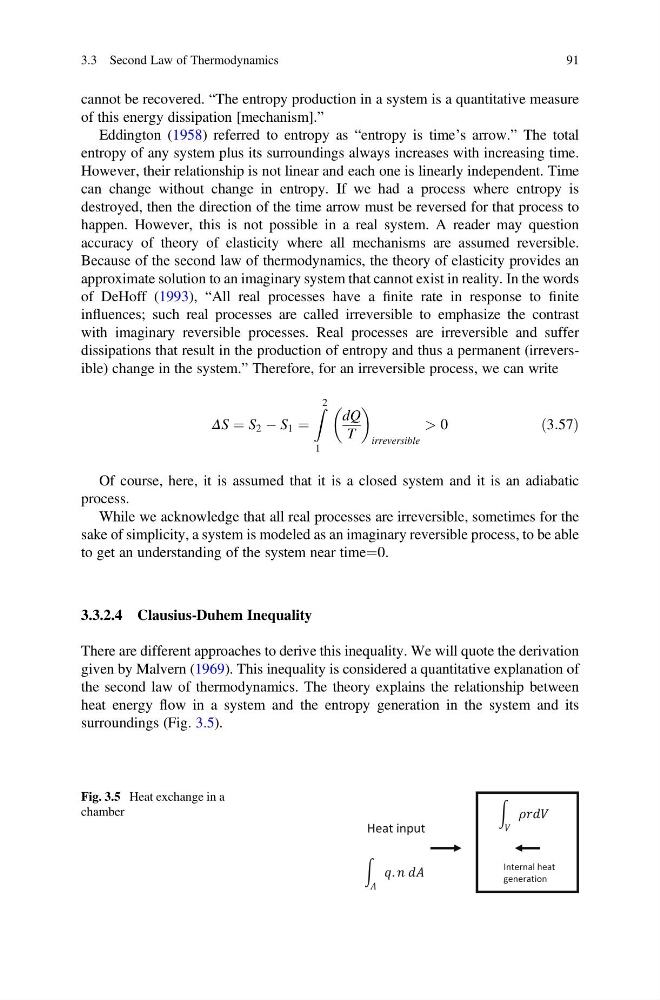
the second law of thermodynamics. The theory explains the relationship between
heat energy flow in a system and the entropy generation in the system and its
surroundings (Fig. 3.5).
Fig. 3.5 Heat exchange in a
chamber
3.3 Second Law of Thermodynamics
91
of this energy dissipation [mechanism].”
Eddington (1958) referred to entropy as “entropy is time’s arrow.” The total
entropy of any system plus its surroundings always increases with increasing time.
However, their relationship is not linear and each one is linearly independent. Time
can change without change in entropy. If we had a process where entropy is
destroyed, then the direction of the time arrow must be reversed for that process to
happen. However, this is not possible in a real system. A reader may question
accuracy of theory of elasticity where all mechanisms are assumed reversible.
Because of the second law of thermodynamics, the theory of elasticity provides an
approximate solution to an imaginary system that cannot exist in reality. In the words
of DeHoff (1993), “All real processes have a finite rate in response to finite
influences; such real processes are called irreversible to emphasize the contrast
with imaginary reversible processes. Real processes are irreversible and suffer
dissipations that result in the production of entropy and thus a permanent (irreversible) change in the system.” Therefore, for an irreversible process, we can write
ΔS ¼ S 2 À S 1 ¼
Z 2
1
dQ
T
irreversible
> 0
ð3:57Þ
Of course, here, it is assumed that it is a closed system and it is an adiabatic
process.
While we acknowledge that all real processes are irreversible, sometimes for the
sake of simplicity, a system is modeled as an imaginary reversible process, to be able
to get an understanding of the system near time¼0.
3.3.2.4 Clausius-Duhem Inequality
There are different approaches to derive this inequality. We will quote the derivation
given by Malvern (1969). This inequality is considered a quantitative explanation of
the second law of thermodynamics. The theory explains the relationship between
heat energy flow in a system and the entropy generation in the system and its
surroundings (Fig. 3.5).
Fig. 3.5 Heat exchange in a
chamber
3.3 Second Law of Thermodynamics
91