

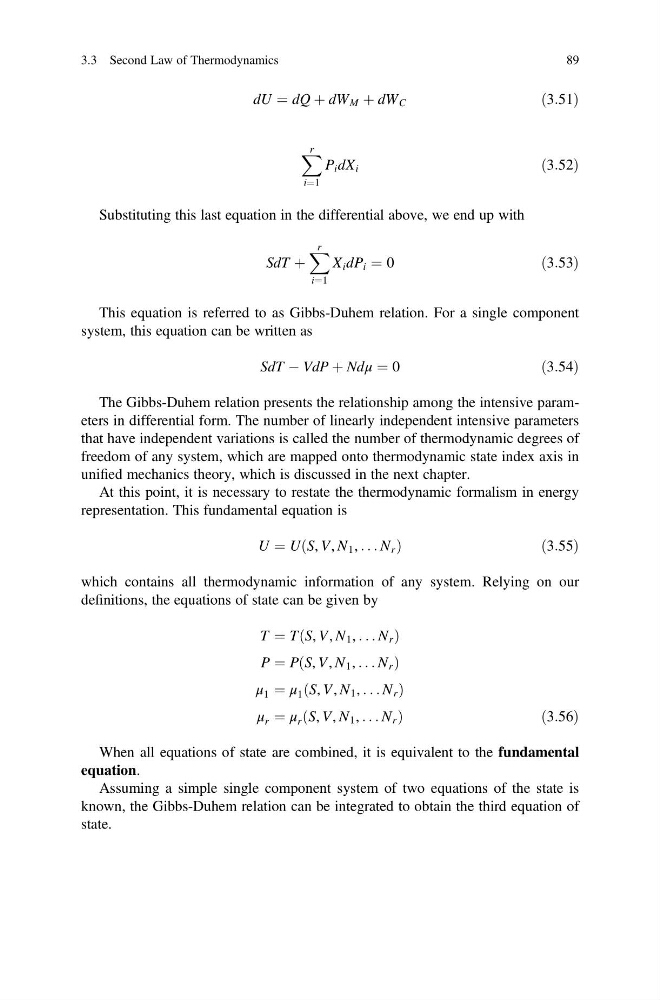
dU ¼ dQ þ dW M þ dW C
ð3:51Þ
X r
i¼1
P i dX i
ð3:52Þ
Substituting this last equation in the differential above, we end up with
SdT þ
X r
i¼1
X i dP i ¼ 0
ð3:53Þ
This equation is referred to as Gibbs-Duhem relation. For a single component
system, this equation can be written as
SdT À VdP þ Ndμ ¼ 0
ð3:54Þ
The Gibbs-Duhem relation presents the relationship among the intensive parameters in differential form. The number of linearly independent intensive parameters
that have independent variations is called the number of thermodynamic degrees of
freedom of any system, which are mapped onto thermodynamic state index axis in
unified mechanics theory, which is discussed in the next chapter.
At this point, it is necessary to restate the thermodynamic formalism in energy
representation. This fundamental equation is
U ¼ U S, V, N 1 , . . . N r
ð
Þ
ð 3:55Þ
which contains all thermodynamic information of any system. Relying on our
definitions, the equations of state can be given by
T ¼ T S, V, N 1 , . . . N r
ð
Þ
P ¼ P S, V, N 1 , . . . N r
ð
Þ
μ 1 ¼ μ 1 S, V, N 1 , . . . N r
ð
Þ
μ r ¼ μ r S, V, N 1 , . . . N r
ð
Þ
ð 3:56Þ
When all equations of state are combined, it is equivalent to the fundamental
equation.
Assuming a simple single component system of two equations of the state is
known, the Gibbs-Duhem relation can be integrated to obtain the third equation of
state.
3.3 Second Law of Thermodynamics
89
ð3:51Þ
X r
i¼1
P i dX i
ð3:52Þ
Substituting this last equation in the differential above, we end up with
SdT þ
X r
i¼1
X i dP i ¼ 0
ð3:53Þ
This equation is referred to as Gibbs-Duhem relation. For a single component
system, this equation can be written as
SdT À VdP þ Ndμ ¼ 0
ð3:54Þ
The Gibbs-Duhem relation presents the relationship among the intensive parameters in differential form. The number of linearly independent intensive parameters
that have independent variations is called the number of thermodynamic degrees of
freedom of any system, which are mapped onto thermodynamic state index axis in
unified mechanics theory, which is discussed in the next chapter.
At this point, it is necessary to restate the thermodynamic formalism in energy
representation. This fundamental equation is
U ¼ U S, V, N 1 , . . . N r
ð
Þ
ð 3:55Þ
which contains all thermodynamic information of any system. Relying on our
definitions, the equations of state can be given by
T ¼ T S, V, N 1 , . . . N r
ð
Þ
P ¼ P S, V, N 1 , . . . N r
ð
Þ
μ 1 ¼ μ 1 S, V, N 1 , . . . N r
ð
Þ
μ r ¼ μ r S, V, N 1 , . . . N r
ð
Þ
ð 3:56Þ
When all equations of state are combined, it is equivalent to the fundamental
equation.
Assuming a simple single component system of two equations of the state is
known, the Gibbs-Duhem relation can be integrated to obtain the third equation of
state.
3.3 Second Law of Thermodynamics
89