

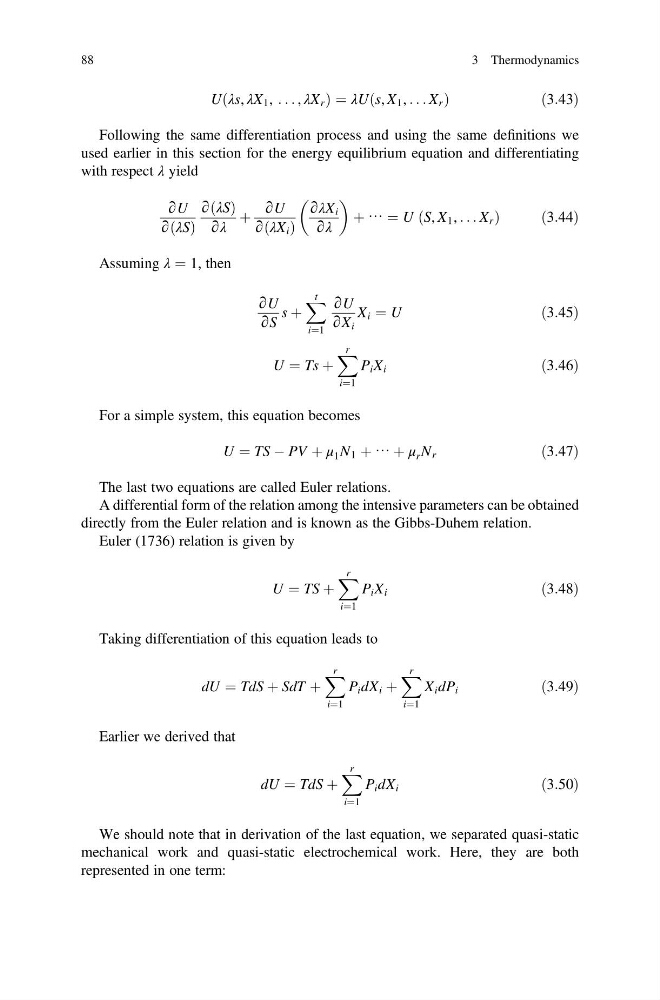
U λs, λX 1 , . . . , λX r
ð
Þ ¼ λU s, X 1 , . . . X r
ð
Þ
ð 3:43Þ
Following the same differentiation process and using the same definitions we
used earlier in this section for the energy equilibrium equation and differentiating
with respect λ yield
∂U
∂ λS
ð Þ
∂ λS
ð Þ
∂λ
þ
∂U
∂ λX i
ð Þ
∂λX i
∂λ
þ ⋯ ¼ U S, X 1 , . . . X r
ð
Þ
ð 3:44Þ
Assuming λ ¼ 1, then
∂U
∂S
s þ
X t
i¼1
∂U
∂X i
X i ¼ U
ð3:45Þ
U ¼ Ts þ
X r
i¼1
P i X i
ð3:46Þ
For a simple system, this equation becomes
U ¼ TS À PV þ μ 1 N 1 þ ⋯ þ μ r N r
ð3:47Þ
The last two equations are called Euler relations.
A differential form of the relation among the intensive parameters can be obtained
directly from the Euler relation and is known as the Gibbs-Duhem relation.
Euler (1736) relation is given by
U ¼ TS þ
X r
i¼1
P i X i
ð3:48Þ
Taking differentiation of this equation leads to
dU ¼ TdS þ SdT þ
X r
i¼1
P i dX i þ
X r
i¼1
X i dP i
ð3:49Þ
Earlier we derived that
dU ¼ TdS þ
X r
i¼1
P i dX i
ð3:50Þ
We should note that in derivation of the last equation, we separated quasi-static
mechanical work and quasi-static electrochemical work. Here, they are both
represented in one term:
88
3 Thermodynamics
ð
Þ ¼ λU s, X 1 , . . . X r
ð
Þ
ð 3:43Þ
Following the same differentiation process and using the same definitions we
used earlier in this section for the energy equilibrium equation and differentiating
with respect λ yield
∂U
∂ λS
ð Þ
∂ λS
ð Þ
∂λ
þ
∂U
∂ λX i
ð Þ
∂λX i
∂λ
þ ⋯ ¼ U S, X 1 , . . . X r
ð
Þ
ð 3:44Þ
Assuming λ ¼ 1, then
∂U
∂S
s þ
X t
i¼1
∂U
∂X i
X i ¼ U
ð3:45Þ
U ¼ Ts þ
X r
i¼1
P i X i
ð3:46Þ
For a simple system, this equation becomes
U ¼ TS À PV þ μ 1 N 1 þ ⋯ þ μ r N r
ð3:47Þ
The last two equations are called Euler relations.
A differential form of the relation among the intensive parameters can be obtained
directly from the Euler relation and is known as the Gibbs-Duhem relation.
Euler (1736) relation is given by
U ¼ TS þ
X r
i¼1
P i X i
ð3:48Þ
Taking differentiation of this equation leads to
dU ¼ TdS þ SdT þ
X r
i¼1
P i dX i þ
X r
i¼1
X i dP i
ð3:49Þ
Earlier we derived that
dU ¼ TdS þ
X r
i¼1
P i dX i
ð3:50Þ
We should note that in derivation of the last equation, we separated quasi-static
mechanical work and quasi-static electrochemical work. Here, they are both
represented in one term:
88
3 Thermodynamics