

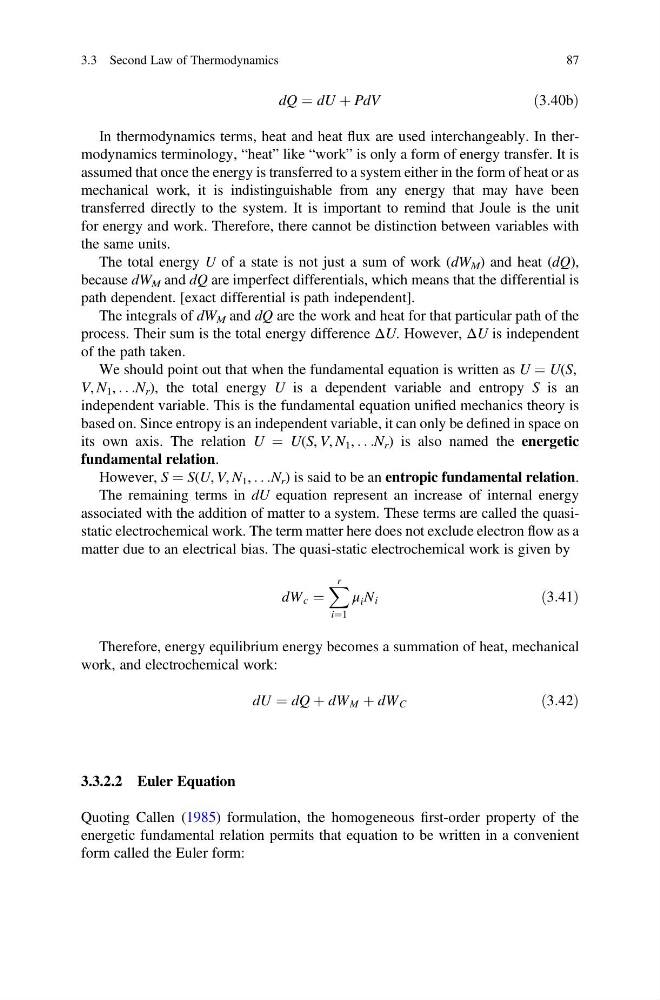
dQ ¼ dU þ PdV
ð3:40bÞ
In thermodynamics terms, heat and heat flux are used interchangeably. In thermodynamics terminology, “heat” like “work” is only a form of energy transfer. It is
assumed that once the energy is transferred to a system either in the form of heat or as
mechanical work, it is indistinguishable from any energy that may have been
transferred directly to the system. It is important to remind that Joule is the unit
for energy and work. Therefore, there cannot be distinction between variables with
the same units.
The total energy U of a state is not just a sum of work (dW M ) and heat (dQ),
because dW M and dQ are imperfect differentials, which means that the differential is
path dependent. [exact differential is path independent].
The integrals of dW M and dQ are the work and heat for that particular path of the
process. Their sum is the total energy difference ΔU. However, ΔU is independent
of the path taken.
We should point out that when the fundamental equation is written as U ¼ U(S,
V, N 1 , . . .N r ), the total energy U is a dependent variable and entropy S is an
independent variable. This is the fundamental equation unified mechanics theory is
based on. Since entropy is an independent variable, it can only be defined in space on
its own axis. The relation U ¼ U(S, V, N 1 , . . .N r ) is also named the energetic
fundamental relation.
However, S ¼ S(U, V, N 1 , . . .N r ) is said to be an entropic fundamental relation.
The remaining terms in dU equation represent an increase of internal energy
associated with the addition of matter to a system. These terms are called the quasistatic electrochemical work. The term matter here does not exclude electron flow as a
matter due to an electrical bias. The quasi-static electrochemical work is given by
dW c ¼
X r
i¼1
μ i N i
ð3:41Þ
Therefore, energy equilibrium energy becomes a summation of heat, mechanical
work, and electrochemical work:
dU ¼ dQ þ dW M þ dW C
ð3:42Þ
3.3.2.2 Euler Equation
Quoting Callen (1985) formulation, the homogeneous first-order property of the
energetic fundamental relation permits that equation to be written in a convenient
form called the Euler form:
3.3 Second Law of Thermodynamics
87
ð3:40bÞ
In thermodynamics terms, heat and heat flux are used interchangeably. In thermodynamics terminology, “heat” like “work” is only a form of energy transfer. It is
assumed that once the energy is transferred to a system either in the form of heat or as
mechanical work, it is indistinguishable from any energy that may have been
transferred directly to the system. It is important to remind that Joule is the unit
for energy and work. Therefore, there cannot be distinction between variables with
the same units.
The total energy U of a state is not just a sum of work (dW M ) and heat (dQ),
because dW M and dQ are imperfect differentials, which means that the differential is
path dependent. [exact differential is path independent].
The integrals of dW M and dQ are the work and heat for that particular path of the
process. Their sum is the total energy difference ΔU. However, ΔU is independent
of the path taken.
We should point out that when the fundamental equation is written as U ¼ U(S,
V, N 1 , . . .N r ), the total energy U is a dependent variable and entropy S is an
independent variable. This is the fundamental equation unified mechanics theory is
based on. Since entropy is an independent variable, it can only be defined in space on
its own axis. The relation U ¼ U(S, V, N 1 , . . .N r ) is also named the energetic
fundamental relation.
However, S ¼ S(U, V, N 1 , . . .N r ) is said to be an entropic fundamental relation.
The remaining terms in dU equation represent an increase of internal energy
associated with the addition of matter to a system. These terms are called the quasistatic electrochemical work. The term matter here does not exclude electron flow as a
matter due to an electrical bias. The quasi-static electrochemical work is given by
dW c ¼
X r
i¼1
μ i N i
ð3:41Þ
Therefore, energy equilibrium energy becomes a summation of heat, mechanical
work, and electrochemical work:
dU ¼ dQ þ dW M þ dW C
ð3:42Þ
3.3.2.2 Euler Equation
Quoting Callen (1985) formulation, the homogeneous first-order property of the
energetic fundamental relation permits that equation to be written in a convenient
form called the Euler form:
3.3 Second Law of Thermodynamics
87