

∂U
∂S
¼ T, temperature
ð
Þ
ð 3:35Þ
À
∂U
∂V
¼ P, pressure
ð
Þ
ð 3:36Þ
∂U
∂N i
¼ μ i , the electrochemical potential of the i
th component
À
Á ð3:37Þ
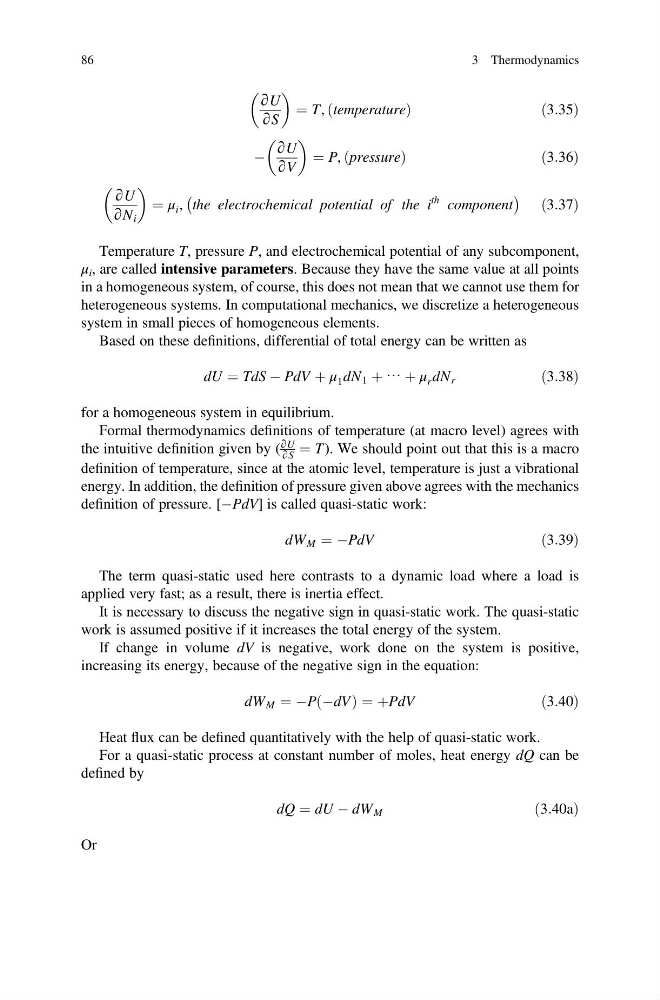
Temperature T, pressure P, and electrochemical potential of any subcomponent,
μ i , are called intensive parameters. Because they have the same value at all points
in a homogeneous system, of course, this does not mean that we cannot use them for
heterogeneous systems. In computational mechanics, we discretize a heterogeneous
system in small pieces of homogeneous elements.
Based on these definitions, differential of total energy can be written as
dU ¼ TdS À PdV þ μ 1 dN 1 þ ⋯ þ μ r dN r
ð3:38Þ
for a homogeneous system in equilibrium.
Formal thermodynamics definitions of temperature (at macro level) agrees with
the intuitive definition given by (
∂U
∂S
¼ T). We should point out that this is a macro
definition of temperature, since at the atomic level, temperature is just a vibrational
energy. In addition, the definition of pressure given above agrees with the mechanics
definition of pressure. [ÀPdV] is called quasi-static work:
dW M ¼ ÀPdV
ð3:39Þ
The term quasi-static used here contrasts to a dynamic load where a load is
applied very fast; as a result, there is inertia effect.
It is necessary to discuss the negative sign in quasi-static work. The quasi-static
work is assumed positive if it increases the total energy of the system.
If change in volume dV is negative, work done on the system is positive,
increasing its energy, because of the negative sign in the equation:
dW M ¼ ÀP ÀdV
ð
Þ¼þPdV
ð3:40Þ
Heat flux can be defined quantitatively with the help of quasi-static work.
For a quasi-static process at constant number of moles, heat energy dQ can be
defined by
dQ ¼ dU À dW M
ð3:40aÞ
Or
86
3 Thermodynamics
∂S
¼ T, temperature
ð
Þ
ð 3:35Þ
À
∂U
∂V
¼ P, pressure
ð
Þ
ð 3:36Þ
∂U
∂N i
¼ μ i , the electrochemical potential of the i
th component
À
Á ð3:37Þ
Temperature T, pressure P, and electrochemical potential of any subcomponent,
μ i , are called intensive parameters. Because they have the same value at all points
in a homogeneous system, of course, this does not mean that we cannot use them for
heterogeneous systems. In computational mechanics, we discretize a heterogeneous
system in small pieces of homogeneous elements.
Based on these definitions, differential of total energy can be written as
dU ¼ TdS À PdV þ μ 1 dN 1 þ ⋯ þ μ r dN r
ð3:38Þ
for a homogeneous system in equilibrium.
Formal thermodynamics definitions of temperature (at macro level) agrees with
the intuitive definition given by (
∂U
∂S
¼ T). We should point out that this is a macro
definition of temperature, since at the atomic level, temperature is just a vibrational
energy. In addition, the definition of pressure given above agrees with the mechanics
definition of pressure. [ÀPdV] is called quasi-static work:
dW M ¼ ÀPdV
ð3:39Þ
The term quasi-static used here contrasts to a dynamic load where a load is
applied very fast; as a result, there is inertia effect.
It is necessary to discuss the negative sign in quasi-static work. The quasi-static
work is assumed positive if it increases the total energy of the system.
If change in volume dV is negative, work done on the system is positive,
increasing its energy, because of the negative sign in the equation:
dW M ¼ ÀP ÀdV
ð
Þ¼þPdV
ð3:40Þ
Heat flux can be defined quantitatively with the help of quasi-static work.
For a quasi-static process at constant number of moles, heat energy dQ can be
defined by
dQ ¼ dU À dW M
ð3:40aÞ
Or
86
3 Thermodynamics