

introduction of functional groups in their substrates facilitating
downstream coupling of oligosaccharides to the carrier protein
[13, 14], and can be exploited for the generation of functional
glycoconjugates, using standard, low-cost lab equipment (Fig. 1)
[14, 15].
In the herein presented protocol, we use the capsule polymerases Cps4B and Cps11D of Actinobacillus pleuropneumoniae
(App) serotypes 4 and 11, respectively, to illustrate how enzymatic
synthesis of capsule polymer can be achieved in vitro. App is a pig
specific pathogen that causes huge economic losses in animal husbandry, and although effective glycoconjugate vaccines have been
generated using polymer from bacterial cultures [16, 17], presumably the high costs for their production have hindered further
efforts to bring them to market [7]. Both Cps4B and Cps11D are
part of an ATP-transporter dependent assembly system in vivo, also
known as group 2 capsule biosynthesis complex [1]. Group 2 polymerases, though believed to be membrane associated, are not integral membrane proteins, allowing soluble expression and
purification of recombinant constructs with good yields. In addition, all group 2 polymerases generate negatively charged polymers
with good solubility in water, and most enzymes can initiate polymerization in vitro also in the absence of their priming acceptor
[18], solely requiring nucleotide activated substrates for polymer
production [19–21].
Cps4B and Cps11D belong to the recently described TagF-like
capsule polymerase family that consists of multidomain enzymes
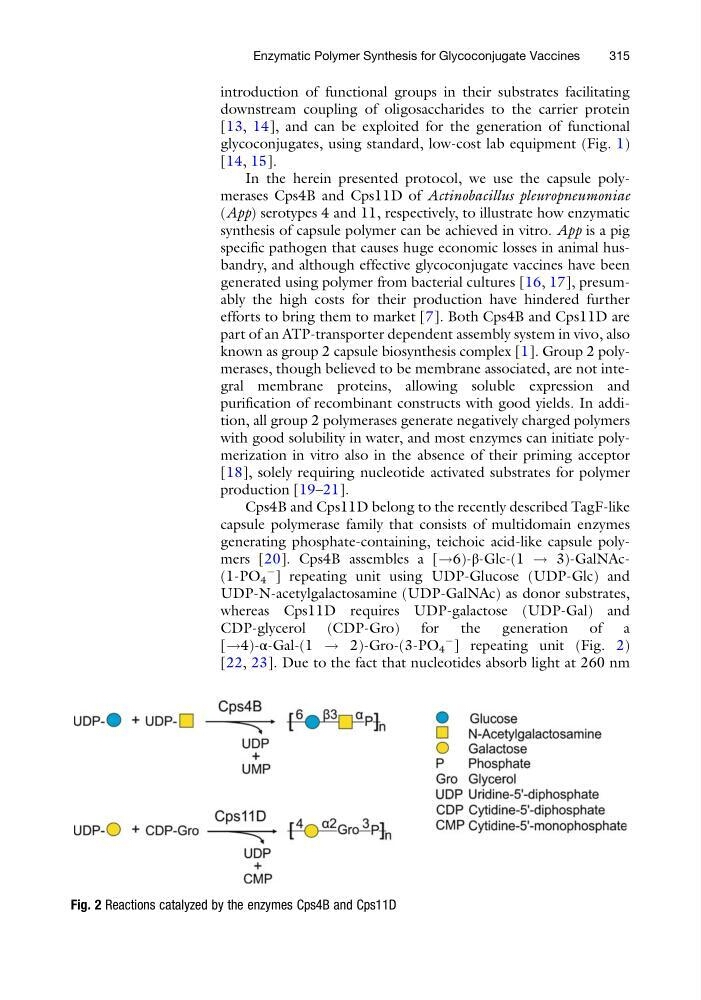
generating phosphate-containing, teichoic acid-like capsule polymers [20]. Cps4B assembles a [!6)-β-Glc-(1 ! 3)-GalNAc(1-PO 4
À
] repeating unit using UDP-Glucose (UDP-Glc) and
UDP-N-acetylgalactosamine (UDP-GalNAc) as donor substrates,
whereas Cps11D requires UDP-galactose (UDP-Gal) and
CDP-glycerol (CDP-Gro) for
the generation of a
[!4)-α-Gal-(1 ! 2)-Gro-(3-PO 4
À ] repeating unit (Fig. 2)
[22, 23]. Due to the fact that nucleotides absorb light at 260 nm
Fig. 2 Reactions catalyzed by the enzymes Cps4B and Cps11D
Enzymatic Polymer Synthesis for Glycoconjugate Vaccines
315
downstream coupling of oligosaccharides to the carrier protein
[13, 14], and can be exploited for the generation of functional
glycoconjugates, using standard, low-cost lab equipment (Fig. 1)
[14, 15].
In the herein presented protocol, we use the capsule polymerases Cps4B and Cps11D of Actinobacillus pleuropneumoniae
(App) serotypes 4 and 11, respectively, to illustrate how enzymatic
synthesis of capsule polymer can be achieved in vitro. App is a pig
specific pathogen that causes huge economic losses in animal husbandry, and although effective glycoconjugate vaccines have been
generated using polymer from bacterial cultures [16, 17], presumably the high costs for their production have hindered further
efforts to bring them to market [7]. Both Cps4B and Cps11D are
part of an ATP-transporter dependent assembly system in vivo, also
known as group 2 capsule biosynthesis complex [1]. Group 2 polymerases, though believed to be membrane associated, are not integral membrane proteins, allowing soluble expression and
purification of recombinant constructs with good yields. In addition, all group 2 polymerases generate negatively charged polymers
with good solubility in water, and most enzymes can initiate polymerization in vitro also in the absence of their priming acceptor
[18], solely requiring nucleotide activated substrates for polymer
production [19–21].
Cps4B and Cps11D belong to the recently described TagF-like
capsule polymerase family that consists of multidomain enzymes
generating phosphate-containing, teichoic acid-like capsule polymers [20]. Cps4B assembles a [!6)-β-Glc-(1 ! 3)-GalNAc(1-PO 4
À
] repeating unit using UDP-Glucose (UDP-Glc) and
UDP-N-acetylgalactosamine (UDP-GalNAc) as donor substrates,
whereas Cps11D requires UDP-galactose (UDP-Gal) and
CDP-glycerol (CDP-Gro) for
the generation of a
[!4)-α-Gal-(1 ! 2)-Gro-(3-PO 4
À ] repeating unit (Fig. 2)
[22, 23]. Due to the fact that nucleotides absorb light at 260 nm
Fig. 2 Reactions catalyzed by the enzymes Cps4B and Cps11D
Enzymatic Polymer Synthesis for Glycoconjugate Vaccines
315