

drop, possible higher flow rates, and improved binding capacities.
For the membrane chromatography-based purification of viruses
and virus particles, mainly ion exchange membranes [33–35] but
also affinity [36] and pseudoaffinity [30, 31, 37–40] matrices have
been applied [41]. For a broad applicability and a robust process
performance, platform technologies largely independent on specific
surface properties of the product should be selected. Virtually all
viral nanoplexes can easily be distinguished from contaminating
process components by their size. In literature, two chromatographic methods are described, that build upon this principle:
the size exclusion chromatography (SEC) [42, 43] and the steric
exclusion chromatography (SXC) [44]. The drawback of the SEC is
the high dilution of the product and the low column capacities. The
SXC enables a circumvention of these drawbacks. Therefore, and
due to its general applicability for nanoplexes, this method was
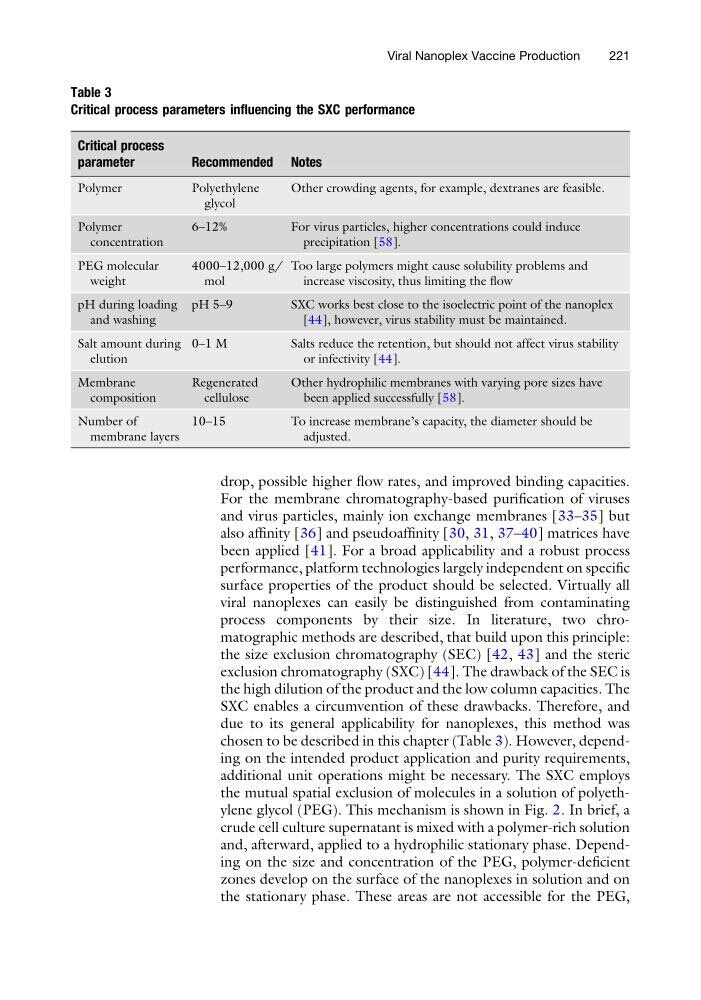
chosen to be described in this chapter (Table 3). However, depending on the intended product application and purity requirements,
additional unit operations might be necessary. The SXC employs
the mutual spatial exclusion of molecules in a solution of polyethylene glycol (PEG). This mechanism is shown in Fig. 2. In brief, a
crude cell culture supernatant is mixed with a polymer-rich solution
and, afterward, applied to a hydrophilic stationary phase. Depending on the size and concentration of the PEG, polymer-deficient
zones develop on the surface of the nanoplexes in solution and on
the stationary phase. These areas are not accessible for the PEG,
Table 3
Critical process parameters influencing the SXC performance
Critical process
parameter
Recommended Notes
Polymer
Polyethylene
glycol
Other crowding agents, for example, dextranes are feasible.
Polymer
concentration
6–12%
For virus particles, higher concentrations could induce
precipitation [58].
PEG molecular
weight
4000–12,000 g/
mol
Too large polymers might cause solubility problems and
increase viscosity, thus limiting the flow
pH during loading
and washing
pH 5–9
SXC works best close to the isoelectric point of the nanoplex
[44], however, virus stability must be maintained.
Salt amount during
elution
0–1 M
Salts reduce the retention, but should not affect virus stability
or infectivity [44].
Membrane
composition
Regenerated
cellulose
Other hydrophilic membranes with varying pore sizes have
been applied successfully [58].
Number of
membrane layers
10–15
To increase membrane’s capacity, the diameter should be
adjusted.
Viral Nanoplex Vaccine Production
221
For the membrane chromatography-based purification of viruses
and virus particles, mainly ion exchange membranes [33–35] but
also affinity [36] and pseudoaffinity [30, 31, 37–40] matrices have
been applied [41]. For a broad applicability and a robust process
performance, platform technologies largely independent on specific
surface properties of the product should be selected. Virtually all
viral nanoplexes can easily be distinguished from contaminating
process components by their size. In literature, two chromatographic methods are described, that build upon this principle:
the size exclusion chromatography (SEC) [42, 43] and the steric
exclusion chromatography (SXC) [44]. The drawback of the SEC is
the high dilution of the product and the low column capacities. The
SXC enables a circumvention of these drawbacks. Therefore, and
due to its general applicability for nanoplexes, this method was
chosen to be described in this chapter (Table 3). However, depending on the intended product application and purity requirements,
additional unit operations might be necessary. The SXC employs
the mutual spatial exclusion of molecules in a solution of polyethylene glycol (PEG). This mechanism is shown in Fig. 2. In brief, a
crude cell culture supernatant is mixed with a polymer-rich solution
and, afterward, applied to a hydrophilic stationary phase. Depending on the size and concentration of the PEG, polymer-deficient
zones develop on the surface of the nanoplexes in solution and on
the stationary phase. These areas are not accessible for the PEG,
Table 3
Critical process parameters influencing the SXC performance
Critical process
parameter
Recommended Notes
Polymer
Polyethylene
glycol
Other crowding agents, for example, dextranes are feasible.
Polymer
concentration
6–12%
For virus particles, higher concentrations could induce
precipitation [58].
PEG molecular
weight
4000–12,000 g/
mol
Too large polymers might cause solubility problems and
increase viscosity, thus limiting the flow
pH during loading
and washing
pH 5–9
SXC works best close to the isoelectric point of the nanoplex
[44], however, virus stability must be maintained.
Salt amount during
elution
0–1 M
Salts reduce the retention, but should not affect virus stability
or infectivity [44].
Membrane
composition
Regenerated
cellulose
Other hydrophilic membranes with varying pore sizes have
been applied successfully [58].
Number of
membrane layers
10–15
To increase membrane’s capacity, the diameter should be
adjusted.
Viral Nanoplex Vaccine Production
221