

purification, polishing, and sterile filtration (depending on the virus
size) [3, 28].
The cell culture-derived supernatant is a highly complex suspension comprising the target nanoplexes as well as the contaminants, such as cells, cell debris, host-cell DNA and proteins, and
medium components. In consequence, the downstream process
must ensure, according to the regulatory guidelines, a sufficient
nanoplex purity and concentration, for which, generally, process
trains of different unit operations have to be established. For this
purpose a variety of methods and techniques are currently applied
along the lines of the general purification schemes for biotechnological products, that is, clarification, concentration, intermediate
purification, and polishing [3, 28]. These methods include, among
others, centrifugation, micro- and ultrafiltration for clarification,
and concentration, as a first process step. For final purification and
polishing, chromatography is usually the method of choice [3, 29–
31]. It is worth to note, that for the chromatography of viral
nanoplexes, such as vaccines and viral vectors, membrane-based
systems offer certain advantages in contrast to resins, due to their
convective flow properties [5, 32]. This eliminates the limitations
of pore diffusion and pore exclusion resulting in a reduced pressure
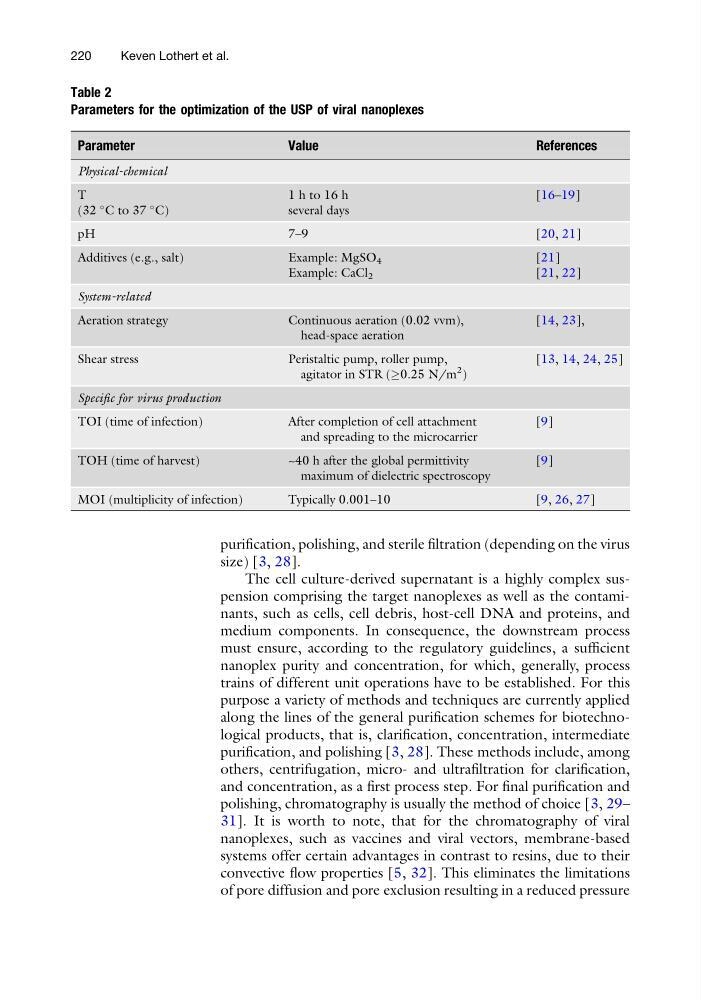
Table 2
Parameters for the optimization of the USP of viral nanoplexes
Parameter
Value
References
Physical-chemical
T
(32
C to 37
C)
1 h to 16 h
several days
[16–19]
pH
7–9
[20, 21]
Additives (e.g., salt)
Example: MgSO 4
Example: CaCl 2
[21]
[21, 22]
System-related
Aeration strategy
Continuous aeration (0.02 vvm),
head-space aeration
[14, 23],
Shear stress
Peristaltic pump, roller pump,
agitator in STR (!0.25 N/m
2 )
[13, 14, 24, 25]
Specific for virus production
TOI (time of infection)
After completion of cell attachment
and spreading to the microcarrier
[9]
TOH (time of harvest)
~40 h after the global permittivity
maximum of dielectric spectroscopy
[9]
MOI (multiplicity of infection)
Typically 0.001–10
[9, 26, 27]
220
Keven Lothert et al.
size) [3, 28].
The cell culture-derived supernatant is a highly complex suspension comprising the target nanoplexes as well as the contaminants, such as cells, cell debris, host-cell DNA and proteins, and
medium components. In consequence, the downstream process
must ensure, according to the regulatory guidelines, a sufficient
nanoplex purity and concentration, for which, generally, process
trains of different unit operations have to be established. For this
purpose a variety of methods and techniques are currently applied
along the lines of the general purification schemes for biotechnological products, that is, clarification, concentration, intermediate
purification, and polishing [3, 28]. These methods include, among
others, centrifugation, micro- and ultrafiltration for clarification,
and concentration, as a first process step. For final purification and
polishing, chromatography is usually the method of choice [3, 29–
31]. It is worth to note, that for the chromatography of viral
nanoplexes, such as vaccines and viral vectors, membrane-based
systems offer certain advantages in contrast to resins, due to their
convective flow properties [5, 32]. This eliminates the limitations
of pore diffusion and pore exclusion resulting in a reduced pressure
Table 2
Parameters for the optimization of the USP of viral nanoplexes
Parameter
Value
References
Physical-chemical
T
(32
C to 37
C)
1 h to 16 h
several days
[16–19]
pH
7–9
[20, 21]
Additives (e.g., salt)
Example: MgSO 4
Example: CaCl 2
[21]
[21, 22]
System-related
Aeration strategy
Continuous aeration (0.02 vvm),
head-space aeration
[14, 23],
Shear stress
Peristaltic pump, roller pump,
agitator in STR (!0.25 N/m
2 )
[13, 14, 24, 25]
Specific for virus production
TOI (time of infection)
After completion of cell attachment
and spreading to the microcarrier
[9]
TOH (time of harvest)
~40 h after the global permittivity
maximum of dielectric spectroscopy
[9]
MOI (multiplicity of infection)
Typically 0.001–10
[9, 26, 27]
220
Keven Lothert et al.