

virus production. However, many viruses only replicate to high
titers in anchorage-dependent cells [10]. Also, the infection of
cells commonly leads to cell lysis during the production process,
releasing intracellular components to the supernatant. As these can
affect the product enzymatically (proteases, glycosidase, lipases,
etc.), the infectivity of viral products might be compromised. Additionally, it has to be considered that the released host cell components increase the load of contaminants, which have to be removed
in the subsequent downstream process. This can affect the necessary filtration area, column volumes, buffer consumptions, and the
required equipment utilization, impacting the process economics.
Furthermore, viral nanoplexes are frequently sensitive to chemical,
physical and environmental stress [15]. Particularly, typical cultivation temperatures for the host cells can affect their infectivity.
Therefore, the parameters in USP must be well chosen to avoid a
damage of the virus. Critical parameters that need to be considered
during a viral nanoplex production are, for example, cell concentration at infection (CCI), the time of infection (TOI), the time of
harvest (TOH), the multiplicity of infection (MOI), the process
temperature, the pH value, as well as the aeration and the shear
stress (Table 2).
1.2 Downstream
Processing of Viral
Nanoplexes
The downstream process includes the clarification for the removal
of remaining cells and cell debris, concentration, inactivation if
noninfectious virus particles are required, nuclease treatment,
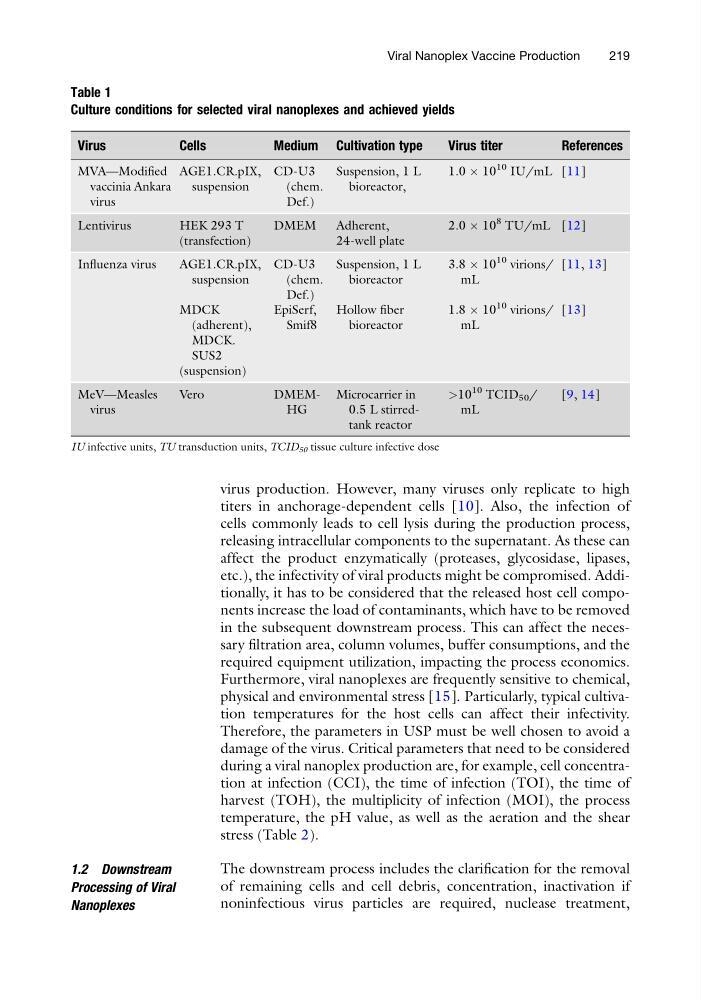
Table 1
Culture conditions for selected viral nanoplexes and achieved yields
Virus
Cells
Medium Cultivation type
Virus titer
References
MVA—Modified
vaccinia Ankara
virus
AGE1.CR.pIX,
suspension
CD-U3
(chem.
Def.)
Suspension, 1 L
bioreactor,
1.0 Â 10
10 IU/mL [11]
Lentivirus
HEK 293 T
(transfection)
DMEM
Adherent,
24-well plate
2.0 Â 10
8 TU/mL [12]
Influenza virus
AGE1.CR.pIX,
suspension
CD-U3
(chem.
Def.)
Suspension, 1 L
bioreactor
3.8 Â 10
10 virions/
mL
[11, 13]
MDCK
(adherent),
MDCK.
SUS2
(suspension)
EpiSerf,
Smif8
Hollow fiber
bioreactor
1.8 Â 10
10 virions/
mL
[13]
MeV—Measles
virus
Vero
DMEMHG
Microcarrier in
0.5 L stirredtank reactor
>10
10 TCID 50 /
mL
[9, 14]
IU infective units, TU transduction units, TCID 50 tissue culture infective dose
Viral Nanoplex Vaccine Production
219
titers in anchorage-dependent cells [10]. Also, the infection of
cells commonly leads to cell lysis during the production process,
releasing intracellular components to the supernatant. As these can
affect the product enzymatically (proteases, glycosidase, lipases,
etc.), the infectivity of viral products might be compromised. Additionally, it has to be considered that the released host cell components increase the load of contaminants, which have to be removed
in the subsequent downstream process. This can affect the necessary filtration area, column volumes, buffer consumptions, and the
required equipment utilization, impacting the process economics.
Furthermore, viral nanoplexes are frequently sensitive to chemical,
physical and environmental stress [15]. Particularly, typical cultivation temperatures for the host cells can affect their infectivity.
Therefore, the parameters in USP must be well chosen to avoid a
damage of the virus. Critical parameters that need to be considered
during a viral nanoplex production are, for example, cell concentration at infection (CCI), the time of infection (TOI), the time of
harvest (TOH), the multiplicity of infection (MOI), the process
temperature, the pH value, as well as the aeration and the shear
stress (Table 2).
1.2 Downstream
Processing of Viral
Nanoplexes
The downstream process includes the clarification for the removal
of remaining cells and cell debris, concentration, inactivation if
noninfectious virus particles are required, nuclease treatment,
Table 1
Culture conditions for selected viral nanoplexes and achieved yields
Virus
Cells
Medium Cultivation type
Virus titer
References
MVA—Modified
vaccinia Ankara
virus
AGE1.CR.pIX,
suspension
CD-U3
(chem.
Def.)
Suspension, 1 L
bioreactor,
1.0 Â 10
10 IU/mL [11]
Lentivirus
HEK 293 T
(transfection)
DMEM
Adherent,
24-well plate
2.0 Â 10
8 TU/mL [12]
Influenza virus
AGE1.CR.pIX,
suspension
CD-U3
(chem.
Def.)
Suspension, 1 L
bioreactor
3.8 Â 10
10 virions/
mL
[11, 13]
MDCK
(adherent),
MDCK.
SUS2
(suspension)
EpiSerf,
Smif8
Hollow fiber
bioreactor
1.8 Â 10
10 virions/
mL
[13]
MeV—Measles
virus
Vero
DMEMHG
Microcarrier in
0.5 L stirredtank reactor
>10
10 TCID 50 /
mL
[9, 14]
IU infective units, TU transduction units, TCID 50 tissue culture infective dose
Viral Nanoplex Vaccine Production
219