

[10]. Typical examples for these cells are primary cells, diploid cells,
or continuous (transformed) cell lines like: chicken embryo fibroblast cells (CEF), epithelial kidney cells from an African green
monkey (Vero cells), Madin-Darby canine kidney cells (MDCK),
retina cells from a Muscovy duck (AGE1.CR
® cells), transformed
cells lines from a human fetus (PER.C6
® cells), duck embryonic
stem cells (EB66), and human embryonic kidney cells (HEK 293).
Each cell line, each virus, and every pharmaceutical preparation
requires the specific design of an integrated upstream and downstream process [10]. The target for these processes is to achieve a
maximum volumetric viral yield, taking into account the upstream
requirements and the resources to be used as well as the efficiency of
the subsequent downstream process. For this, the cell culture
medium with the required supplements, the production vessels,
the cultivation conditions, the infection conditions (time and multiplicity of infection), the time of harvest, as well as the modes of
operation have to be selected.
Here, we describe a commonly applicable initial method for the
development of a process to produce enveloped virus particles,
using eukaryotic host cells cultured under controlled conditions
in a stirred tank bioreactor. In addition, we depict a generally
employable chromatographic method for nanoplex purification
and the critical process parameters for the optimization of the
procedures in terms of its economics, safety, and robustness are
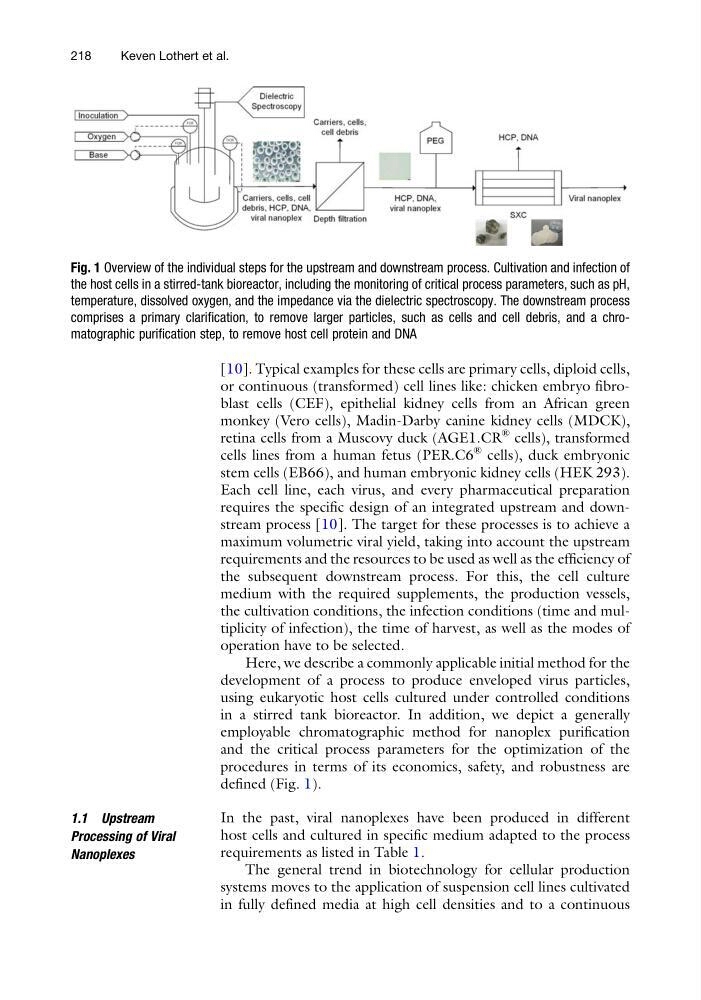
defined (Fig. 1).
1.1 Upstream
Processing of Viral
Nanoplexes
In the past, viral nanoplexes have been produced in different
host cells and cultured in specific medium adapted to the process
requirements as listed in Table 1.
The general trend in biotechnology for cellular production
systems moves to the application of suspension cell lines cultivated
in fully defined media at high cell densities and to a continuous
Fig. 1 Overview of the individual steps for the upstream and downstream process. Cultivation and infection of
the host cells in a stirred-tank bioreactor, including the monitoring of critical process parameters, such as pH,
temperature, dissolved oxygen, and the impedance via the dielectric spectroscopy. The downstream process
comprises a primary clarification, to remove larger particles, such as cells and cell debris, and a chromatographic purification step, to remove host cell protein and DNA
218
Keven Lothert et al.
or continuous (transformed) cell lines like: chicken embryo fibroblast cells (CEF), epithelial kidney cells from an African green
monkey (Vero cells), Madin-Darby canine kidney cells (MDCK),
retina cells from a Muscovy duck (AGE1.CR
® cells), transformed
cells lines from a human fetus (PER.C6
® cells), duck embryonic
stem cells (EB66), and human embryonic kidney cells (HEK 293).
Each cell line, each virus, and every pharmaceutical preparation
requires the specific design of an integrated upstream and downstream process [10]. The target for these processes is to achieve a
maximum volumetric viral yield, taking into account the upstream
requirements and the resources to be used as well as the efficiency of
the subsequent downstream process. For this, the cell culture
medium with the required supplements, the production vessels,
the cultivation conditions, the infection conditions (time and multiplicity of infection), the time of harvest, as well as the modes of
operation have to be selected.
Here, we describe a commonly applicable initial method for the
development of a process to produce enveloped virus particles,
using eukaryotic host cells cultured under controlled conditions
in a stirred tank bioreactor. In addition, we depict a generally
employable chromatographic method for nanoplex purification
and the critical process parameters for the optimization of the
procedures in terms of its economics, safety, and robustness are
defined (Fig. 1).
1.1 Upstream
Processing of Viral
Nanoplexes
In the past, viral nanoplexes have been produced in different
host cells and cultured in specific medium adapted to the process
requirements as listed in Table 1.
The general trend in biotechnology for cellular production
systems moves to the application of suspension cell lines cultivated
in fully defined media at high cell densities and to a continuous
Fig. 1 Overview of the individual steps for the upstream and downstream process. Cultivation and infection of
the host cells in a stirred-tank bioreactor, including the monitoring of critical process parameters, such as pH,
temperature, dissolved oxygen, and the impedance via the dielectric spectroscopy. The downstream process
comprises a primary clarification, to remove larger particles, such as cells and cell debris, and a chromatographic purification step, to remove host cell protein and DNA
218
Keven Lothert et al.