

6. Measure the concentration of the digested PCR product and
plasmid vector using a NanoDrop™ 2000 spectrophotometer.
7. Ligate the digested PCR product into the purified digested
pcDNA™ 3.1(+) plasmid vector at a ratio of 1:3 (vector–
insert) as follows:
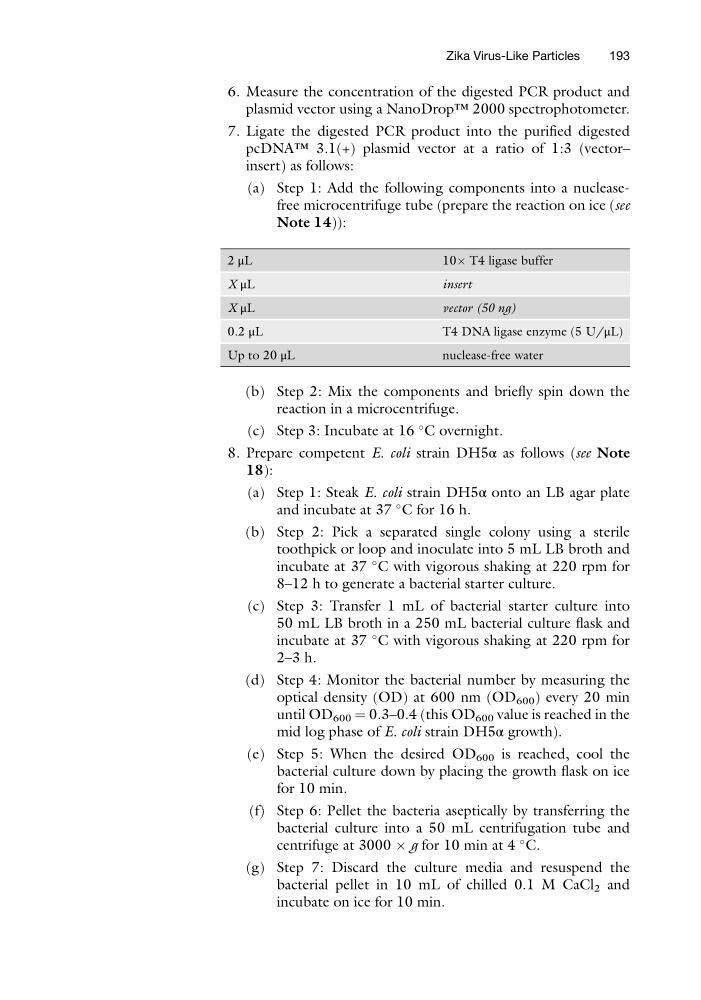
(a) Step 1: Add the following components into a nucleasefree microcentrifuge tube (prepare the reaction on ice (see
Note 14)):
2 μL
1 0 Â T4 ligase buffer
X μL
insert
X μL
vector (50 ng)
0.2 μL
T4 DNA ligase enzyme (5 U/μL)
Up to 20 μL
nuclease-free water
(b) Step 2: Mix the components and briefly spin down the
reaction in a microcentrifuge.
(c) Step 3: Incubate at 16
C overnight.
8. Prepare competent E. coli strain DH5α as follows (see Note
18):
(a) Step 1: Steak E. coli strain DH5α onto an LB agar plate
and incubate at 37
C for 16 h.
(b) Step 2: Pick a separated single colony using a sterile
toothpick or loop and inoculate into 5 mL LB broth and
incubate at 37
C with vigorous shaking at 220 rpm for
8–12 h to generate a bacterial starter culture.
(c) Step 3: Transfer 1 mL of bacterial starter culture into
50 mL LB broth in a 250 mL bacterial culture flask and
incubate at 37
C with vigorous shaking at 220 rpm for
2–3 h.
(d) Step 4: Monitor the bacterial number by measuring the
optical density (OD) at 600 nm (OD 600 ) every 20 min
until OD 600 ¼ 0.3–0.4 (this OD 600 value is reached in the
mid log phase of E. coli strain DH5α growth).
(e) Step 5: When the desired OD 600 is reached, cool the
bacterial culture down by placing the growth flask on ice
for 10 min.
(f) Step 6: Pellet the bacteria aseptically by transferring the
bacterial culture into a 50 mL centrifugation tube and
centrifuge at 3000 Â g for 10 min at 4
C.
(g) Step 7: Discard the culture media and resuspend the
bacterial pellet in 10 mL of chilled 0.1 M CaCl 2 and
incubate on ice for 10 min.
Zika Virus-Like Particles
193
plasmid vector using a NanoDrop™ 2000 spectrophotometer.
7. Ligate the digested PCR product into the purified digested
pcDNA™ 3.1(+) plasmid vector at a ratio of 1:3 (vector–
insert) as follows:
(a) Step 1: Add the following components into a nucleasefree microcentrifuge tube (prepare the reaction on ice (see
Note 14)):
2 μL
1 0 Â T4 ligase buffer
X μL
insert
X μL
vector (50 ng)
0.2 μL
T4 DNA ligase enzyme (5 U/μL)
Up to 20 μL
nuclease-free water
(b) Step 2: Mix the components and briefly spin down the
reaction in a microcentrifuge.
(c) Step 3: Incubate at 16
C overnight.
8. Prepare competent E. coli strain DH5α as follows (see Note
18):
(a) Step 1: Steak E. coli strain DH5α onto an LB agar plate
and incubate at 37
C for 16 h.
(b) Step 2: Pick a separated single colony using a sterile
toothpick or loop and inoculate into 5 mL LB broth and
incubate at 37
C with vigorous shaking at 220 rpm for
8–12 h to generate a bacterial starter culture.
(c) Step 3: Transfer 1 mL of bacterial starter culture into
50 mL LB broth in a 250 mL bacterial culture flask and
incubate at 37
C with vigorous shaking at 220 rpm for
2–3 h.
(d) Step 4: Monitor the bacterial number by measuring the
optical density (OD) at 600 nm (OD 600 ) every 20 min
until OD 600 ¼ 0.3–0.4 (this OD 600 value is reached in the
mid log phase of E. coli strain DH5α growth).
(e) Step 5: When the desired OD 600 is reached, cool the
bacterial culture down by placing the growth flask on ice
for 10 min.
(f) Step 6: Pellet the bacteria aseptically by transferring the
bacterial culture into a 50 mL centrifugation tube and
centrifuge at 3000 Â g for 10 min at 4
C.
(g) Step 7: Discard the culture media and resuspend the
bacterial pellet in 10 mL of chilled 0.1 M CaCl 2 and
incubate on ice for 10 min.
Zika Virus-Like Particles
193