

(h) Step 8: Remove CaCl 2 by centrifugation at 3000 Â g for
10 min at 4
C and resuspend cells in 2 mL 15% glycerol in
0.1 M CaCl 2 .
(i) Step 9: Aliquot 100 μL competent cells into each 1.7 mL
microcentrifuge tube and immediately soak in liquid
nitrogen.
(j) Step 10: Store the competent cells at À80
C until use.
9. Transform the recombinant plasmid into competent Escherichia coli (E. coli) strain DH5α as follows:
(a) Step 1: Add 10 μL of ligation reaction mixture to 100 μL
of competent cells.
(b) Step 2: Incubate on ice for 10 min.
(c) Step 3: Immediately incubate at 42
C for 45 s (heat
shock).
(d) Step 4: Immediately transfer the tube onto ice and incubate for 5 min.
(e) Step 5: Add 900 μL of LB broth (without antibiotic) to
the competent cell mixture.
(f) Step 6: Incubate the transformants at 37
C for 1 h with
shaking at 220 rpm.
(g) Step 7: Spread the transformants on the LB agar plates
containing 100 μg/mL ampicillin, allow to dry, and then
incubate inverted at 37
C for 16 h.
(h) Step 8: Make a master plate by randomly picking isolated
transformants using a sterile toothpick and streaking the
transformants in an orderly manner (see Fig. 1) onto a new
LB agar plate containing 100 μg/mL ampicillin, then
incubate inverted at 37
C for 16 h.
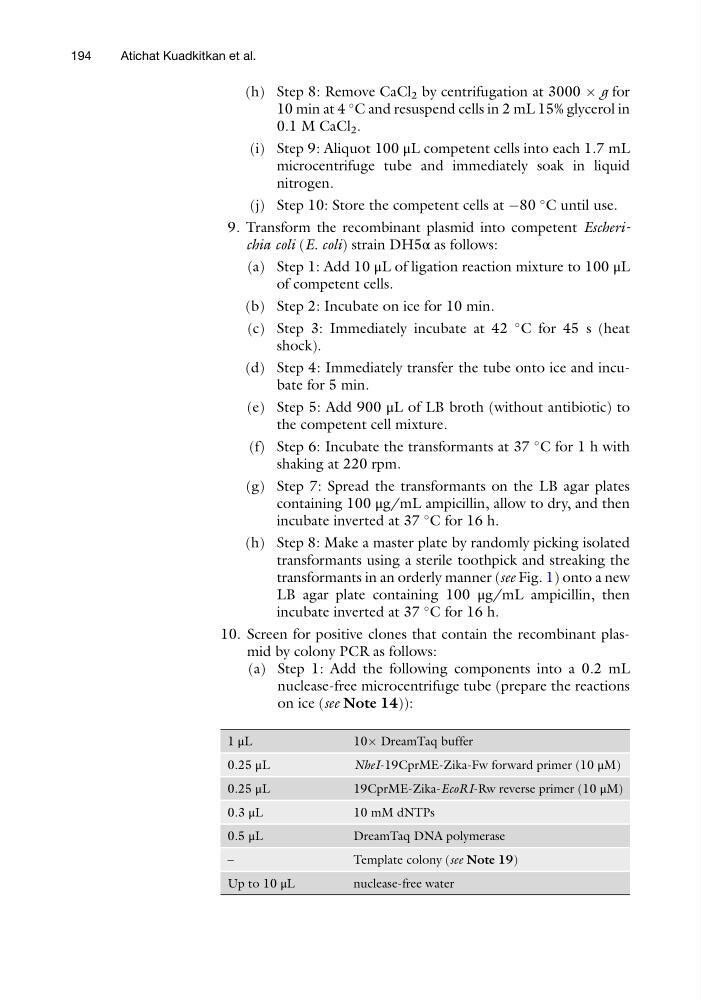
10. Screen for positive clones that contain the recombinant plasmid by colony PCR as follows:
(a) Step 1: Add the following components into a 0.2 mL
nuclease-free microcentrifuge tube (prepare the reactions
on ice (see Note 14)):
1 μL
1 0 Â DreamTaq buffer
0.25 μL
NheI-19CprME-Zika-Fw forward primer (10 μM)
0.25 μL
19CprME-Zika-EcoRI-Rw reverse primer (10 μM)
0.3 μL
10 mM dNTPs
0.5 μL
DreamTaq DNA polymerase
–
Template colony (see Note 19)
Up to 10 μL
nuclease-free water
194
Atichat Kuadkitkan et al.
10 min at 4
C and resuspend cells in 2 mL 15% glycerol in
0.1 M CaCl 2 .
(i) Step 9: Aliquot 100 μL competent cells into each 1.7 mL
microcentrifuge tube and immediately soak in liquid
nitrogen.
(j) Step 10: Store the competent cells at À80
C until use.
9. Transform the recombinant plasmid into competent Escherichia coli (E. coli) strain DH5α as follows:
(a) Step 1: Add 10 μL of ligation reaction mixture to 100 μL
of competent cells.
(b) Step 2: Incubate on ice for 10 min.
(c) Step 3: Immediately incubate at 42
C for 45 s (heat
shock).
(d) Step 4: Immediately transfer the tube onto ice and incubate for 5 min.
(e) Step 5: Add 900 μL of LB broth (without antibiotic) to
the competent cell mixture.
(f) Step 6: Incubate the transformants at 37
C for 1 h with
shaking at 220 rpm.
(g) Step 7: Spread the transformants on the LB agar plates
containing 100 μg/mL ampicillin, allow to dry, and then
incubate inverted at 37
C for 16 h.
(h) Step 8: Make a master plate by randomly picking isolated
transformants using a sterile toothpick and streaking the
transformants in an orderly manner (see Fig. 1) onto a new
LB agar plate containing 100 μg/mL ampicillin, then
incubate inverted at 37
C for 16 h.
10. Screen for positive clones that contain the recombinant plasmid by colony PCR as follows:
(a) Step 1: Add the following components into a 0.2 mL
nuclease-free microcentrifuge tube (prepare the reactions
on ice (see Note 14)):
1 μL
1 0 Â DreamTaq buffer
0.25 μL
NheI-19CprME-Zika-Fw forward primer (10 μM)
0.25 μL
19CprME-Zika-EcoRI-Rw reverse primer (10 μM)
0.3 μL
10 mM dNTPs
0.5 μL
DreamTaq DNA polymerase
–
Template colony (see Note 19)
Up to 10 μL
nuclease-free water
194
Atichat Kuadkitkan et al.