

(b) Step 2: Take 10 μL from the master mix as a negative
control.
(c) Step 3: Add 1 μL template plasmid (dilution 1:100).
(d) Step 4: Mix and spin down the PCR solution in a 0.2 mL
microcentrifuge tube.
(e) Step 5: Perform the PCR condition using the following
conditions: denature template at 98
C for 30 s, followed
by 25–30 cycles of 98
C for 10 s, 60
C for 30 s, and
72
C for 2 min. Then incubate at 72
C for 5 min to
complete
amplification.
The
negative
control
(no template) should be subjected to PCR in parallel
with the experimental sample.
2. Examine the PCR product by duplicate electrophoresis
through 1% agarose gels in 1Â TAE buffer, followed by staining one gel with EthBr (see Note 4) and one with methylene
blue (see Note 16).
3. Excise the PCR product band from the methylene blue stained
gel and perform gel purification using the FavorPrep™
GEL/PCR Purification Mini Kit following the manufacturer’s
protocol.
4. Digest the purified PCR product and pcDNA™ 3.1(+) plasmid
vector with restriction enzymes to get sticky end overhangs as
follows:
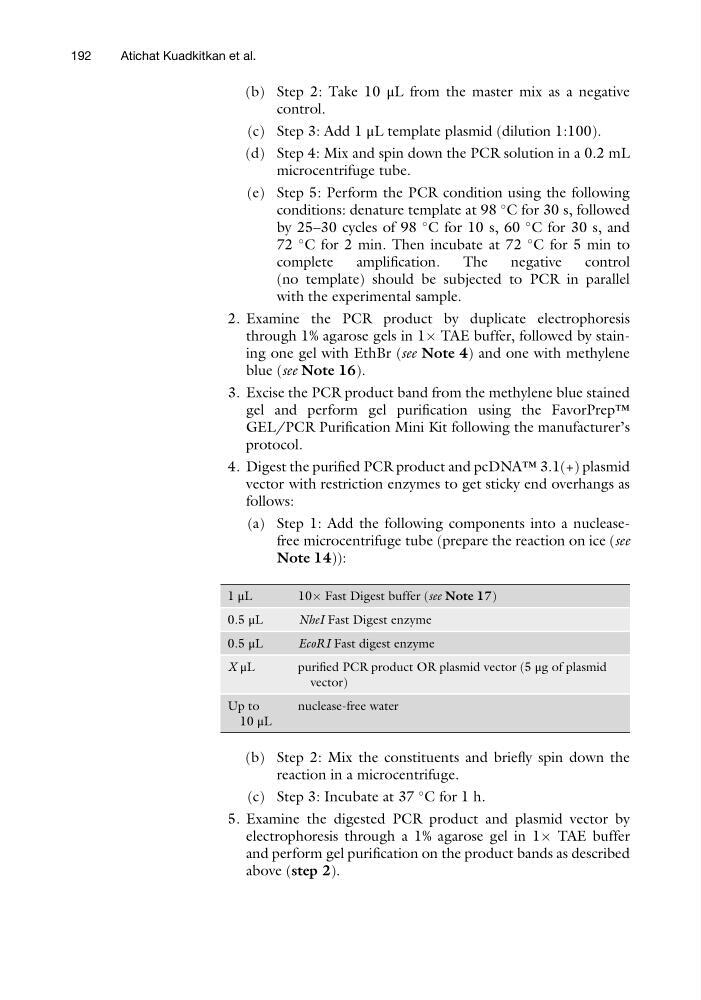
(a) Step 1: Add the following components into a nucleasefree microcentrifuge tube (prepare the reaction on ice (see
Note 14)):
1 μL
1 0 Â Fast Digest buffer (see Note 17)
0.5 μL
NheI Fast Digest enzyme
0.5 μL
EcoRI Fast digest enzyme
X μL
purified PCR product OR plasmid vector (5 μg of plasmid
vector)
Up to
10 μL
nuclease-free water
(b) Step 2: Mix the constituents and briefly spin down the
reaction in a microcentrifuge.
(c) Step 3: Incubate at 37
C for 1 h.
5. Examine the digested PCR product and plasmid vector by
electrophoresis through a 1% agarose gel in 1Â TAE buffer
and perform gel purification on the product bands as described
above (step 2).
192
Atichat Kuadkitkan et al.
control.
(c) Step 3: Add 1 μL template plasmid (dilution 1:100).
(d) Step 4: Mix and spin down the PCR solution in a 0.2 mL
microcentrifuge tube.
(e) Step 5: Perform the PCR condition using the following
conditions: denature template at 98
C for 30 s, followed
by 25–30 cycles of 98
C for 10 s, 60
C for 30 s, and
72
C for 2 min. Then incubate at 72
C for 5 min to
complete
amplification.
The
negative
control
(no template) should be subjected to PCR in parallel
with the experimental sample.
2. Examine the PCR product by duplicate electrophoresis
through 1% agarose gels in 1Â TAE buffer, followed by staining one gel with EthBr (see Note 4) and one with methylene
blue (see Note 16).
3. Excise the PCR product band from the methylene blue stained
gel and perform gel purification using the FavorPrep™
GEL/PCR Purification Mini Kit following the manufacturer’s
protocol.
4. Digest the purified PCR product and pcDNA™ 3.1(+) plasmid
vector with restriction enzymes to get sticky end overhangs as
follows:
(a) Step 1: Add the following components into a nucleasefree microcentrifuge tube (prepare the reaction on ice (see
Note 14)):
1 μL
1 0 Â Fast Digest buffer (see Note 17)
0.5 μL
NheI Fast Digest enzyme
0.5 μL
EcoRI Fast digest enzyme
X μL
purified PCR product OR plasmid vector (5 μg of plasmid
vector)
Up to
10 μL
nuclease-free water
(b) Step 2: Mix the constituents and briefly spin down the
reaction in a microcentrifuge.
(c) Step 3: Incubate at 37
C for 1 h.
5. Examine the digested PCR product and plasmid vector by
electrophoresis through a 1% agarose gel in 1Â TAE buffer
and perform gel purification on the product bands as described
above (step 2).
192
Atichat Kuadkitkan et al.