

10. Ultra-Clear Tubes 9 = 16 Â 3 1 = 2 in: (14 Â 89 mm) (Beckman
Coulter, Brea, CA).
11. Tomy MX-301 centrifuge.
12. Beckman Optima XL-A centrifuge, SW 41Ti rotor.
2.5 Zika VLP
Detection by
Transmission Electron
Microscopy
1. Formvar-coated grids with evaporated carbon film on
400 mesh nickel grid.
2. 2% Uranyl acetate. Weigh 0.4 g of uranyl acetate into a brown
glass bottle then add 10 mL of methanol and 10 mL of deionized water (see Note 13). Warm the solution at 70
C for
40 min then store at 4
C. The solution should be filtered
through two layers of 8 μm filter paper (Whatman
® paper
Grade 40 Ashless) before use.
3. Glass funnel.
4. Dumont Tweezer, style N3 Dumont Tweezer, style N7.
5. Clear glass microscope slides.
6. Quorum SC7620 Sputter Coater.
7. Transmission electron microscope (TEM).
8. Whatman
® paper Grade 40 Ashless.
3 Method
Perform all procedures at room temperature, except where stated
otherwise.
3.1 Construction
of Zika VLP Expression
Plasmid
Good aseptic technique is required for this experiment to avoid
contamination between samples. Importantly, working with
recombinant plasmid and bacteria must be undertaken carefully to
avoid spread to the environment.
1. The 19 amino acids at the C-terminal end of the capsid (C)
along with the premembrane/membrane (prM/M) and envelope
(E) gene of Zika virus will be amplified.
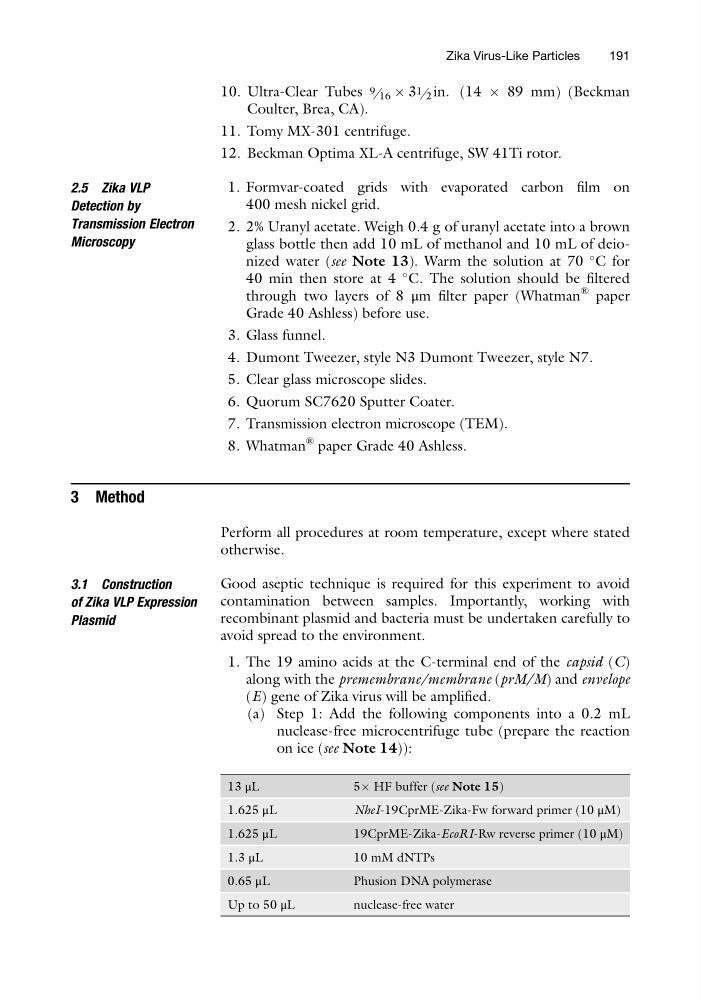
(a) Step 1: Add the following components into a 0.2 mL
nuclease-free microcentrifuge tube (prepare the reaction
on ice (see Note 14)):
13 μL
5 Â HF buffer (see Note 15)
1.625 μL
NheI-19CprME-Zika-Fw forward primer (10 μM)
1.625 μL
19CprME-Zika-EcoRI-Rw reverse primer (10 μM)
1.3 μL
10 mM dNTPs
0.65 μL
Phusion DNA polymerase
Up to 50 μL
nuclease-free water
Zika Virus-Like Particles
191
Coulter, Brea, CA).
11. Tomy MX-301 centrifuge.
12. Beckman Optima XL-A centrifuge, SW 41Ti rotor.
2.5 Zika VLP
Detection by
Transmission Electron
Microscopy
1. Formvar-coated grids with evaporated carbon film on
400 mesh nickel grid.
2. 2% Uranyl acetate. Weigh 0.4 g of uranyl acetate into a brown
glass bottle then add 10 mL of methanol and 10 mL of deionized water (see Note 13). Warm the solution at 70
C for
40 min then store at 4
C. The solution should be filtered
through two layers of 8 μm filter paper (Whatman
® paper
Grade 40 Ashless) before use.
3. Glass funnel.
4. Dumont Tweezer, style N3 Dumont Tweezer, style N7.
5. Clear glass microscope slides.
6. Quorum SC7620 Sputter Coater.
7. Transmission electron microscope (TEM).
8. Whatman
® paper Grade 40 Ashless.
3 Method
Perform all procedures at room temperature, except where stated
otherwise.
3.1 Construction
of Zika VLP Expression
Plasmid
Good aseptic technique is required for this experiment to avoid
contamination between samples. Importantly, working with
recombinant plasmid and bacteria must be undertaken carefully to
avoid spread to the environment.
1. The 19 amino acids at the C-terminal end of the capsid (C)
along with the premembrane/membrane (prM/M) and envelope
(E) gene of Zika virus will be amplified.
(a) Step 1: Add the following components into a 0.2 mL
nuclease-free microcentrifuge tube (prepare the reaction
on ice (see Note 14)):
13 μL
5 Â HF buffer (see Note 15)
1.625 μL
NheI-19CprME-Zika-Fw forward primer (10 μM)
1.625 μL
19CprME-Zika-EcoRI-Rw reverse primer (10 μM)
1.3 μL
10 mM dNTPs
0.65 μL
Phusion DNA polymerase
Up to 50 μL
nuclease-free water
Zika Virus-Like Particles
191