

66
2 Optical Fiber Structures and Light Guiding Principles
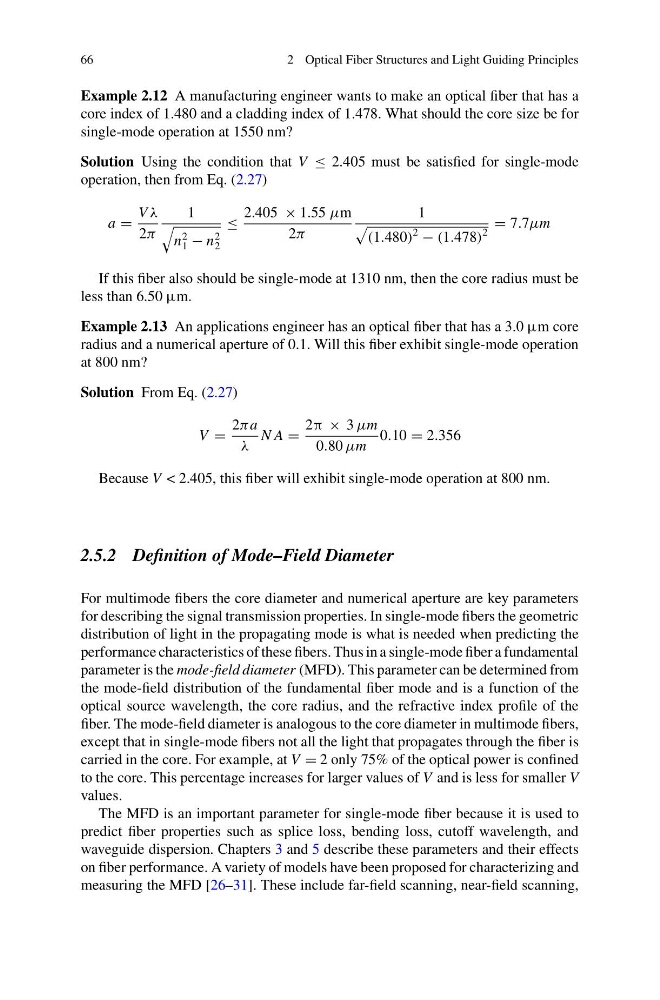
Example 2.12 A manufacturing engineer wants to make an optical fiber that has a
core index of 1.480 and a cladding index of 1.478. What should the core size be for
single-mode operation at 1550 nm?
Solution Using the condition that V ≤ 2.405 must be satisfied for single-mode
operation, then from Eq. (2.27)
a =
V λ
2π
1
n
2
1 − n
2
2
≤
2.405 × 1.55 μm
2π
1
(1.480)
2
− (1.478)
2
= 7.7μm
If this fiber also should be single-mode at 1310 nm, then the core radius must be
less than 6.50 μm.
Example 2.13 An applications engineer has an optical fiber that has a 3.0 μm core
radius and a numerical aperture of 0.1. Will this fiber exhibit single-mode operation
at 800 nm?
Solution From Eq. (2.27)
V =
2πa
λ
N A =
2π × 3 μm
0.80 μm
0.10 = 2.356
Because V < 2.405, this fiber will exhibit single-mode operation at 800 nm.
2.5.2 Definition of Mode–Field Diameter
For multimode fibers the core diameter and numerical aperture are key parameters
for describing the signal transmission properties. In single-mode fibers the geometric
distribution of light in the propagating mode is what is needed when predicting the
performance characteristics of these fibers. Thus in a single-mode fiber a fundamental
parameter is the mode-field diameter (MFD). This parameter can be determined from
the mode-field distribution of the fundamental fiber mode and is a function of the
optical source wavelength, the core radius, and the refractive index profile of the
fiber. The mode-field diameter is analogous to the core diameter in multimode fibers,
except that in single-mode fibers not all the light that propagates through the fiber is
carried in the core. For example, at V = 2 only 75% of the optical power is confined
to the core. This percentage increases for larger values of V and is less for smaller V
values.
The MFD is an important parameter for single-mode fiber because it is used to
predict fiber properties such as splice loss, bending loss, cutoff wavelength, and
waveguide dispersion. Chapters 3 and 5 describe these parameters and their effects
on fiber performance. A variety of models have been proposed for characterizing and
measuring the MFD [26–31]. These include far-field scanning, near-field scanning,
2 Optical Fiber Structures and Light Guiding Principles
Example 2.12 A manufacturing engineer wants to make an optical fiber that has a
core index of 1.480 and a cladding index of 1.478. What should the core size be for
single-mode operation at 1550 nm?
Solution Using the condition that V ≤ 2.405 must be satisfied for single-mode
operation, then from Eq. (2.27)
a =
V λ
2π
1
n
2
1 − n
2
2
≤
2.405 × 1.55 μm
2π
1
(1.480)
2
− (1.478)
2
= 7.7μm
If this fiber also should be single-mode at 1310 nm, then the core radius must be
less than 6.50 μm.
Example 2.13 An applications engineer has an optical fiber that has a 3.0 μm core
radius and a numerical aperture of 0.1. Will this fiber exhibit single-mode operation
at 800 nm?
Solution From Eq. (2.27)
V =
2πa
λ
N A =
2π × 3 μm
0.80 μm
0.10 = 2.356
Because V < 2.405, this fiber will exhibit single-mode operation at 800 nm.
2.5.2 Definition of Mode–Field Diameter
For multimode fibers the core diameter and numerical aperture are key parameters
for describing the signal transmission properties. In single-mode fibers the geometric
distribution of light in the propagating mode is what is needed when predicting the
performance characteristics of these fibers. Thus in a single-mode fiber a fundamental
parameter is the mode-field diameter (MFD). This parameter can be determined from
the mode-field distribution of the fundamental fiber mode and is a function of the
optical source wavelength, the core radius, and the refractive index profile of the
fiber. The mode-field diameter is analogous to the core diameter in multimode fibers,
except that in single-mode fibers not all the light that propagates through the fiber is
carried in the core. For example, at V = 2 only 75% of the optical power is confined
to the core. This percentage increases for larger values of V and is less for smaller V
values.
The MFD is an important parameter for single-mode fiber because it is used to
predict fiber properties such as splice loss, bending loss, cutoff wavelength, and
waveguide dispersion. Chapters 3 and 5 describe these parameters and their effects
on fiber performance. A variety of models have been proposed for characterizing and
measuring the MFD [26–31]. These include far-field scanning, near-field scanning,