

2.4 Modes in Circular Waveguides
63
P clad
P
=
4
3
√
M
(2.31)
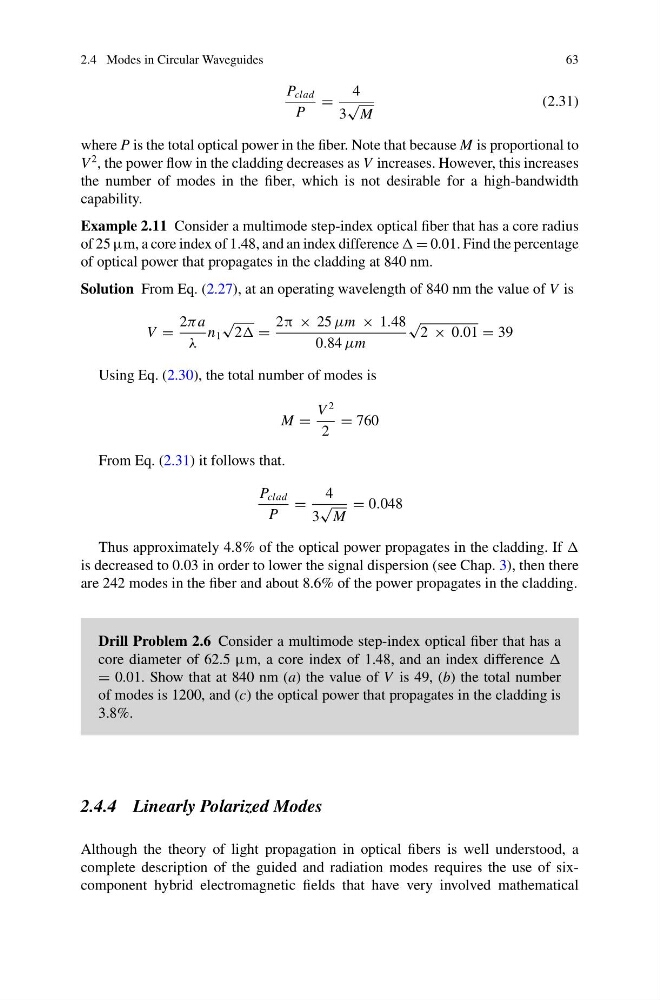
where P is the total optical power in the fiber. Note that because M is proportional to
V
2 , the power flow in the cladding decreases as V increases. However, this increases
the number of modes in the fiber, which is not desirable for a high-bandwidth
capability.
Example 2.11 Consider a multimode step-index optical fiber that has a core radius
of 25 μm, a core index of 1.48, and an index difference = 0.01. Find the percentage
of optical power that propagates in the cladding at 840 nm.
Solution From Eq. (2.27), at an operating wavelength of 840 nm the value of V is
V =
2πa
λ
n 1
√
2 =
2π × 25 μm × 1.48
0.84 μm
√
2 × 0.01 = 39
Using Eq. (2.30), the total number of modes is
M =
V
2
2
= 760
From Eq. (2.31) it follows that.
P clad
P
=
4
3
√
M
= 0.048
Thus approximately 4.8% of the optical power propagates in the cladding. If
is decreased to 0.03 in order to lower the signal dispersion (see Chap. 3), then there
are 242 modes in the fiber and about 8.6% of the power propagates in the cladding.
Drill Problem 2.6 Consider a multimode step-index optical fiber that has a
core diameter of 62.5 μm, a core index of 1.48, and an index difference
= 0.01. Show that at 840 nm (a) the value of V is 49, (b) the total number
of modes is 1200, and (c) the optical power that propagates in the cladding is
3.8%.
2.4.4 Linearly Polarized Modes
Although the theory of light propagation in optical fibers is well understood, a
complete description of the guided and radiation modes requires the use of sixcomponent hybrid electromagnetic fields that have very involved mathematical
63
P clad
P
=
4
3
√
M
(2.31)
where P is the total optical power in the fiber. Note that because M is proportional to
V
2 , the power flow in the cladding decreases as V increases. However, this increases
the number of modes in the fiber, which is not desirable for a high-bandwidth
capability.
Example 2.11 Consider a multimode step-index optical fiber that has a core radius
of 25 μm, a core index of 1.48, and an index difference = 0.01. Find the percentage
of optical power that propagates in the cladding at 840 nm.
Solution From Eq. (2.27), at an operating wavelength of 840 nm the value of V is
V =
2πa
λ
n 1
√
2 =
2π × 25 μm × 1.48
0.84 μm
√
2 × 0.01 = 39
Using Eq. (2.30), the total number of modes is
M =
V
2
2
= 760
From Eq. (2.31) it follows that.
P clad
P
=
4
3
√
M
= 0.048
Thus approximately 4.8% of the optical power propagates in the cladding. If
is decreased to 0.03 in order to lower the signal dispersion (see Chap. 3), then there
are 242 modes in the fiber and about 8.6% of the power propagates in the cladding.
Drill Problem 2.6 Consider a multimode step-index optical fiber that has a
core diameter of 62.5 μm, a core index of 1.48, and an index difference
= 0.01. Show that at 840 nm (a) the value of V is 49, (b) the total number
of modes is 1200, and (c) the optical power that propagates in the cladding is
3.8%.
2.4.4 Linearly Polarized Modes
Although the theory of light propagation in optical fibers is well understood, a
complete description of the guided and radiation modes requires the use of sixcomponent hybrid electromagnetic fields that have very involved mathematical