

62
2 Optical Fiber Structures and Light Guiding Principles
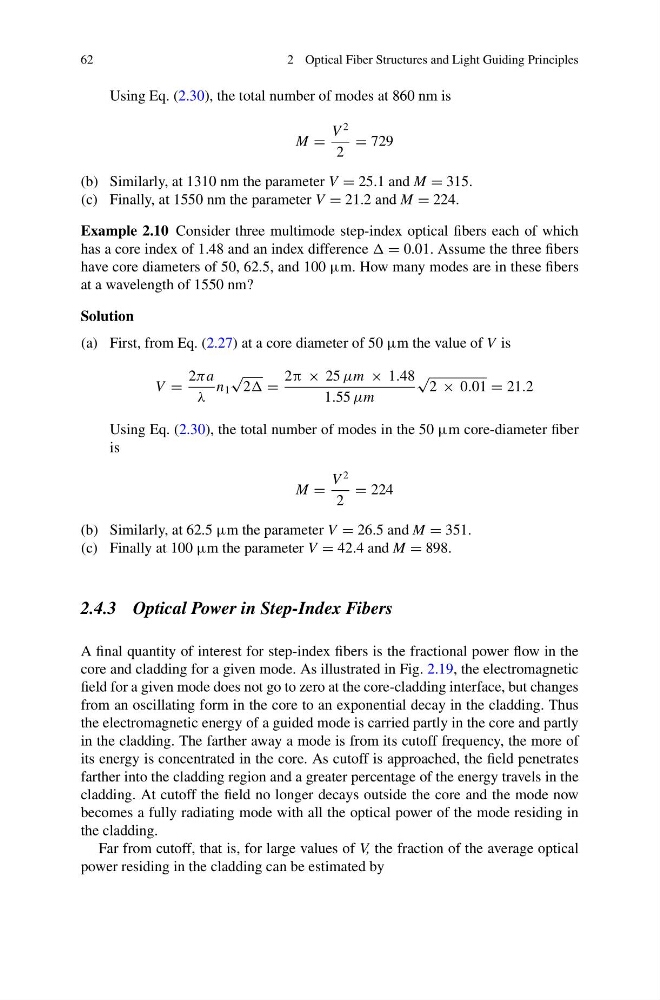
Using Eq. (2.30), the total number of modes at 860 nm is
M =
V
2
2
= 729
(b) Similarly, at 1310 nm the parameter V = 25.1 and M = 315.
(c) Finally, at 1550 nm the parameter V = 21.2 and M = 224.
Example 2.10 Consider three multimode step-index optical fibers each of which
has a core index of 1.48 and an index difference = 0.01. Assume the three fibers
have core diameters of 50, 62.5, and 100 μm. How many modes are in these fibers
at a wavelength of 1550 nm?
Solution
(a) First, from Eq. (2.27) at a core diameter of 50 μm the value of V is
V =
2πa
λ
n 1
√
2 =
2π × 25 μm × 1.48
1.55 μm
√
2 × 0.01 = 21.2
Using Eq. (2.30), the total number of modes in the 50 μm core-diameter fiber
is
M =
V
2
2
= 224
(b) Similarly, at 62.5 μm the parameter V = 26.5 and M = 351.
(c) Finally at 100 μm the parameter V = 42.4 and M = 898.
2.4.3 Optical Power in Step-Index Fibers
A final quantity of interest for step-index fibers is the fractional power flow in the
core and cladding for a given mode. As illustrated in Fig. 2.19, the electromagnetic
field for a given mode does not go to zero at the core-cladding interface, but changes
from an oscillating form in the core to an exponential decay in the cladding. Thus
the electromagnetic energy of a guided mode is carried partly in the core and partly
in the cladding. The farther away a mode is from its cutoff frequency, the more of
its energy is concentrated in the core. As cutoff is approached, the field penetrates
farther into the cladding region and a greater percentage of the energy travels in the
cladding. At cutoff the field no longer decays outside the core and the mode now
becomes a fully radiating mode with all the optical power of the mode residing in
the cladding.
Far from cutoff, that is, for large values of V, the fraction of the average optical
power residing in the cladding can be estimated by
2 Optical Fiber Structures and Light Guiding Principles
Using Eq. (2.30), the total number of modes at 860 nm is
M =
V
2
2
= 729
(b) Similarly, at 1310 nm the parameter V = 25.1 and M = 315.
(c) Finally, at 1550 nm the parameter V = 21.2 and M = 224.
Example 2.10 Consider three multimode step-index optical fibers each of which
has a core index of 1.48 and an index difference = 0.01. Assume the three fibers
have core diameters of 50, 62.5, and 100 μm. How many modes are in these fibers
at a wavelength of 1550 nm?
Solution
(a) First, from Eq. (2.27) at a core diameter of 50 μm the value of V is
V =
2πa
λ
n 1
√
2 =
2π × 25 μm × 1.48
1.55 μm
√
2 × 0.01 = 21.2
Using Eq. (2.30), the total number of modes in the 50 μm core-diameter fiber
is
M =
V
2
2
= 224
(b) Similarly, at 62.5 μm the parameter V = 26.5 and M = 351.
(c) Finally at 100 μm the parameter V = 42.4 and M = 898.
2.4.3 Optical Power in Step-Index Fibers
A final quantity of interest for step-index fibers is the fractional power flow in the
core and cladding for a given mode. As illustrated in Fig. 2.19, the electromagnetic
field for a given mode does not go to zero at the core-cladding interface, but changes
from an oscillating form in the core to an exponential decay in the cladding. Thus
the electromagnetic energy of a guided mode is carried partly in the core and partly
in the cladding. The farther away a mode is from its cutoff frequency, the more of
its energy is concentrated in the core. As cutoff is approached, the field penetrates
farther into the cladding region and a greater percentage of the energy travels in the
cladding. At cutoff the field no longer decays outside the core and the mode now
becomes a fully radiating mode with all the optical power of the mode residing in
the cladding.
Far from cutoff, that is, for large values of V, the fraction of the average optical
power residing in the cladding can be estimated by