

618
14 Basic Measurement and Monitoring Techniques
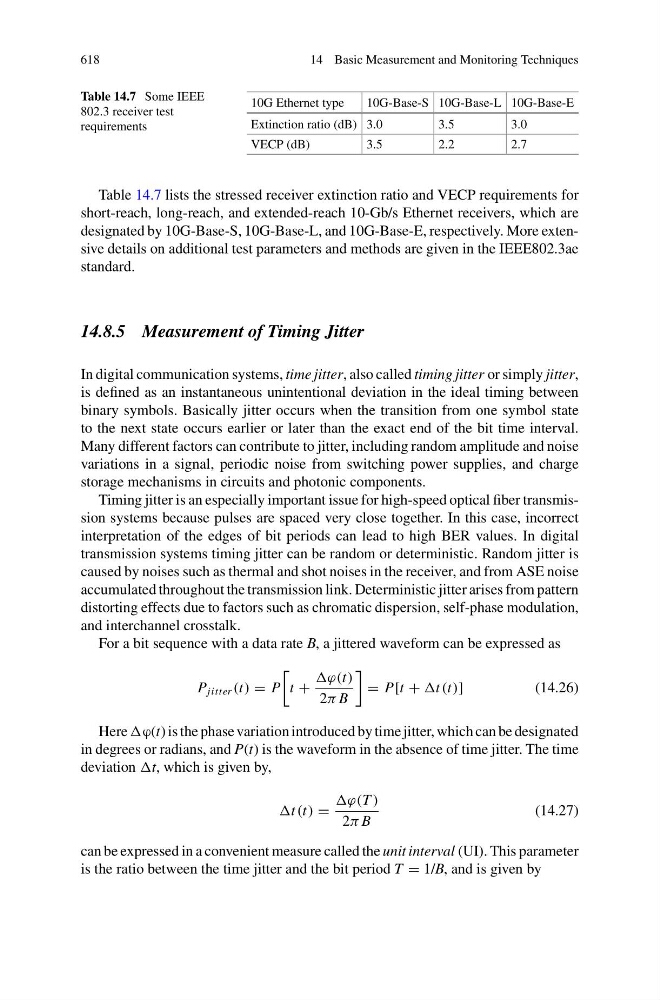
Table 14.7 Some IEEE
802.3 receiver test
requirements
10G Ethernet type
10G-Base-S 10G-Base-L 10G-Base-E
Extinction ratio (dB) 3.0
3.5
3.0
VECP (dB)
3.5
2.2
2.7
Table 14.7 lists the stressed receiver extinction ratio and VECP requirements for
short-reach, long-reach, and extended-reach 10-Gb/s Ethernet receivers, which are
designated by 10G-Base-S, 10G-Base-L, and 10G-Base-E, respectively. More extensive details on additional test parameters and methods are given in the IEEE802.3ae
standard.
14.8.5 Measurement of Timing Jitter
In digital communication systems, time jitter, also called timing jitter or simply jitter,
is defined as an instantaneous unintentional deviation in the ideal timing between
binary symbols. Basically jitter occurs when the transition from one symbol state
to the next state occurs earlier or later than the exact end of the bit time interval.
Many different factors can contribute to jitter, including random amplitude and noise
variations in a signal, periodic noise from switching power supplies, and charge
storage mechanisms in circuits and photonic components.
Timing jitter is an especially important issue for high-speed optical fiber transmission systems because pulses are spaced very close together. In this case, incorrect
interpretation of the edges of bit periods can lead to high BER values. In digital
transmission systems timing jitter can be random or deterministic. Random jitter is
caused by noises such as thermal and shot noises in the receiver, and from ASE noise
accumulated throughout the transmission link. Deterministic jitter arises from pattern
distorting effects due to factors such as chromatic dispersion, self-phase modulation,
and interchannel crosstalk.
For a bit sequence with a data rate B, a jittered waveform can be expressed as
P jitter (t) = P
t +
2π B
= P[t + t (t)]
(14.26)
Here ϕ(t) is the phase variation introduced by time jitter, which can be designated
in degrees or radians, and P(t) is the waveform in the absence of time jitter. The time
deviation t, which is given by,
t (t) =
)
2π B
(14.27)
can be expressed in a convenient measure called the unit interval (UI). This parameter
is the ratio between the time jitter and the bit period T = 1/B, and is given by