

14.8 Optical Fiber Network Performance Testing
619
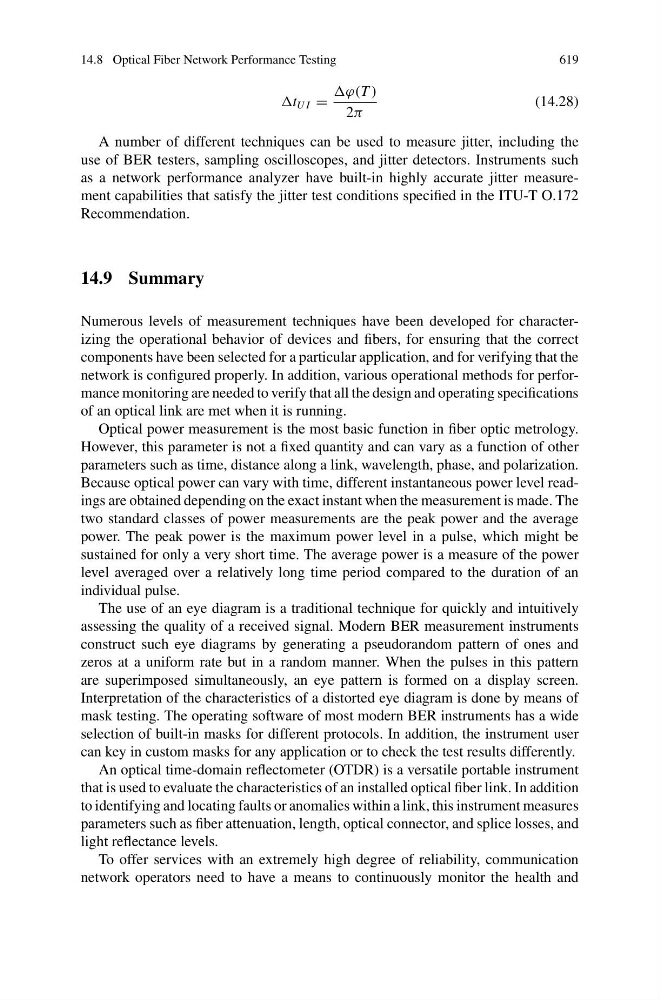
t U I =
ϕ(T )
2π
(14.28)
A number of different techniques can be used to measure jitter, including the
use of BER testers, sampling oscilloscopes, and jitter detectors. Instruments such
as a network performance analyzer have built-in highly accurate jitter measurement capabilities that satisfy the jitter test conditions specified in the ITU-T O.172
Recommendation.
14.9 Summary
Numerous levels of measurement techniques have been developed for characterizing the operational behavior of devices and fibers, for ensuring that the correct
components have been selected for a particular application, and for verifying that the
network is configured properly. In addition, various operational methods for performance monitoring are needed to verify that all the design and operating specifications
of an optical link are met when it is running.
Optical power measurement is the most basic function in fiber optic metrology.
However, this parameter is not a fixed quantity and can vary as a function of other
parameters such as time, distance along a link, wavelength, phase, and polarization.
Because optical power can vary with time, different instantaneous power level readings are obtained depending on the exact instant when the measurement is made. The
two standard classes of power measurements are the peak power and the average
power. The peak power is the maximum power level in a pulse, which might be
sustained for only a very short time. The average power is a measure of the power
level averaged over a relatively long time period compared to the duration of an
individual pulse.
The use of an eye diagram is a traditional technique for quickly and intuitively
assessing the quality of a received signal. Modern BER measurement instruments
construct such eye diagrams by generating a pseudorandom pattern of ones and
zeros at a uniform rate but in a random manner. When the pulses in this pattern
are superimposed simultaneously, an eye pattern is formed on a display screen.
Interpretation of the characteristics of a distorted eye diagram is done by means of
mask testing. The operating software of most modern BER instruments has a wide
selection of built-in masks for different protocols. In addition, the instrument user
can key in custom masks for any application or to check the test results differently.
An optical time-domain reflectometer (OTDR) is a versatile portable instrument
that is used to evaluate the characteristics of an installed optical fiber link. In addition
to identifying and locating faults or anomalies within a link, this instrument measures
parameters such as fiber attenuation, length, optical connector, and splice losses, and
light reflectance levels.
To offer services with an extremely high degree of reliability, communication
network operators need to have a means to continuously monitor the health and