

2.2 Basic Laws and Definitions of Optics
43
Thus any light ray traveling in the dielectric material that is incident on the material–air interface at an angle θ 1 with respect to the normal (as shown in Fig. 2.7)
greater than 42.5° is totally reflected back into the dielectric material.
Example 2.4 A light ray traveling in air (n 1 = 1.00) is incident on a smooth, flat slab
of crown glass, which has a refractive index n 2 = 1.52. If the incoming ray makes
an angle of θ 1 = 30.0° with respect to the normal, what is the angle of refraction θ 2
in the glass?
Solution From Snell’s law given by Eq. (2.16),
sin θ 2 =
n 1
n 2
sin θ 1 =
1.00
1.52
sin 30
◦
= 0.658 × 0.50 = 0.329
Solving for θ 2 then yields θ 2 = sin
−1 (0.329) = 19.2°.
Drill Problem 2.2 Consider the interface between a GaAs surface with a
refractive index n 1 = 3.299 and air for which n 2 = 1.000. Show that the critical
angle is θ c = 17.6°.
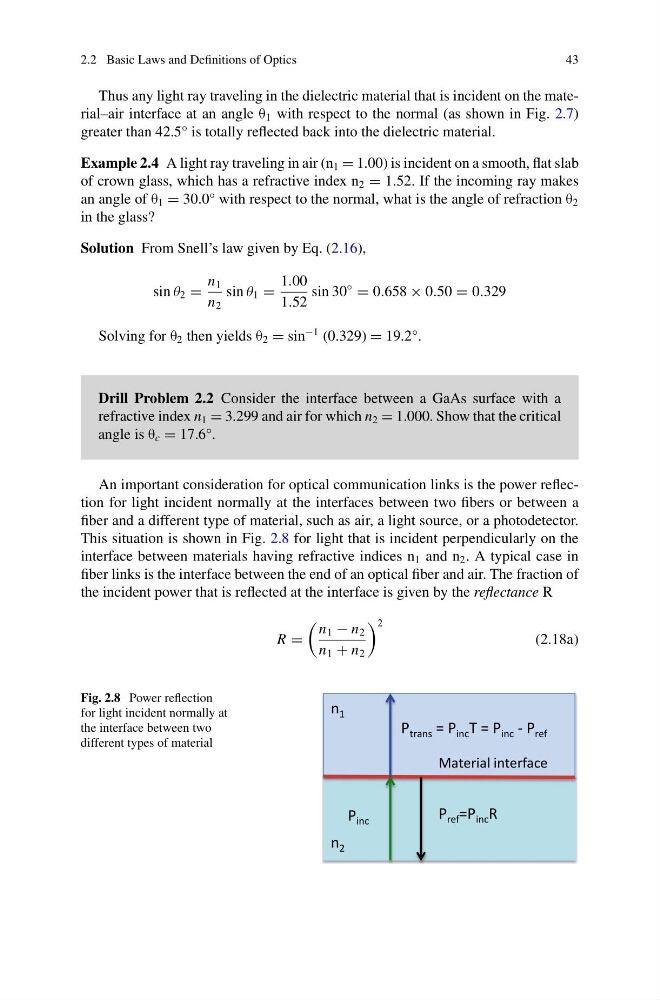
An important consideration for optical communication links is the power reflection for light incident normally at the interfaces between two fibers or between a
fiber and a different type of material, such as air, a light source, or a photodetector.
This situation is shown in Fig. 2.8 for light that is incident perpendicularly on the
interface between materials having refractive indices n 1 and n 2 . A typical case in
fiber links is the interface between the end of an optical fiber and air. The fraction of
the incident power that is reflected at the interface is given by the reflectance R
R =
n 1 − n 2
n 1 + n 2
2
(2.18a)
Fig. 2.8 Power reflection
for light incident normally at
the interface between two
different types of material
P trans = P inc T = P inc - P ref
P inc
P ref =P inc R
n 1
n 2
Material interface
43
Thus any light ray traveling in the dielectric material that is incident on the material–air interface at an angle θ 1 with respect to the normal (as shown in Fig. 2.7)
greater than 42.5° is totally reflected back into the dielectric material.
Example 2.4 A light ray traveling in air (n 1 = 1.00) is incident on a smooth, flat slab
of crown glass, which has a refractive index n 2 = 1.52. If the incoming ray makes
an angle of θ 1 = 30.0° with respect to the normal, what is the angle of refraction θ 2
in the glass?
Solution From Snell’s law given by Eq. (2.16),
sin θ 2 =
n 1
n 2
sin θ 1 =
1.00
1.52
sin 30
◦
= 0.658 × 0.50 = 0.329
Solving for θ 2 then yields θ 2 = sin
−1 (0.329) = 19.2°.
Drill Problem 2.2 Consider the interface between a GaAs surface with a
refractive index n 1 = 3.299 and air for which n 2 = 1.000. Show that the critical
angle is θ c = 17.6°.
An important consideration for optical communication links is the power reflection for light incident normally at the interfaces between two fibers or between a
fiber and a different type of material, such as air, a light source, or a photodetector.
This situation is shown in Fig. 2.8 for light that is incident perpendicularly on the
interface between materials having refractive indices n 1 and n 2 . A typical case in
fiber links is the interface between the end of an optical fiber and air. The fraction of
the incident power that is reflected at the interface is given by the reflectance R
R =
n 1 − n 2
n 1 + n 2
2
(2.18a)
Fig. 2.8 Power reflection
for light incident normally at
the interface between two
different types of material
P trans = P inc T = P inc - P ref
P inc
P ref =P inc R
n 1
n 2
Material interface