

42
2 Optical Fiber Structures and Light Guiding Principles
Normal line
Reflected ray
Incident ray
Refracted
ray
n 2 < n 1
n 1
θ 1 = θ c
θ 2 = 90°
Normal line
Reflected ray
Incident ray
No refracted
ray
n 2 < n 1
n 1
θ 1 > θ c
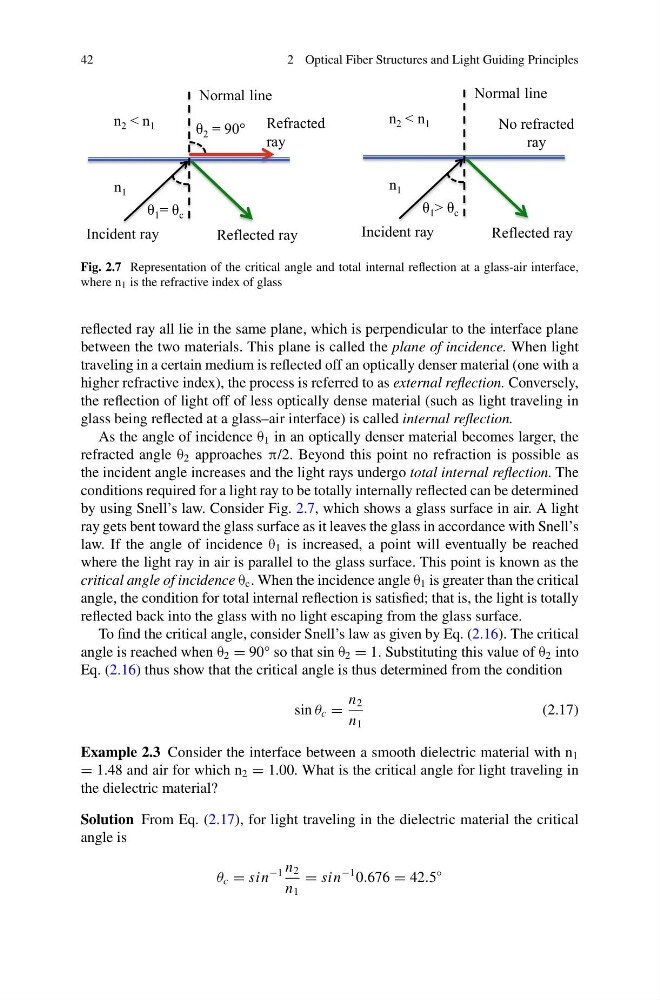
Fig. 2.7 Representation of the critical angle and total internal reflection at a glass-air interface,
where n 1 is the refractive index of glass
reflected ray all lie in the same plane, which is perpendicular to the interface plane
between the two materials. This plane is called the plane of incidence. When light
traveling in a certain medium is reflected off an optically denser material (one with a
higher refractive index), the process is referred to as external reflection. Conversely,
the reflection of light off of less optically dense material (such as light traveling in
glass being reflected at a glass–air interface) is called internal reflection.
As the angle of incidence θ 1 in an optically denser material becomes larger, the
refracted angle θ 2 approaches π/2. Beyond this point no refraction is possible as
the incident angle increases and the light rays undergo total internal reflection. The
conditions required for a light ray to be totally internally reflected can be determined
by using Snell’s law. Consider Fig. 2.7, which shows a glass surface in air. A light
ray gets bent toward the glass surface as it leaves the glass in accordance with Snell’s
law. If the angle of incidence θ 1 is increased, a point will eventually be reached
where the light ray in air is parallel to the glass surface. This point is known as the
critical angle of incidence θ c . When the incidence angle θ 1 is greater than the critical
angle, the condition for total internal reflection is satisfied; that is, the light is totally
reflected back into the glass with no light escaping from the glass surface.
To find the critical angle, consider Snell’s law as given by Eq. (2.16). The critical
angle is reached when θ 2 = 90° so that sin θ 2 = 1. Substituting this value of θ 2 into
Eq. (2.16) thus show that the critical angle is thus determined from the condition
sin θ c =
n 2
n 1
(2.17)
Example 2.3 Consider the interface between a smooth dielectric material with n 1
= 1.48 and air for which n 2 = 1.00. What is the critical angle for light traveling in
the dielectric material?
Solution From Eq. (2.17), for light traveling in the dielectric material the critical
angle is
θ c = sin
−1 n 2
n 1
= sin
−1 0.676 = 42.5
◦
2 Optical Fiber Structures and Light Guiding Principles
Normal line
Reflected ray
Incident ray
Refracted
ray
n 2 < n 1
n 1
θ 1 = θ c
θ 2 = 90°
Normal line
Reflected ray
Incident ray
No refracted
ray
n 2 < n 1
n 1
θ 1 > θ c
Fig. 2.7 Representation of the critical angle and total internal reflection at a glass-air interface,
where n 1 is the refractive index of glass
reflected ray all lie in the same plane, which is perpendicular to the interface plane
between the two materials. This plane is called the plane of incidence. When light
traveling in a certain medium is reflected off an optically denser material (one with a
higher refractive index), the process is referred to as external reflection. Conversely,
the reflection of light off of less optically dense material (such as light traveling in
glass being reflected at a glass–air interface) is called internal reflection.
As the angle of incidence θ 1 in an optically denser material becomes larger, the
refracted angle θ 2 approaches π/2. Beyond this point no refraction is possible as
the incident angle increases and the light rays undergo total internal reflection. The
conditions required for a light ray to be totally internally reflected can be determined
by using Snell’s law. Consider Fig. 2.7, which shows a glass surface in air. A light
ray gets bent toward the glass surface as it leaves the glass in accordance with Snell’s
law. If the angle of incidence θ 1 is increased, a point will eventually be reached
where the light ray in air is parallel to the glass surface. This point is known as the
critical angle of incidence θ c . When the incidence angle θ 1 is greater than the critical
angle, the condition for total internal reflection is satisfied; that is, the light is totally
reflected back into the glass with no light escaping from the glass surface.
To find the critical angle, consider Snell’s law as given by Eq. (2.16). The critical
angle is reached when θ 2 = 90° so that sin θ 2 = 1. Substituting this value of θ 2 into
Eq. (2.16) thus show that the critical angle is thus determined from the condition
sin θ c =
n 2
n 1
(2.17)
Example 2.3 Consider the interface between a smooth dielectric material with n 1
= 1.48 and air for which n 2 = 1.00. What is the critical angle for light traveling in
the dielectric material?
Solution From Eq. (2.17), for light traveling in the dielectric material the critical
angle is
θ c = sin
−1 n 2
n 1
= sin
−1 0.676 = 42.5
◦