

2.2 Basic Laws and Definitions of Optics
41
Table. 2.1 Examples of
the indices of refraction for
various substances
Material
Refractive index
Acetone
1.356
Air
1.000
Diamond
2.419
Ethyl alcohol
1.361
Fused quartz (SiO 2 ): varies with
wavelength
1.453 @ 850 nm
Gallium arsenide (GaAs)
3.299 (infrared region)
Glass, crown
1.52–1.62
Glycerin
1.473
Polymethylmethacrylate (PMMA) 1.489
Silicon (varies with wavelength)
3.650 @ 850 nm
Water
1.333
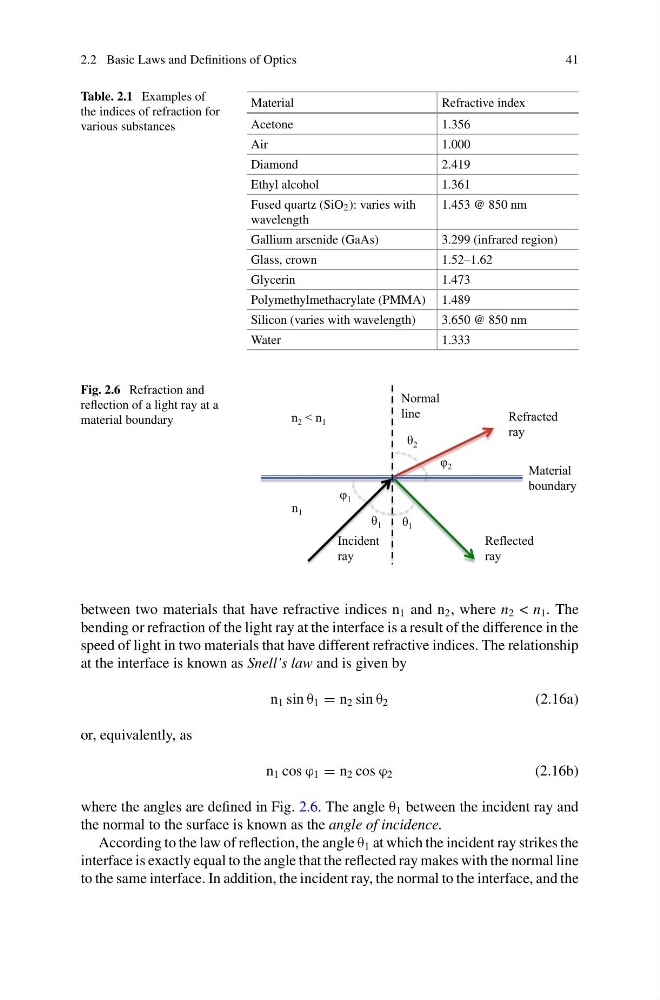
Fig. 2.6 Refraction and
reflection of a light ray at a
material boundary
Normal
line
Reflected
ray
Material
boundary
Incident
ray
Refracted
ray
n 2 < n 1
n 1
θ 1
θ 1
θ 2
φ 1
φ 2
between two materials that have refractive indices n 1 and n 2 , where n 2 < n 1 . The
bending or refraction of the light ray at the interface is a result of the difference in the
speed of light in two materials that have different refractive indices. The relationship
at the interface is known as Snell’s law and is given by
n 1 sin θ 1 = n 2 sin θ 2
(2.16a)
or, equivalently, as
n 1 cos ϕ 1 = n 2 cos ϕ 2
(2.16b)
where the angles are defined in Fig. 2.6. The angle θ 1 between the incident ray and
the normal to the surface is known as the angle of incidence.
According to the law of reflection, the angle θ 1 at which the incident ray strikes the
interface is exactly equal to the angle that the reflected ray makes with the normal line
to the same interface. In addition, the incident ray, the normal to the interface, and the
41
Table. 2.1 Examples of
the indices of refraction for
various substances
Material
Refractive index
Acetone
1.356
Air
1.000
Diamond
2.419
Ethyl alcohol
1.361
Fused quartz (SiO 2 ): varies with
wavelength
1.453 @ 850 nm
Gallium arsenide (GaAs)
3.299 (infrared region)
Glass, crown
1.52–1.62
Glycerin
1.473
Polymethylmethacrylate (PMMA) 1.489
Silicon (varies with wavelength)
3.650 @ 850 nm
Water
1.333
Fig. 2.6 Refraction and
reflection of a light ray at a
material boundary
Normal
line
Reflected
ray
Material
boundary
Incident
ray
Refracted
ray
n 2 < n 1
n 1
θ 1
θ 1
θ 2
φ 1
φ 2
between two materials that have refractive indices n 1 and n 2 , where n 2 < n 1 . The
bending or refraction of the light ray at the interface is a result of the difference in the
speed of light in two materials that have different refractive indices. The relationship
at the interface is known as Snell’s law and is given by
n 1 sin θ 1 = n 2 sin θ 2
(2.16a)
or, equivalently, as
n 1 cos ϕ 1 = n 2 cos ϕ 2
(2.16b)
where the angles are defined in Fig. 2.6. The angle θ 1 between the incident ray and
the normal to the surface is known as the angle of incidence.
According to the law of reflection, the angle θ 1 at which the incident ray strikes the
interface is exactly equal to the angle that the reflected ray makes with the normal line
to the same interface. In addition, the incident ray, the normal to the interface, and the