

14.7 Optical Performance Monitoring
605
information in a management information base (MIB), and then provide the data to
management entities within a network management system (NMS) that resides in the
management workstation. A MIB is a logical base of information that defines data
elements and their appropriate syntax and identifier, such as the fields in a database.
This information may be stored in tables, counters, or switch settings. The MIB
does not define how to collect or use data elements. It only specifies what the agent
should collect and how to organize these data elements so that other systems can
use them. The information transfer from the MIB to the NMS is done via a network
management protocol such as the widely used simple network management protocol
(SNMP).
When agents notice problems in the element they are monitoring (for example, link
or component faults, wavelength drifts, reduction in optical power levels, or excessive
bit-error rates), they send alerts to the management entities. Upon receiving an alert,
the management entities can initiate one or more actions such as operator notification,
event logging, system shutdown, or automatic attempts at fault isolation or repair.
The EMS also can query or poll the agents in the elements to check the status of
certain conditions or variables. This polling can be automatic or operator-initiated.
In addition, there are management proxies that provide management information on
behalf of devices that are not able to host an agent.
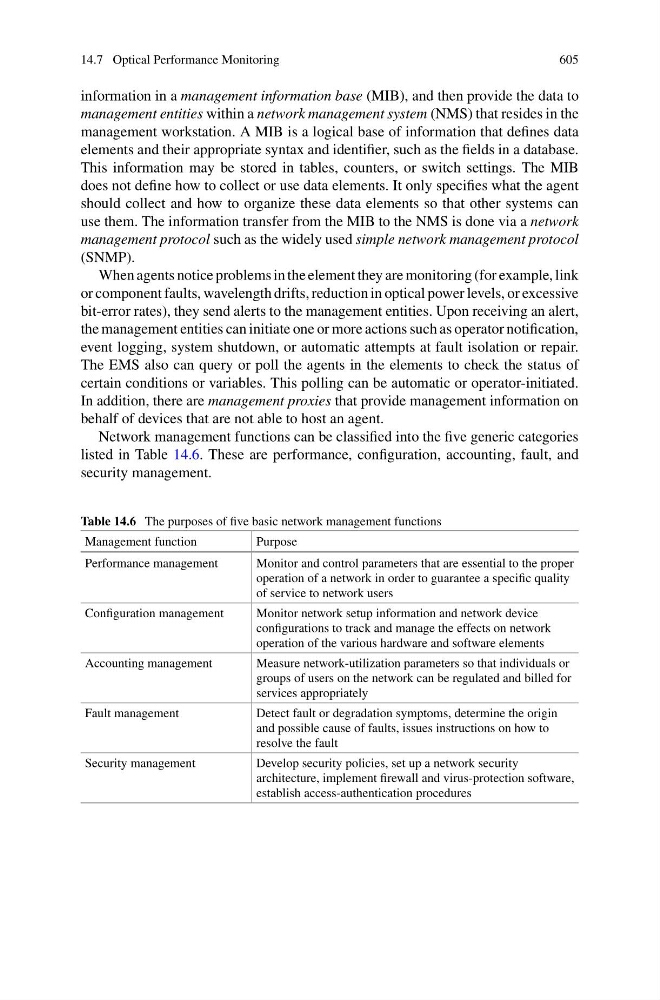
Network management functions can be classified into the five generic categories
listed in Table 14.6. These are performance, configuration, accounting, fault, and
security management.
Table 14.6 The purposes of five basic network management functions
Management function
Purpose
Performance management
Monitor and control parameters that are essential to the proper
operation of a network in order to guarantee a specific quality
of service to network users
Configuration management
Monitor network setup information and network device
configurations to track and manage the effects on network
operation of the various hardware and software elements
Accounting management
Measure network-utilization parameters so that individuals or
groups of users on the network can be regulated and billed for
services appropriately
Fault management
Detect fault or degradation symptoms, determine the origin
and possible cause of faults, issues instructions on how to
resolve the fault
Security management
Develop security policies, set up a network security
architecture, implement firewall and virus-protection software,
establish access-authentication procedures