

606
14 Basic Measurement and Monitoring Techniques
14.7.2 Optical Layer Management
To deal with standardized management functions in the optical layer, the ITU-T
defined a three-layer optical transport network (OTN) model in ITU-T Rec. G.709,
which also is referred to as the Digital Wrapper standard. Just as the SONET/SDH
standard enabled the management of single-wavelength optical networks using
equipment from many different vendors, the G.709 standard enables the broad adoption of technology for managing multiwavelength optical networks. The structure and
layers of the OTN closely parallel the path, line, and section sublayers of SONET.
The model is based on a client/server concept. The exchange of information
between processes running in two different devices connected through a network
may be characterized by a client/server interaction. The terms client and server
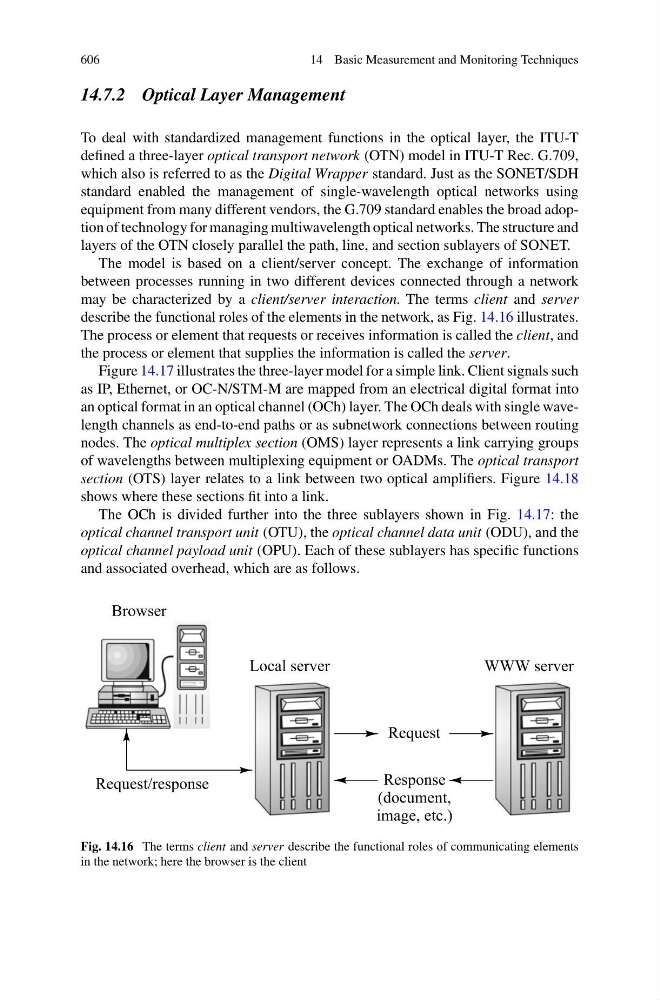
describe the functional roles of the elements in the network, as Fig. 14.16 illustrates.
The process or element that requests or receives information is called the client, and
the process or element that supplies the information is called the server.
Figure 14.17 illustrates the three-layer model for a simple link. Client signals such
as IP, Ethernet, or OC-N/STM-M are mapped from an electrical digital format into
an optical format in an optical channel (OCh) layer. The OCh deals with single wavelength channels as end-to-end paths or as subnetwork connections between routing
nodes. The optical multiplex section (OMS) layer represents a link carrying groups
of wavelengths between multiplexing equipment or OADMs. The optical transport
section (OTS) layer relates to a link between two optical amplifiers. Figure 14.18
shows where these sections fit into a link.
The OCh is divided further into the three sublayers shown in Fig. 14.17: the
optical channel transport unit (OTU), the optical channel data unit (ODU), and the
optical channel payload unit (OPU). Each of these sublayers has specific functions
and associated overhead, which are as follows.
Fig. 14.16 The terms client and server describe the functional roles of communicating elements
in the network; here the browser is the client