

14.6 Optical Time-Domain Reflectometer
603
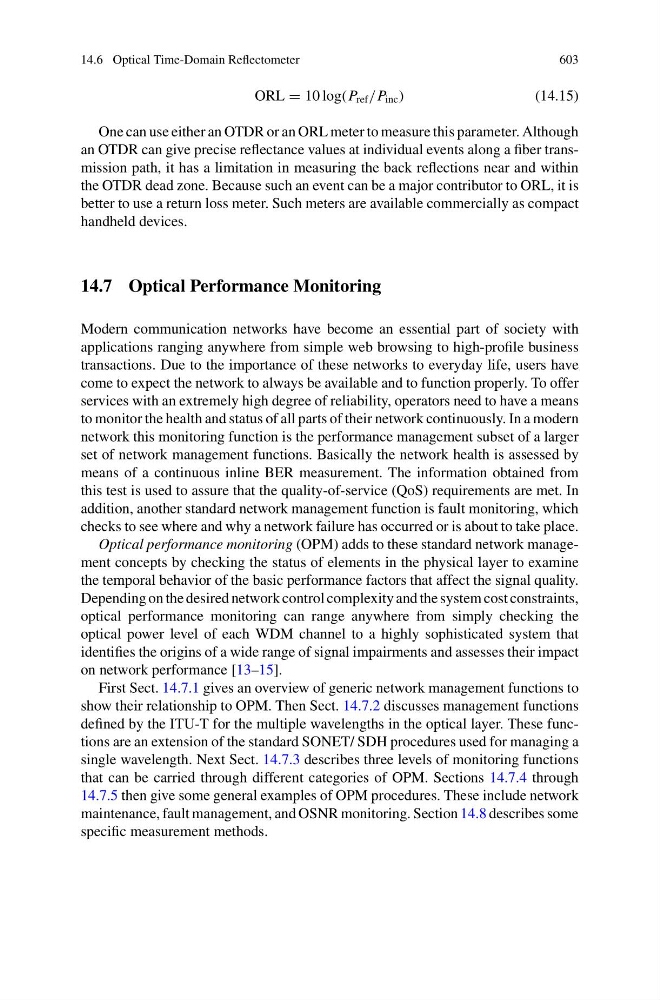
ORL = 10 log(P ref /P inc )
(14.15)
One can use either an OTDR or an ORL meter to measure this parameter. Although
an OTDR can give precise reflectance values at individual events along a fiber transmission path, it has a limitation in measuring the back reflections near and within
the OTDR dead zone. Because such an event can be a major contributor to ORL, it is
better to use a return loss meter. Such meters are available commercially as compact
handheld devices.
14.7 Optical Performance Monitoring
Modern communication networks have become an essential part of society with
applications ranging anywhere from simple web browsing to high-profile business
transactions. Due to the importance of these networks to everyday life, users have
come to expect the network to always be available and to function properly. To offer
services with an extremely high degree of reliability, operators need to have a means
to monitor the health and status of all parts of their network continuously. In a modern
network this monitoring function is the performance management subset of a larger
set of network management functions. Basically the network health is assessed by
means of a continuous inline BER measurement. The information obtained from
this test is used to assure that the quality-of-service (QoS) requirements are met. In
addition, another standard network management function is fault monitoring, which
checks to see where and why a network failure has occurred or is about to take place.
Optical performance monitoring (OPM) adds to these standard network management concepts by checking the status of elements in the physical layer to examine
the temporal behavior of the basic performance factors that affect the signal quality.
Depending on the desired network control complexity and the system cost constraints,
optical performance monitoring can range anywhere from simply checking the
optical power level of each WDM channel to a highly sophisticated system that
identifies the origins of a wide range of signal impairments and assesses their impact
on network performance [13–15].
First Sect. 14.7.1 gives an overview of generic network management functions to
show their relationship to OPM. Then Sect. 14.7.2 discusses management functions
defined by the ITU-T for the multiple wavelengths in the optical layer. These functions are an extension of the standard SONET/ SDH procedures used for managing a
single wavelength. Next Sect. 14.7.3 describes three levels of monitoring functions
that can be carried through different categories of OPM. Sections 14.7.4 through
14.7.5 then give some general examples of OPM procedures. These include network
maintenance, fault management, and OSNR monitoring. Section 14.8 describes some
specific measurement methods.