

596
14 Basic Measurement and Monitoring Techniques
14.5.3 BER Contours
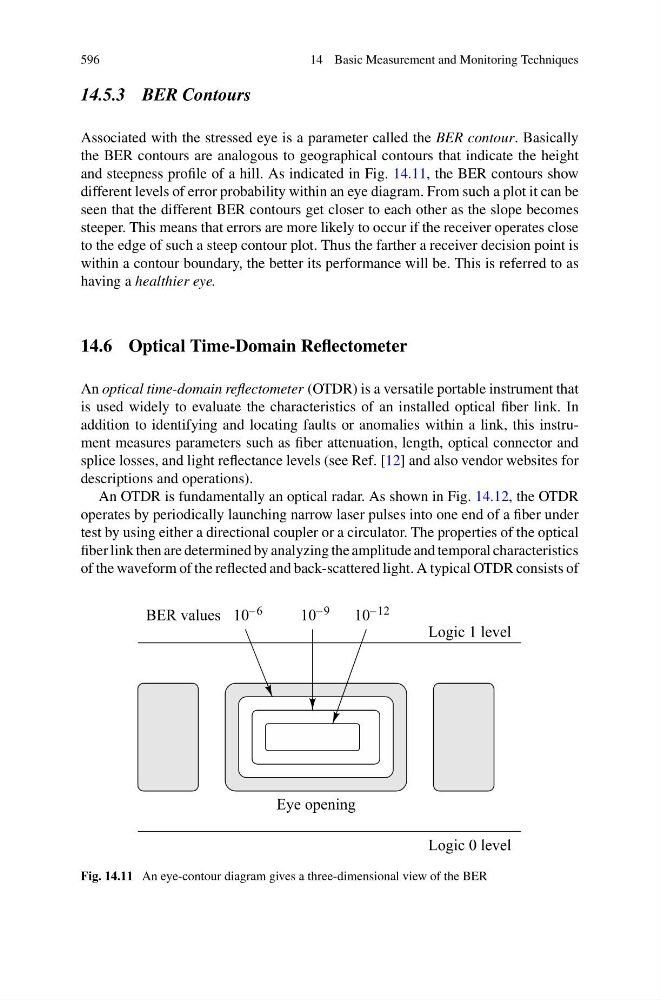
Associated with the stressed eye is a parameter called the BER contour. Basically
the BER contours are analogous to geographical contours that indicate the height
and steepness profile of a hill. As indicated in Fig. 14.11, the BER contours show
different levels of error probability within an eye diagram. From such a plot it can be
seen that the different BER contours get closer to each other as the slope becomes
steeper. This means that errors are more likely to occur if the receiver operates close
to the edge of such a steep contour plot. Thus the farther a receiver decision point is
within a contour boundary, the better its performance will be. This is referred to as
having a healthier eye.
14.6 Optical Time-Domain Reflectometer
An optical time-domain reflectometer (OTDR) is a versatile portable instrument that
is used widely to evaluate the characteristics of an installed optical fiber link. In
addition to identifying and locating faults or anomalies within a link, this instrument measures parameters such as fiber attenuation, length, optical connector and
splice losses, and light reflectance levels (see Ref. [12] and also vendor websites for
descriptions and operations).
An OTDR is fundamentally an optical radar. As shown in Fig. 14.12, the OTDR
operates by periodically launching narrow laser pulses into one end of a fiber under
test by using either a directional coupler or a circulator. The properties of the optical
fiber link then are determined by analyzing the amplitude and temporal characteristics
of the waveform of the reflected and back-scattered light. A typical OTDR consists of
Fig. 14.11 An eye-contour diagram gives a three-dimensional view of the BER