

14.5 Concept of Eye Diagram Tests
595
Table 14.5 Standard NRZ eye-mask parameters for several protocols given in terms of unit intervals
Protocol
Jitter
Rise time
Eye height
Overshoot
Undershoot
OC-3
0.15
0.200
0.60
0.20
0.20
OC-12
0.25
0.150
0.60
0.20
0.20
OC-48/192
0.40
0.000
0.50
0.25
0.25
Gigabit Ethernet
0.22
0.155
0.60
0.30
0.20
Fibre Channel
0.15
0.200
0.60
0.30
0.20
has UI = 1.0. Note that the rise-time parameter for OC-48 is zero, because the mask
is a rectangle.
14.5.2 Stressed Eye Opening
The standards for many high-speed transmission protocols specify a test that uses
what is called a stressed eye. Among these standards are Gigabit Ethernet, 10-Gigabit
Ethernet (l0GigE), Fibre Channel, and SONET OC-48 and OC-192. The concept of
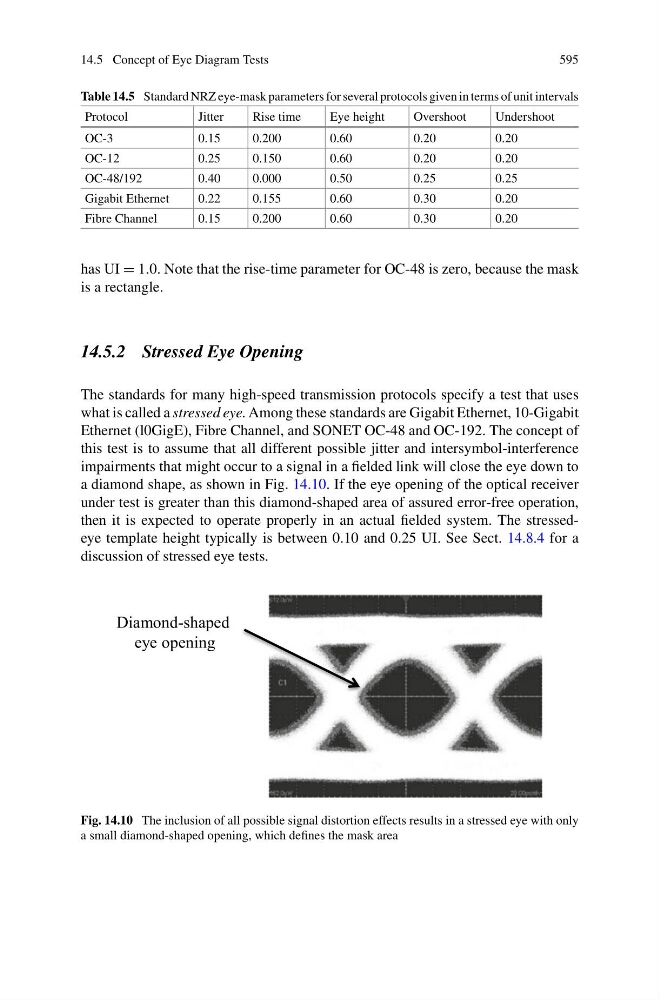
this test is to assume that all different possible jitter and intersymbol-interference
impairments that might occur to a signal in a fielded link will close the eye down to
a diamond shape, as shown in Fig. 14.10. If the eye opening of the optical receiver
under test is greater than this diamond-shaped area of assured error-free operation,
then it is expected to operate properly in an actual fielded system. The stressedeye template height typically is between 0.10 and 0.25 UI. See Sect. 14.8.4 for a
discussion of stressed eye tests.
Diamond-shaped
eye opening
Fig. 14.10 The inclusion of all possible signal distortion effects results in a stressed eye with only
a small diamond-shaped opening, which defines the mask area