

594
14 Basic Measurement and Monitoring Techniques
14.5.1 Standard Mask Testing
Interpretation of the characteristics of a distorted eye diagram is done by means of
mask testing. Depending on which protocol standard is used, industry-defined masks
can take the shape of a polygon or a square, which must fit within the eye diagram
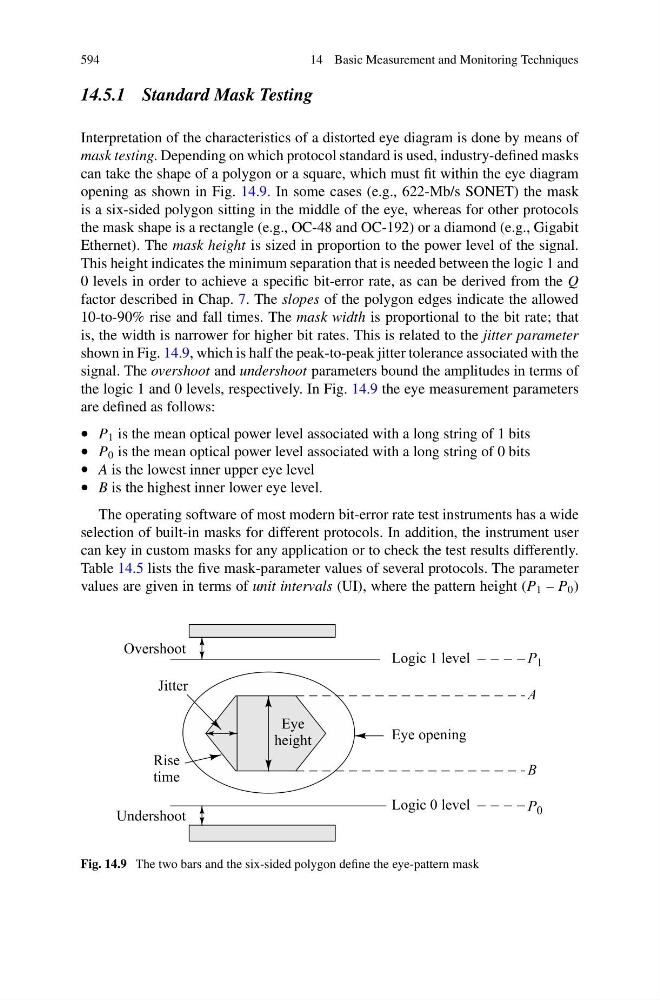
opening as shown in Fig. 14.9. In some cases (e.g., 622-Mb/s SONET) the mask
is a six-sided polygon sitting in the middle of the eye, whereas for other protocols
the mask shape is a rectangle (e.g., OC-48 and OC-192) or a diamond (e.g., Gigabit
Ethernet). The mask height is sized in proportion to the power level of the signal.
This height indicates the minimum separation that is needed between the logic 1 and
0 levels in order to achieve a specific bit-error rate, as can be derived from the Q
factor described in Chap. 7. The slopes of the polygon edges indicate the allowed
10-to-90% rise and fall times. The mask width is proportional to the bit rate; that
is, the width is narrower for higher bit rates. This is related to the jitter parameter
shown in Fig. 14.9, which is half the peak-to-peak jitter tolerance associated with the
signal. The overshoot and undershoot parameters bound the amplitudes in terms of
the logic 1 and 0 levels, respectively. In Fig. 14.9 the eye measurement parameters
are defined as follows:
• P 1 is the mean optical power level associated with a long string of 1 bits
• P 0 is the mean optical power level associated with a long string of 0 bits
• A is the lowest inner upper eye level
• B is the highest inner lower eye level.
The operating software of most modern bit-error rate test instruments has a wide
selection of built-in masks for different protocols. In addition, the instrument user
can key in custom masks for any application or to check the test results differently.
Table 14.5 lists the five mask-parameter values of several protocols. The parameter
values are given in terms of unit intervals (UI), where the pattern height (P 1 – P 0 )
Fig. 14.9 The two bars and the six-sided polygon define the eye-pattern mask