

14.2 Survey of Test Equipment
581
portable, handheld units for field use to sophisticated bench-top or rack-mountable
instruments for laboratory and manufacturing applications. In general, the field units
do not need to have the extremely high precision of laboratory instruments, but
they need to be more rugged to maintain reliable and accurate measurements under
extreme environmental conditions of temperature, humidity, dust, and mechanical
stress. However, even the handheld instruments for field use have reached a high
degree of sophistication with automated microprocessor-controlled test features,
computer interfaces, and Internet access capabilities.
More sophisticated instruments, such as polarization analyzers and optical
communication analyzers, are available for measuring and analyzing polarizationmode dispersion (PMD), eye diagrams, and pulse waveforms. These instruments
enable a variety of statistical measurements to be made at the push of a button, after
the user has keyed in the parameters to be tested and the desired measurement range.
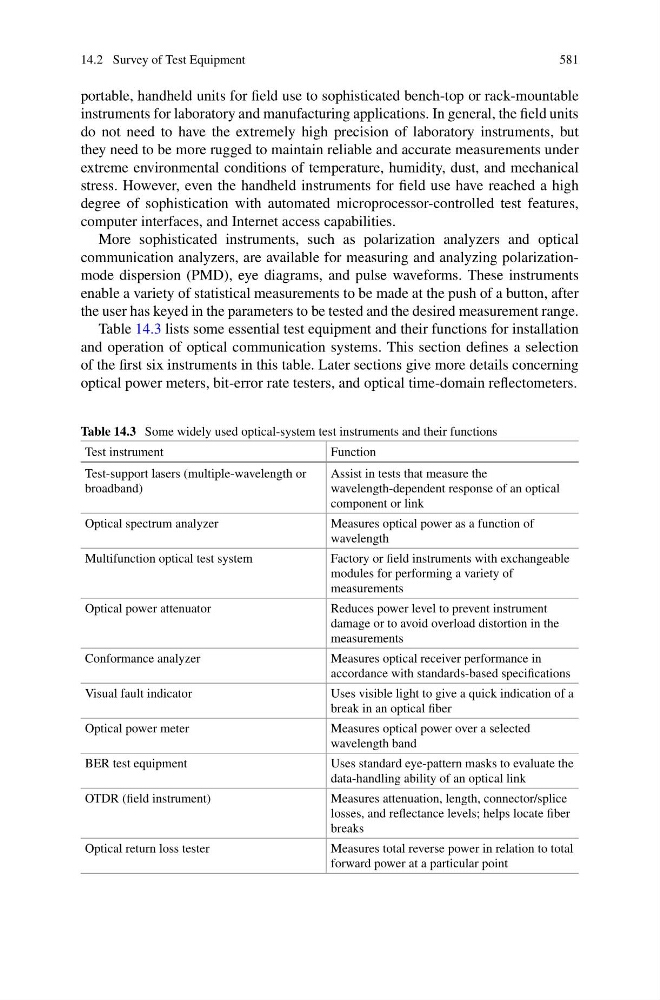
Table 14.3 lists some essential test equipment and their functions for installation
and operation of optical communication systems. This section defines a selection
of the first six instruments in this table. Later sections give more details concerning
optical power meters, bit-error rate testers, and optical time-domain reflectometers.
Table 14.3 Some widely used optical-system test instruments and their functions
Test instrument
Function
Test-support lasers (multiple-wavelength or
broadband)
Assist in tests that measure the
wavelength-dependent response of an optical
component or link
Optical spectrum analyzer
Measures optical power as a function of
wavelength
Multifunction optical test system
Factory or field instruments with exchangeable
modules for performing a variety of
measurements
Optical power attenuator
Reduces power level to prevent instrument
damage or to avoid overload distortion in the
measurements
Conformance analyzer
Measures optical receiver performance in
accordance with standards-based specifications
Visual fault indicator
Uses visible light to give a quick indication of a
break in an optical fiber
Optical power meter
Measures optical power over a selected
wavelength band
BER test equipment
Uses standard eye-pattern masks to evaluate the
data-handling ability of an optical link
OTDR (field instrument)
Measures attenuation, length, connector/splice
losses, and reflectance levels; helps locate fiber
breaks
Optical return loss tester
Measures total reverse power in relation to total
forward power at a particular point