

580
14 Basic Measurement and Monitoring Techniques
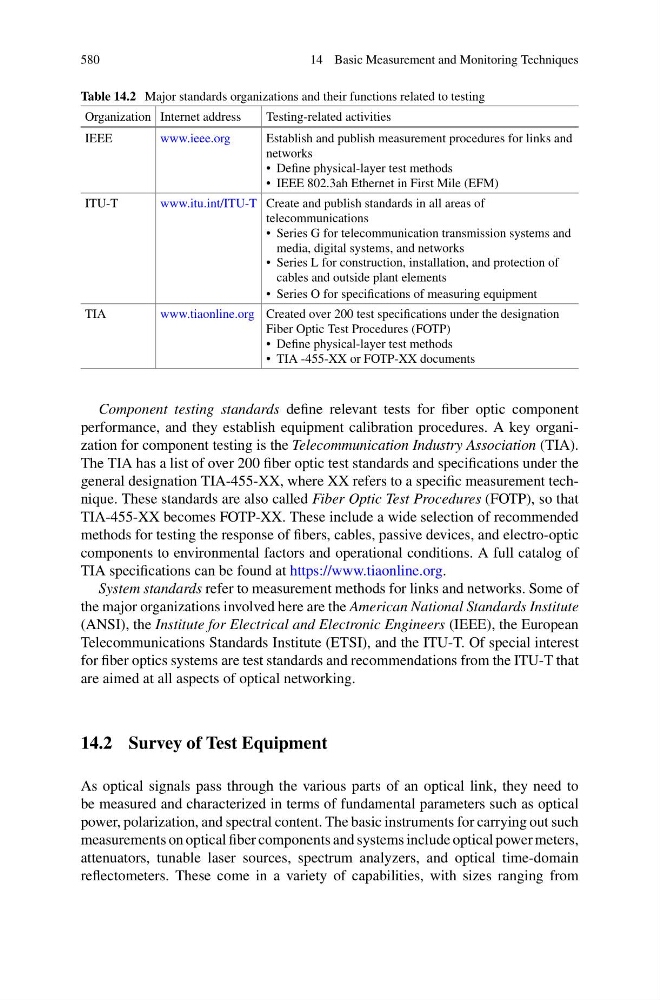
Table 14.2 Major standards organizations and their functions related to testing
Organization Internet address
Testing-related activities
IEEE
www.ieee.org
Establish and publish measurement procedures for links and
networks
• Define physical-layer test methods
• IEEE 802.3ah Ethernet in First Mile (EFM)
ITU-T
www.itu.int/ITU-T Create and publish standards in all areas of
telecommunications
• Series G for telecommunication transmission systems and
media, digital systems, and networks
• Series L for construction, installation, and protection of
cables and outside plant elements
• Series O for specifications of measuring equipment
TIA
www.tiaonline.org Created over 200 test specifications under the designation
Fiber Optic Test Procedures (FOTP)
• Define physical-layer test methods
• TIA -455-XX or FOTP-XX documents
Component testing standards define relevant tests for fiber optic component
performance, and they establish equipment calibration procedures. A key organization for component testing is the Telecommunication Industry Association (TIA).
The TIA has a list of over 200 fiber optic test standards and specifications under the
general designation TIA-455-XX, where XX refers to a specific measurement technique. These standards are also called Fiber Optic Test Procedures (FOTP), so that
TIA-455-XX becomes FOTP-XX. These include a wide selection of recommended
methods for testing the response of fibers, cables, passive devices, and electro-optic
components to environmental factors and operational conditions. A full catalog of
TIA specifications can be found at https://www.tiaonline.org.
System standards refer to measurement methods for links and networks. Some of
the major organizations involved here are the American National Standards Institute
(ANSI), the Institute for Electrical and Electronic Engineers (IEEE), the European
Telecommunications Standards Institute (ETSI), and the ITU-T. Of special interest
for fiber optics systems are test standards and recommendations from the ITU-T that
are aimed at all aspects of optical networking.
14.2 Survey of Test Equipment
As optical signals pass through the various parts of an optical link, they need to
be measured and characterized in terms of fundamental parameters such as optical
power, polarization, and spectral content. The basic instruments for carrying out such
measurements on optical fiber components and systems include optical power meters,
attenuators, tunable laser sources, spectrum analyzers, and optical time-domain
reflectometers. These come in a variety of capabilities, with sizes ranging from