

14 Basic Measurement and Monitoring Techniques
579
can measure attenuation and chromatic dispersion. During and after link installation,
several basic parameters need to be checked. For example, the error performance
can be estimated through eye pattern measurements, which is the topic of Sect. 14.5.
The physical integrity of the fielded link typically is checked with an optical timedomain reflectometer (OTDR), as Sect. 14.6 explains. Section 14.7 discusses optical
performance monitoring, which is essential for managing high-capacity lightwave
transmission networks. Network functions that need such monitoring include amplifier control, channel identification, and assessment of the integrity of optical signals.
Section 14.8 describes some basic performance measurements procedures.
14.1 Overview of Measurement Standards
Before examining measurement techniques, it is helpful to look at what standards
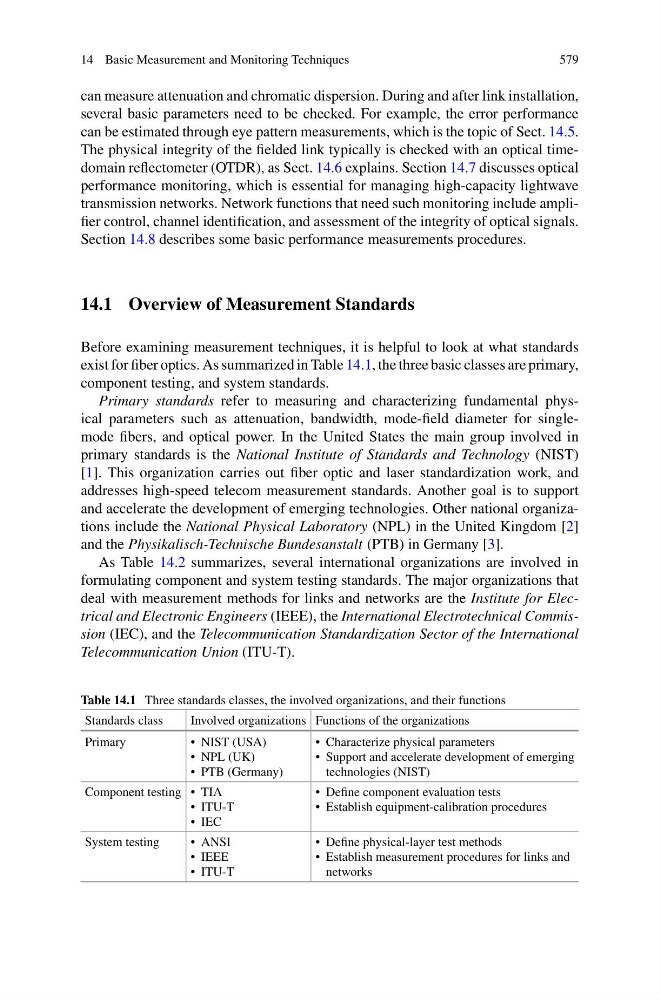
exist for fiber optics. As summarized in Table 14.1, the three basic classes are primary,
component testing, and system standards.
Primary standards refer to measuring and characterizing fundamental physical parameters such as attenuation, bandwidth, mode-field diameter for singlemode fibers, and optical power. In the United States the main group involved in
primary standards is the National Institute of Standards and Technology (NIST)
[1]. This organization carries out fiber optic and laser standardization work, and
addresses high-speed telecom measurement standards. Another goal is to support
and accelerate the development of emerging technologies. Other national organizations include the National Physical Laboratory (NPL) in the United Kingdom [2]
and the Physikalisch-Technische Bundesanstalt (PTB) in Germany [3].
As Table 14.2 summarizes, several international organizations are involved in
formulating component and system testing standards. The major organizations that
deal with measurement methods for links and networks are the Institute for Electrical and Electronic Engineers (IEEE), the International Electrotechnical Commission (IEC), and the Telecommunication Standardization Sector of the International
Telecommunication Union (ITU-T).
Table 14.1 Three standards classes, the involved organizations, and their functions
Standards class
Involved organizations Functions of the organizations
Primary
• NIST (USA)
• NPL (UK)
• PTB (Germany)
• Characterize physical parameters
• Support and accelerate development of emerging
technologies (NIST)
Component testing • TIA
• ITU-T
• IEC
• Define component evaluation tests
• Establish equipment-calibration procedures
System testing
• ANSI
• IEEE
• ITU-T
• Define physical-layer test methods
• Establish measurement procedures for links and
networks