

582
14 Basic Measurement and Monitoring Techniques
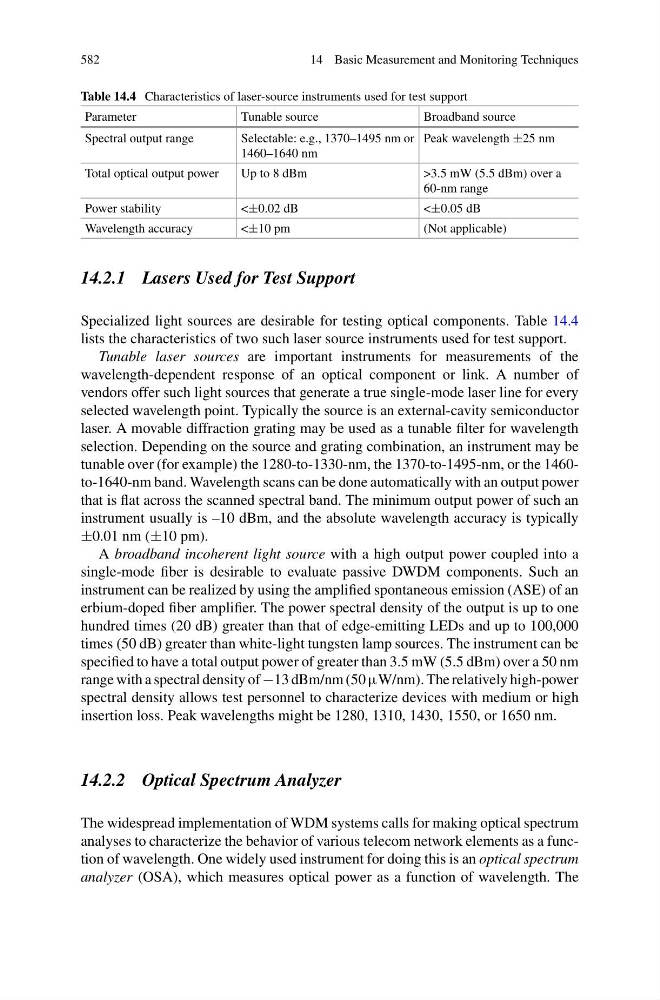
Table 14.4 Characteristics of laser-source instruments used for test support
Parameter
Tunable source
Broadband source
Spectral output range
Selectable: e.g., 1370–1495 nm or
1460–1640 nm
Peak wavelength ±25 nm
Total optical output power
Up to 8 dBm
>3.5 mW (5.5 dBm) over a
60-nm range
Power stability
<±0.02 dB
<±0.05 dB
Wavelength accuracy
<±10 pm
(Not applicable)
14.2.1 Lasers Used for Test Support
Specialized light sources are desirable for testing optical components. Table 14.4
lists the characteristics of two such laser source instruments used for test support.
Tunable laser sources are important instruments for measurements of the
wavelength-dependent response of an optical component or link. A number of
vendors offer such light sources that generate a true single-mode laser line for every
selected wavelength point. Typically the source is an external-cavity semiconductor
laser. A movable diffraction grating may be used as a tunable filter for wavelength
selection. Depending on the source and grating combination, an instrument may be
tunable over (for example) the 1280-to-1330-nm, the 1370-to-1495-nm, or the 1460to-1640-nm band. Wavelength scans can be done automatically with an output power
that is flat across the scanned spectral band. The minimum output power of such an
instrument usually is –10 dBm, and the absolute wavelength accuracy is typically
±0.01 nm (±10 pm).
A broadband incoherent light source with a high output power coupled into a
single-mode fiber is desirable to evaluate passive DWDM components. Such an
instrument can be realized by using the amplified spontaneous emission (ASE) of an
erbium-doped fiber amplifier. The power spectral density of the output is up to one
hundred times (20 dB) greater than that of edge-emitting LEDs and up to 100,000
times (50 dB) greater than white-light tungsten lamp sources. The instrument can be
specified to have a total output power of greater than 3.5 mW (5.5 dBm) over a 50 nm
range with a spectral density of −13 dBm/nm (50 μW/nm). The relatively high-power
spectral density allows test personnel to characterize devices with medium or high
insertion loss. Peak wavelengths might be 1280, 1310, 1430, 1550, or 1650 nm.
14.2.2 Optical Spectrum Analyzer
The widespread implementation of WDM systems calls for making optical spectrum
analyses to characterize the behavior of various telecom network elements as a function of wavelength. One widely used instrument for doing this is an optical spectrum
analyzer (OSA), which measures optical power as a function of wavelength. The