

564
13 Fiber Optic Communication Networks
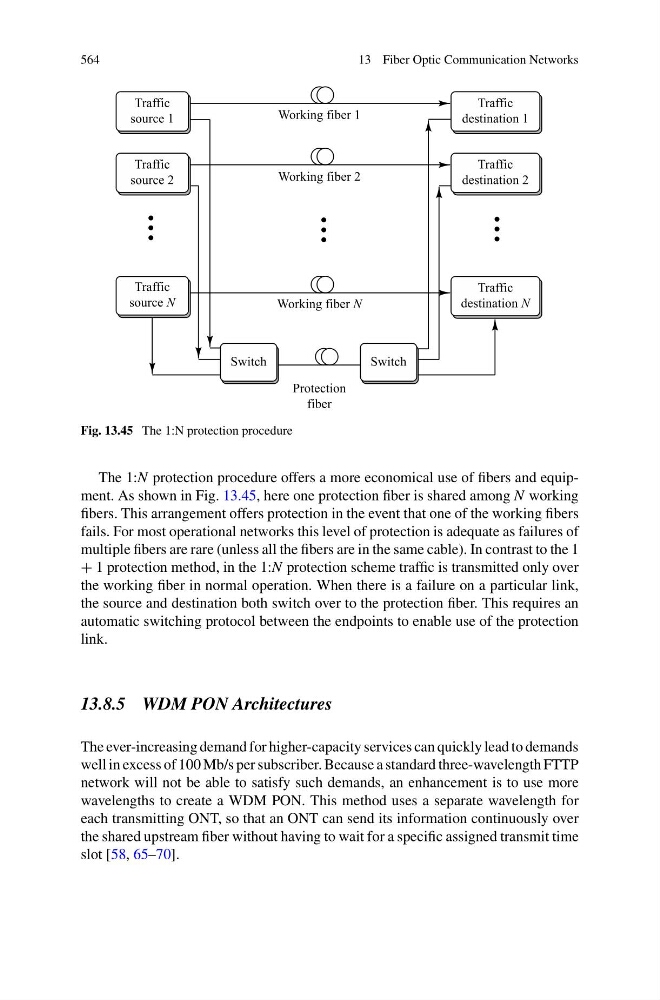
Fig. 13.45 The 1:N protection procedure
The 1:N protection procedure offers a more economical use of fibers and equipment. As shown in Fig. 13.45, here one protection fiber is shared among N working
fibers. This arrangement offers protection in the event that one of the working fibers
fails. For most operational networks this level of protection is adequate as failures of
multiple fibers are rare (unless all the fibers are in the same cable). In contrast to the 1
+ 1 protection method, in the 1:N protection scheme traffic is transmitted only over
the working fiber in normal operation. When there is a failure on a particular link,
the source and destination both switch over to the protection fiber. This requires an
automatic switching protocol between the endpoints to enable use of the protection
link.
13.8.5 WDM PON Architectures
The ever-increasing demand for higher-capacity services can quickly lead to demands
well in excess of 100 Mb/s per subscriber. Because a standard three-wavelength FTTP
network will not be able to satisfy such demands, an enhancement is to use more
wavelengths to create a WDM PON. This method uses a separate wavelength for
each transmitting ONT, so that an ONT can send its information continuously over
the shared upstream fiber without having to wait for a specific assigned transmit time
slot [58, 65–70].