

13.8 Passive Optical Networks
563
Example 13.5 Consider two ONTs located 3 and 20 km from the OLT, respectively.
For these two links, what are the roundtrip propagation times for messages coming
from and returning to the OLT? Let the speed of light in the fiber be 2 × 10
8 m/s.
Solution: The roundtrip propagation times are
t (3 km) = 2(3 km)/
2 × 10
8 m/s
= 30 μs
t (20 km) = 2(20 km)/
2 × 10
8 m/s
= 200 μs
Drill Problem 13.5 Because the ranging procedure in a PON has a limited
accuracy, a guard time is placed between consecutive bursts to avoid collisions
of the independent packets, as Fig. 7.18 illustrates. Verify that a 25.6-ns guard
time consumes 64 bits at a 2.488-Gb/s data rate.
13.8.4 Protection Switching for PON Configurations
The ITU-T Recommendation G.984.1 describes the use of a protection switching
mechanism. This allows several different types of PON configurations that include
redundancy of links and equipment for network protection. Among these are a fully
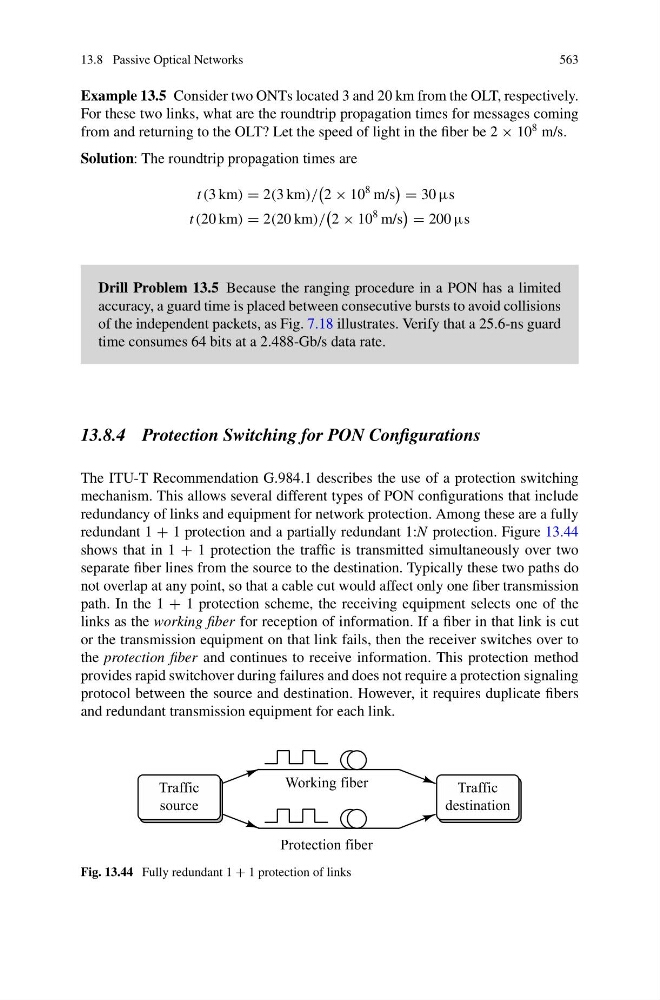
redundant 1 + 1 protection and a partially redundant 1:N protection. Figure 13.44
shows that in 1 + 1 protection the traffic is transmitted simultaneously over two
separate fiber lines from the source to the destination. Typically these two paths do
not overlap at any point, so that a cable cut would affect only one fiber transmission
path. In the 1 + 1 protection scheme, the receiving equipment selects one of the
links as the working fiber for reception of information. If a fiber in that link is cut
or the transmission equipment on that link fails, then the receiver switches over to
the protection fiber and continues to receive information. This protection method
provides rapid switchover during failures and does not require a protection signaling
protocol between the source and destination. However, it requires duplicate fibers
and redundant transmission equipment for each link.
Fig. 13.44 Fully redundant 1 + 1 protection of links