

13.8 Passive Optical Networks
565
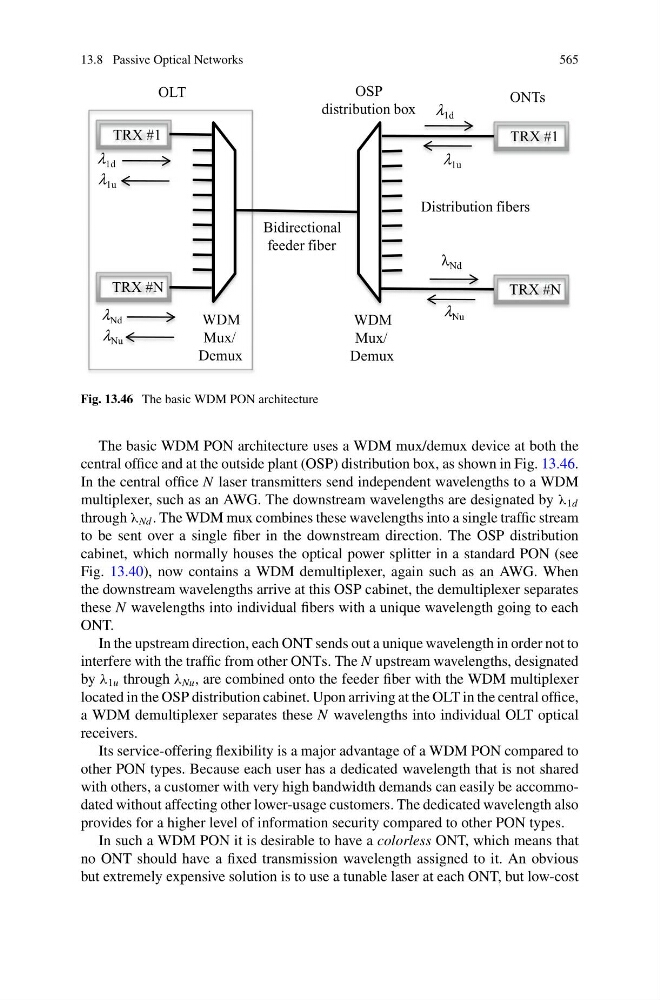
Fig. 13.46 The basic WDM PON architecture
The basic WDM PON architecture uses a WDM mux/demux device at both the
central office and at the outside plant (OSP) distribution box, as shown in Fig. 13.46.
In the central office N laser transmitters send independent wavelengths to a WDM
multiplexer, such as an AWG. The downstream wavelengths are designated by λ 1d
through λ Nd . The WDM mux combines these wavelengths into a single traffic stream
to be sent over a single fiber in the downstream direction. The OSP distribution
cabinet, which normally houses the optical power splitter in a standard PON (see
Fig. 13.40), now contains a WDM demultiplexer, again such as an AWG. When
the downstream wavelengths arrive at this OSP cabinet, the demultiplexer separates
these N wavelengths into individual fibers with a unique wavelength going to each
ONT.
In the upstream direction, each ONT sends out a unique wavelength in order not to
interfere with the traffic from other ONTs. The N upstream wavelengths, designated
by λ 1u through λ Nu , are combined onto the feeder fiber with the WDM multiplexer
located in the OSP distribution cabinet. Upon arriving at the OLT in the central office,
a WDM demultiplexer separates these N wavelengths into individual OLT optical
receivers.
Its service-offering flexibility is a major advantage of a WDM PON compared to
other PON types. Because each user has a dedicated wavelength that is not shared
with others, a customer with very high bandwidth demands can easily be accommodated without affecting other lower-usage customers. The dedicated wavelength also
provides for a higher level of information security compared to other PON types.
In such a WDM PON it is desirable to have a colorless ONT, which means that
no ONT should have a fixed transmission wavelength assigned to it. An obvious
but extremely expensive solution is to use a tunable laser at each ONT, but low-cost