

2.1 The Nature of Light
37
angular frequency ω. Eliminating the (ωt – kz) dependence between Eqs. (2.2) and
(2.3) for a general value of δ yields
E x
E 0x
2
+
E y
E 0y
2
− 2
E x
E 0x
E y
E 0y
cosδ = sin
2
δ
(2.7)
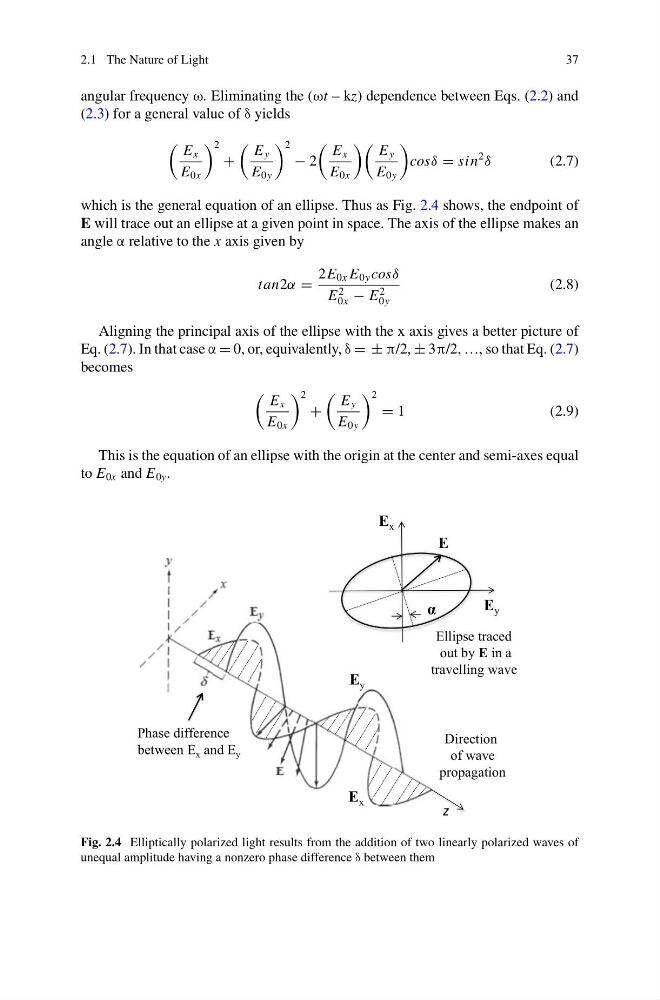
which is the general equation of an ellipse. Thus as Fig. 2.4 shows, the endpoint of
E will trace out an ellipse at a given point in space. The axis of the ellipse makes an
angle α relative to the x axis given by
tan2α =
2E 0x E 0y cosδ
E
2
0x − E
2
0y
(2.8)
Aligning the principal axis of the ellipse with the x axis gives a better picture of
Eq. (2.7). In that case α = 0, or, equivalently, δ = ± π/2, ± 3π/2, …, so that Eq. (2.7)
becomes
E x
E 0x
2
+
E y
E 0y
2
= 1
(2.9)
This is the equation of an ellipse with the origin at the center and semi-axes equal
to E 0x and E 0y .
E
E y
E x
E x
E y
α
Phase difference
between E x and E y
Ellipse traced
out by E in a
travelling wave
z
Direction
of wave
propagation
Fig. 2.4 Elliptically polarized light results from the addition of two linearly polarized waves of
unequal amplitude having a nonzero phase difference δ between them
37
angular frequency ω. Eliminating the (ωt – kz) dependence between Eqs. (2.2) and
(2.3) for a general value of δ yields
E x
E 0x
2
+
E y
E 0y
2
− 2
E x
E 0x
E y
E 0y
cosδ = sin
2
δ
(2.7)
which is the general equation of an ellipse. Thus as Fig. 2.4 shows, the endpoint of
E will trace out an ellipse at a given point in space. The axis of the ellipse makes an
angle α relative to the x axis given by
tan2α =
2E 0x E 0y cosδ
E
2
0x − E
2
0y
(2.8)
Aligning the principal axis of the ellipse with the x axis gives a better picture of
Eq. (2.7). In that case α = 0, or, equivalently, δ = ± π/2, ± 3π/2, …, so that Eq. (2.7)
becomes
E x
E 0x
2
+
E y
E 0y
2
= 1
(2.9)
This is the equation of an ellipse with the origin at the center and semi-axes equal
to E 0x and E 0y .
E
E y
E x
E x
E y
α
Phase difference
between E x and E y
Ellipse traced
out by E in a
travelling wave
z
Direction
of wave
propagation
Fig. 2.4 Elliptically polarized light results from the addition of two linearly polarized waves of
unequal amplitude having a nonzero phase difference δ between them