

36
2 Optical Fiber Structures and Light Guiding Principles
z
Direction
of wave
propagation
Electric field
Linearly polarized
wave along the x axis
Linearly polarized
wave along the y axis
Axial view of the
electric field wave
components
E
E y
E x
θ
E y
E x
E
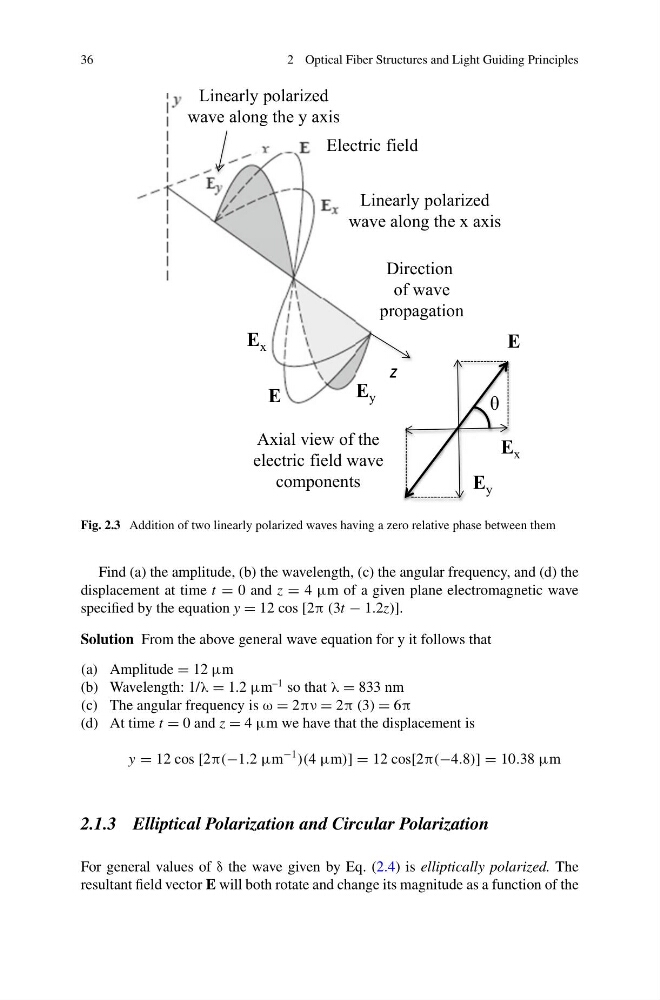
Fig. 2.3 Addition of two linearly polarized waves having a zero relative phase between them
Find (a) the amplitude, (b) the wavelength, (c) the angular frequency, and (d) the
displacement at time t = 0 and z = 4 μm of a given plane electromagnetic wave
specified by the equation y = 12 cos [2π (3t − 1.2z)].
Solution From the above general wave equation for y it follows that
(a) Amplitude = 12 μm
(b) Wavelength: 1/λ = 1.2 μm
–1 so that λ = 833 nm
(c) The angular frequency is ω = 2πν = 2π (3) = 6π
(d) At time t = 0 and z = 4 μm we have that the displacement is
y = 12 cos [2π(−1.2 μm
−1
)(4 μm)] = 12 cos[2π(−4.8)] = 10.38 μm
2.1.3 Elliptical Polarization and Circular Polarization
For general values of δ the wave given by Eq. (2.4) is elliptically polarized. The
resultant field vector E will both rotate and change its magnitude as a function of the
2 Optical Fiber Structures and Light Guiding Principles
z
Direction
of wave
propagation
Electric field
Linearly polarized
wave along the x axis
Linearly polarized
wave along the y axis
Axial view of the
electric field wave
components
E
E y
E x
θ
E y
E x
E
Fig. 2.3 Addition of two linearly polarized waves having a zero relative phase between them
Find (a) the amplitude, (b) the wavelength, (c) the angular frequency, and (d) the
displacement at time t = 0 and z = 4 μm of a given plane electromagnetic wave
specified by the equation y = 12 cos [2π (3t − 1.2z)].
Solution From the above general wave equation for y it follows that
(a) Amplitude = 12 μm
(b) Wavelength: 1/λ = 1.2 μm
–1 so that λ = 833 nm
(c) The angular frequency is ω = 2πν = 2π (3) = 6π
(d) At time t = 0 and z = 4 μm we have that the displacement is
y = 12 cos [2π(−1.2 μm
−1
)(4 μm)] = 12 cos[2π(−4.8)] = 10.38 μm
2.1.3 Elliptical Polarization and Circular Polarization
For general values of δ the wave given by Eq. (2.4) is elliptically polarized. The
resultant field vector E will both rotate and change its magnitude as a function of the