

2.1 The Nature of Light
35
e i = e x , then the real measurable electric field is given by
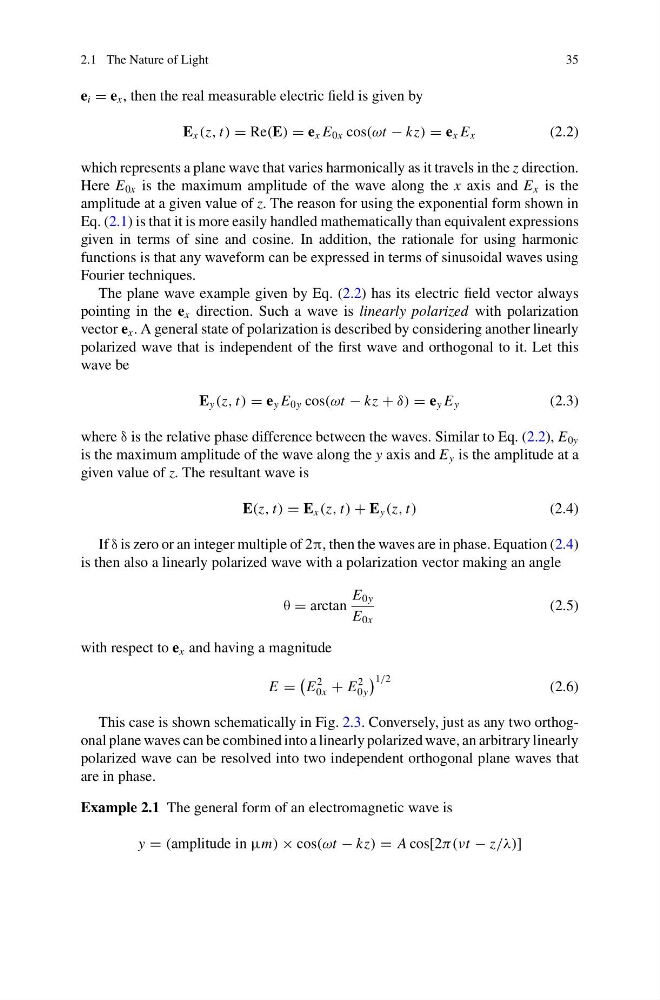
E x (z, t) = Re(E) = e x E 0x cos(ωt − kz) = e x E x
(2.2)
which represents a plane wave that varies harmonically as it travels in the z direction.
Here E 0x is the maximum amplitude of the wave along the x axis and E x is the
amplitude at a given value of z. The reason for using the exponential form shown in
Eq. (2.1) is that it is more easily handled mathematically than equivalent expressions
given in terms of sine and cosine. In addition, the rationale for using harmonic
functions is that any waveform can be expressed in terms of sinusoidal waves using
Fourier techniques.
The plane wave example given by Eq. (2.2) has its electric field vector always
pointing in the e x direction. Such a wave is linearly polarized with polarization
vector e x . A general state of polarization is described by considering another linearly
polarized wave that is independent of the first wave and orthogonal to it. Let this
wave be
E y (z, t) = e y E 0y cos(ωt − kz + δ) = e y E y
(2.3)
where δ is the relative phase difference between the waves. Similar to Eq. (2.2), E 0y
is the maximum amplitude of the wave along the y axis and E y is the amplitude at a
given value of z. The resultant wave is
E(z, t) = E x (z, t) + E y (z, t)
(2.4)
If δ is zero or an integer multiple of 2π, then the waves are in phase. Equation (2.4)
is then also a linearly polarized wave with a polarization vector making an angle
θ = arctan
E 0y
E 0x
(2.5)
with respect to e x and having a magnitude
E =
E
2
0x + E
2
0y
1/2
(2.6)
This case is shown schematically in Fig. 2.3. Conversely, just as any two orthogonal plane waves can be combined into a linearly polarized wave, an arbitrary linearly
polarized wave can be resolved into two independent orthogonal plane waves that
are in phase.
Example 2.1 The general form of an electromagnetic wave is
y = (amplitude in μm) × cos(ωt − kz) = A cos[2π(νt − z/λ)]
35
e i = e x , then the real measurable electric field is given by
E x (z, t) = Re(E) = e x E 0x cos(ωt − kz) = e x E x
(2.2)
which represents a plane wave that varies harmonically as it travels in the z direction.
Here E 0x is the maximum amplitude of the wave along the x axis and E x is the
amplitude at a given value of z. The reason for using the exponential form shown in
Eq. (2.1) is that it is more easily handled mathematically than equivalent expressions
given in terms of sine and cosine. In addition, the rationale for using harmonic
functions is that any waveform can be expressed in terms of sinusoidal waves using
Fourier techniques.
The plane wave example given by Eq. (2.2) has its electric field vector always
pointing in the e x direction. Such a wave is linearly polarized with polarization
vector e x . A general state of polarization is described by considering another linearly
polarized wave that is independent of the first wave and orthogonal to it. Let this
wave be
E y (z, t) = e y E 0y cos(ωt − kz + δ) = e y E y
(2.3)
where δ is the relative phase difference between the waves. Similar to Eq. (2.2), E 0y
is the maximum amplitude of the wave along the y axis and E y is the amplitude at a
given value of z. The resultant wave is
E(z, t) = E x (z, t) + E y (z, t)
(2.4)
If δ is zero or an integer multiple of 2π, then the waves are in phase. Equation (2.4)
is then also a linearly polarized wave with a polarization vector making an angle
θ = arctan
E 0y
E 0x
(2.5)
with respect to e x and having a magnitude
E =
E
2
0x + E
2
0y
1/2
(2.6)
This case is shown schematically in Fig. 2.3. Conversely, just as any two orthogonal plane waves can be combined into a linearly polarized wave, an arbitrary linearly
polarized wave can be resolved into two independent orthogonal plane waves that
are in phase.
Example 2.1 The general form of an electromagnetic wave is
y = (amplitude in μm) × cos(ωt − kz) = A cos[2π(νt − z/λ)]