

38
2 Optical Fiber Structures and Light Guiding Principles
When E 0x = E 0y = E 0 and the relative phase difference δ = ± π/2 + 2mπ, where
m = 0, ± 1, ± 2, …, then the light is circularly polarized. In this case, Eq. (2.9)
reduces to
E
2
x + E
2
y = E
2
0
(2.10)
which defines a circle. Choosing the positive sign for δ, Eqs. (2.2) and (2.3) become
E x (z, t) = e x E 0 cos(ωt − kz)
(2.11)
E y (z, t) = −e y E 0 sin(ωt − kz)
(2.12)
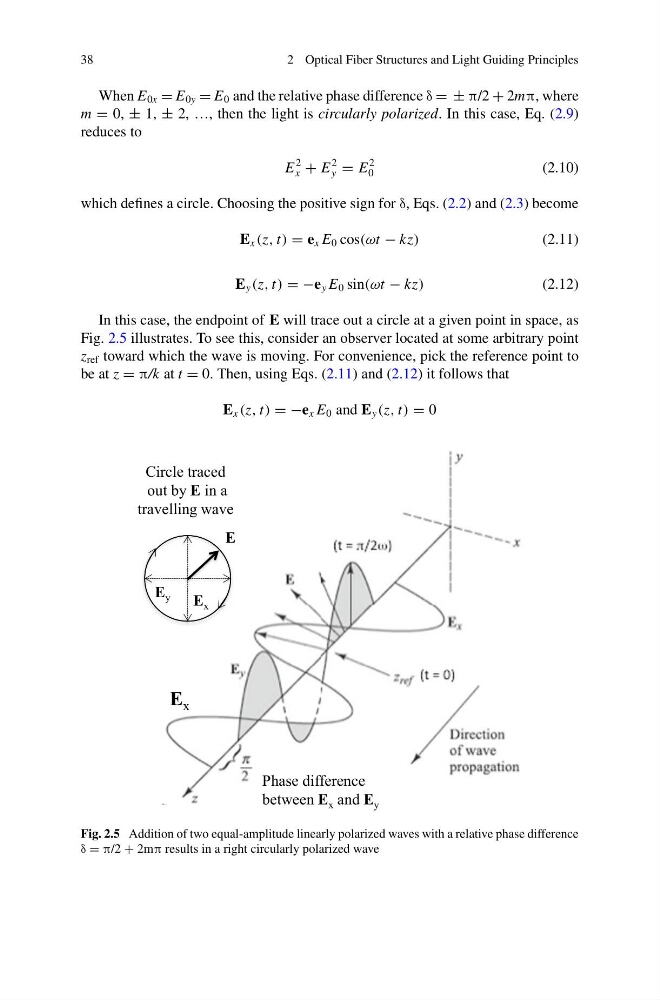
In this case, the endpoint of E will trace out a circle at a given point in space, as
Fig. 2.5 illustrates. To see this, consider an observer located at some arbitrary point
z ref toward which the wave is moving. For convenience, pick the reference point to
be at z = π/k at t = 0. Then, using Eqs. (2.11) and (2.12) it follows that
E x (z, t) = −e x E 0 and E y (z, t) = 0
Phase difference
between E x and E y
E x
Circle traced
out by E in a
travelling wave
E x
E y
E
Fig. 2.5 Addition of two equal-amplitude linearly polarized waves with a relative phase difference
δ = π/2 + 2mπ results in a right circularly polarized wave
2 Optical Fiber Structures and Light Guiding Principles
When E 0x = E 0y = E 0 and the relative phase difference δ = ± π/2 + 2mπ, where
m = 0, ± 1, ± 2, …, then the light is circularly polarized. In this case, Eq. (2.9)
reduces to
E
2
x + E
2
y = E
2
0
(2.10)
which defines a circle. Choosing the positive sign for δ, Eqs. (2.2) and (2.3) become
E x (z, t) = e x E 0 cos(ωt − kz)
(2.11)
E y (z, t) = −e y E 0 sin(ωt − kz)
(2.12)
In this case, the endpoint of E will trace out a circle at a given point in space, as
Fig. 2.5 illustrates. To see this, consider an observer located at some arbitrary point
z ref toward which the wave is moving. For convenience, pick the reference point to
be at z = π/k at t = 0. Then, using Eqs. (2.11) and (2.12) it follows that
E x (z, t) = −e x E 0 and E y (z, t) = 0
Phase difference
between E x and E y
E x
Circle traced
out by E in a
travelling wave
E x
E y
E
Fig. 2.5 Addition of two equal-amplitude linearly polarized waves with a relative phase difference
δ = π/2 + 2mπ results in a right circularly polarized wave