

13.7 WDM Network Implementations
553
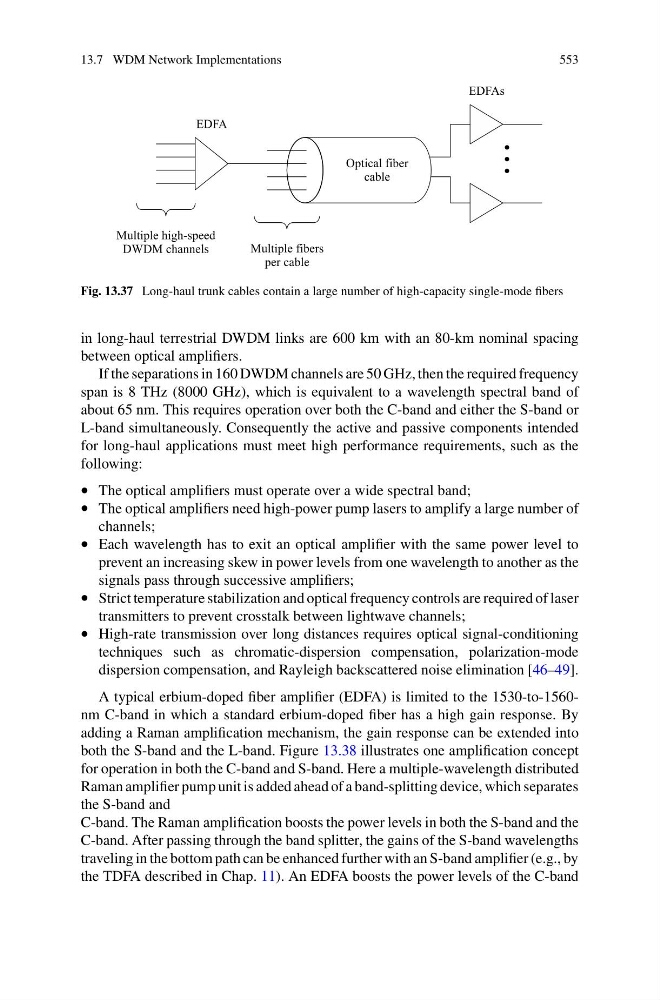
Fig. 13.37 Long-haul trunk cables contain a large number of high-capacity single-mode fibers
in long-haul terrestrial DWDM links are 600 km with an 80-km nominal spacing
between optical amplifiers.
If the separations in 160 DWDM channels are 50 GHz, then the required frequency
span is 8 THz (8000 GHz), which is equivalent to a wavelength spectral band of
about 65 nm. This requires operation over both the C-band and either the S-band or
L-band simultaneously. Consequently the active and passive components intended
for long-haul applications must meet high performance requirements, such as the
following:
• The optical amplifiers must operate over a wide spectral band;
• The optical amplifiers need high-power pump lasers to amplify a large number of
channels;
• Each wavelength has to exit an optical amplifier with the same power level to
prevent an increasing skew in power levels from one wavelength to another as the
signals pass through successive amplifiers;
• Strict temperature stabilization and optical frequency controls are required of laser
transmitters to prevent crosstalk between lightwave channels;
• High-rate transmission over long distances requires optical signal-conditioning
techniques such as chromatic-dispersion compensation, polarization-mode
dispersion compensation, and Rayleigh backscattered noise elimination [46–49].
A typical erbium-doped fiber amplifier (EDFA) is limited to the 1530-to-1560nm C-band in which a standard erbium-doped fiber has a high gain response. By
adding a Raman amplification mechanism, the gain response can be extended into
both the S-band and the L-band. Figure 13.38 illustrates one amplification concept
for operation in both the C-band and S-band. Here a multiple-wavelength distributed
Raman amplifier pump unit is added ahead of a band-splitting device, which separates
the S-band and
C-band. The Raman amplification boosts the power levels in both the S-band and the
C-band. After passing through the band splitter, the gains of the S-band wavelengths
traveling in the bottom path can be enhanced further with an S-band amplifier (e.g., by
the TDFA described in Chap. 11). An EDFA boosts the power levels of the C-band