

552
13 Fiber Optic Communication Networks
13.7 WDM Network Implementations
This section presents some WDM network implementation examples.
13.7.1 Long-Distance WDM Networks
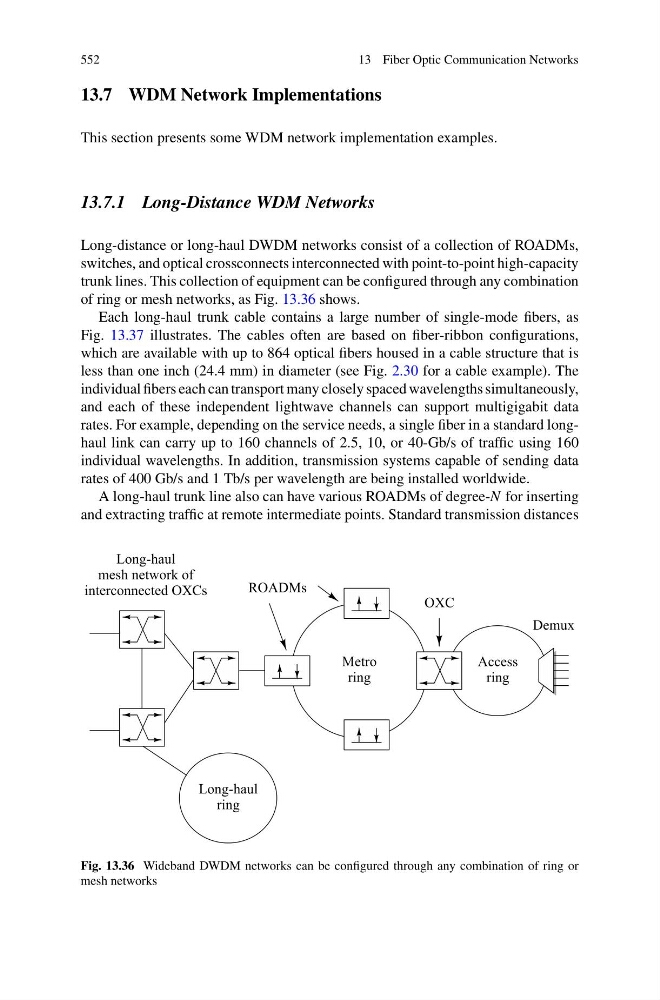
Long-distance or long-haul DWDM networks consist of a collection of ROADMs,
switches, and optical crossconnects interconnected with point-to-point high-capacity
trunk lines. This collection of equipment can be configured through any combination
of ring or mesh networks, as Fig. 13.36 shows.
Each long-haul trunk cable contains a large number of single-mode fibers, as
Fig. 13.37 illustrates. The cables often are based on fiber-ribbon configurations,
which are available with up to 864 optical fibers housed in a cable structure that is
less than one inch (24.4 mm) in diameter (see Fig. 2.30 for a cable example). The
individual fibers each can transport many closely spaced wavelengths simultaneously,
and each of these independent lightwave channels can support multigigabit data
rates. For example, depending on the service needs, a single fiber in a standard longhaul link can carry up to 160 channels of 2.5, 10, or 40-Gb/s of traffic using 160
individual wavelengths. In addition, transmission systems capable of sending data
rates of 400 Gb/s and 1 Tb/s per wavelength are being installed worldwide.
A long-haul trunk line also can have various ROADMs of degree-N for inserting
and extracting traffic at remote intermediate points. Standard transmission distances
Fig. 13.36 Wideband DWDM networks can be configured through any combination of ring or
mesh networks