

13.6 Optical Switching Architectures
551
heavy incoming traffic loads. If the assembled burst length is smaller than B min at the
scheduled burst transmission time, then padding bits are added to bring the length to
B min .
13.6.6 Elastic Optical Networks
The historical development of sophisticated dense WDM networks saw the creation
and specification of fixed spectral grids to accommodate a wide variety of data rates
and modulation formats. In the development process, the ITU-T standardization of
these grids specified increasingly narrower spectral widths moving from 200 to 100
to 50 and then to 25 GHz. These spectral widths correspond to 1.6, 0.8, 0.4, and
0.2 nm, respectively, in the 1550-nm wavelength window. Typical data rates that
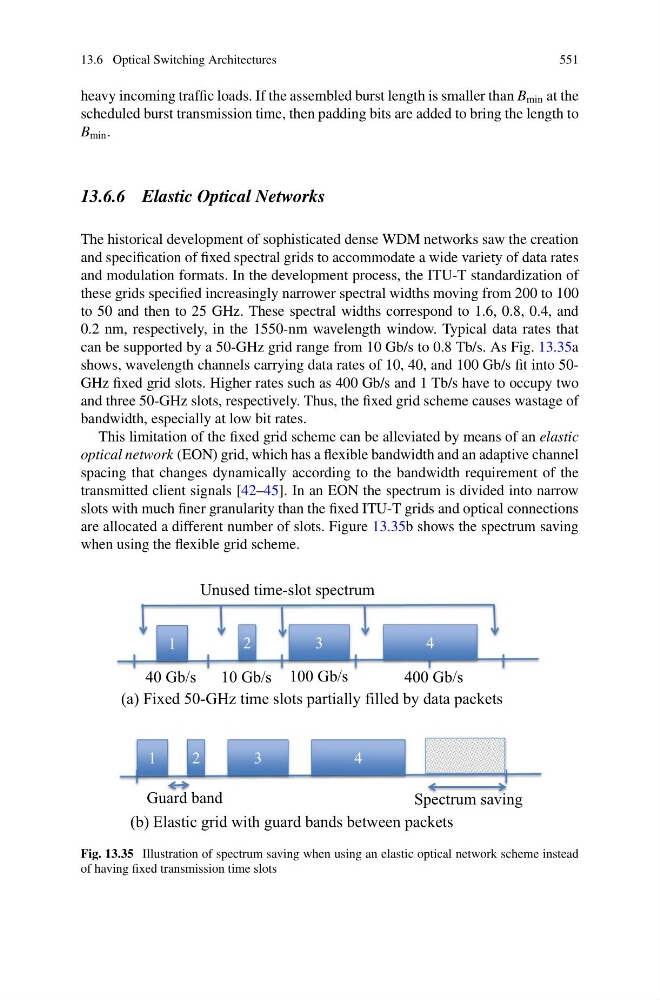
can be supported by a 50-GHz grid range from 10 Gb/s to 0.8 Tb/s. As Fig. 13.35a
shows, wavelength channels carrying data rates of 10, 40, and 100 Gb/s fit into 50GHz fixed grid slots. Higher rates such as 400 Gb/s and 1 Tb/s have to occupy two
and three 50-GHz slots, respectively. Thus, the fixed grid scheme causes wastage of
bandwidth, especially at low bit rates.
This limitation of the fixed grid scheme can be alleviated by means of an elastic
optical network (EON) grid, which has a flexible bandwidth and an adaptive channel
spacing that changes dynamically according to the bandwidth requirement of the
transmitted client signals [42–45]. In an EON the spectrum is divided into narrow
slots with much finer granularity than the fixed ITU-T grids and optical connections
are allocated a different number of slots. Figure 13.35b shows the spectrum saving
when using the flexible grid scheme.
(a) Fixed 50-GHz time slots partially filled by data packets
1
2
3
4
40 Gb/s
100 Gb/s
10 Gb/s
400 Gb/s
Unused time-slot spectrum
(b) Elastic grid with guard bands between packets
1
2
3
4
Guard band
Spectrum saving
Fig. 13.35 Illustration of spectrum saving when using an elastic optical network scheme instead
of having fixed transmission time slots