

554
13 Fiber Optic Communication Networks
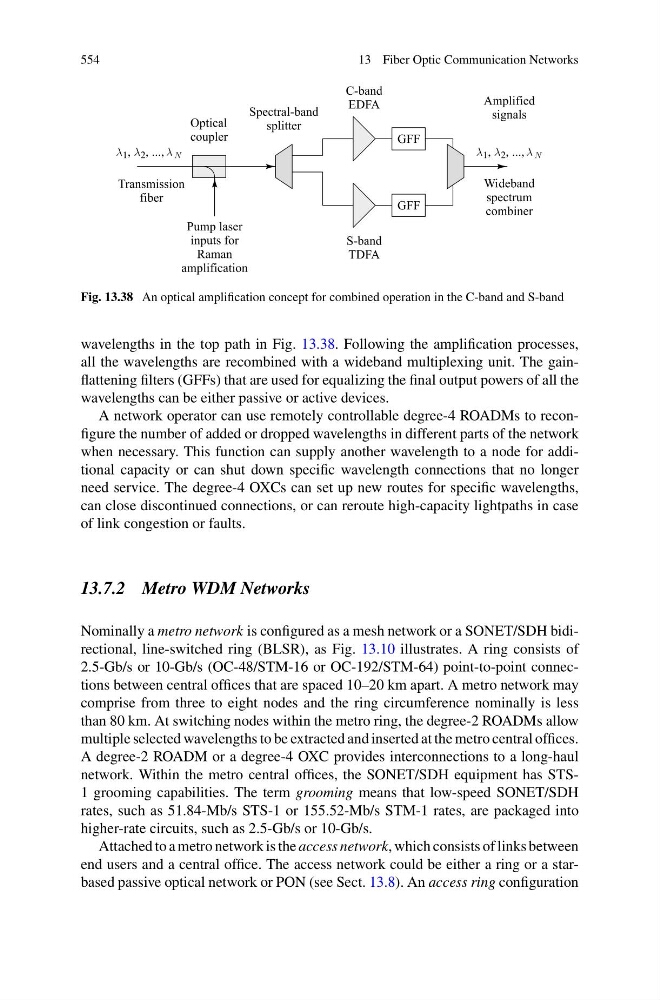
Fig. 13.38 An optical amplification concept for combined operation in the C-band and S-band
wavelengths in the top path in Fig. 13.38. Following the amplification processes,
all the wavelengths are recombined with a wideband multiplexing unit. The gainflattening filters (GFFs) that are used for equalizing the final output powers of all the
wavelengths can be either passive or active devices.
A network operator can use remotely controllable degree-4 ROADMs to reconfigure the number of added or dropped wavelengths in different parts of the network
when necessary. This function can supply another wavelength to a node for additional capacity or can shut down specific wavelength connections that no longer
need service. The degree-4 OXCs can set up new routes for specific wavelengths,
can close discontinued connections, or can reroute high-capacity lightpaths in case
of link congestion or faults.
13.7.2 Metro WDM Networks
Nominally a metro network is configured as a mesh network or a SONET/SDH bidirectional, line-switched ring (BLSR), as Fig. 13.10 illustrates. A ring consists of
2.5-Gb/s or 10-Gb/s (OC-48/STM-16 or OC-192/STM-64) point-to-point connections between central offices that are spaced 10–20 km apart. A metro network may
comprise from three to eight nodes and the ring circumference nominally is less
than 80 km. At switching nodes within the metro ring, the degree-2 ROADMs allow
multiple selected wavelengths to be extracted and inserted at the metro central offices.
A degree-2 ROADM or a degree-4 OXC provides interconnections to a long-haul
network. Within the metro central offices, the SONET/SDH equipment has STS1 grooming capabilities. The term grooming means that low-speed SONET/SDH
rates, such as 51.84-Mb/s STS-1 or 155.52-Mb/s STM-1 rates, are packaged into
higher-rate circuits, such as 2.5-Gb/s or 10-Gb/s.
Attached to a metro network is the access network, which consists of links between
end users and a central office. The access network could be either a ring or a starbased passive optical network or PON (see Sect. 13.8). An access ring configuration