

13.6 Optical Switching Architectures
549
13.6.5 Optical Burst Switching
Optical burst switching (OBS) was conceived to provide an efficient solution for
sending high-speed bursty traffic over WDM networks [39–41]. Traffic is considered as being bursty if there are long idle times between the busy periods in which
a large number of packets arrive from users. This format is typical of data traffic
in contrast to voice traffic, which is characterized by a more continuous bit stream
nature. There are two advantages to OBS. First, it offers the high bandwidth and
packet-sized granularity of optical packet-switched networks without the need for
complex optical buffering. Second, it provides the low packet-processing overhead
that is characteristic of wavelength-routed networks. Thus, the performance characteristics of OBS lie between those of a wavelength-routed network and an optical
packet-switched network.
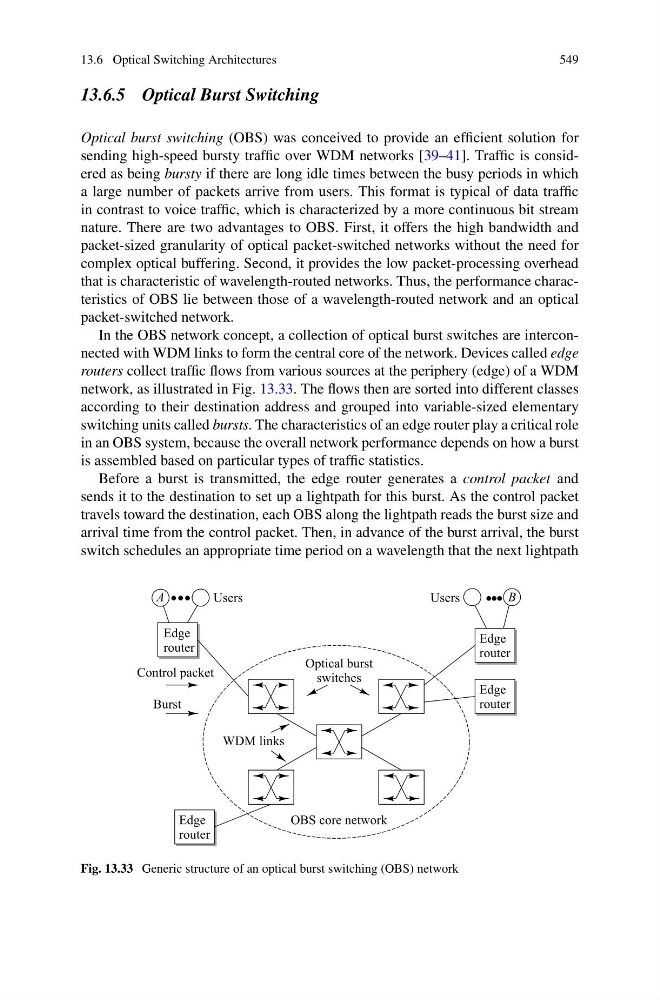
In the OBS network concept, a collection of optical burst switches are interconnected with WDM links to form the central core of the network. Devices called edge
routers collect traffic flows from various sources at the periphery (edge) of a WDM
network, as illustrated in Fig. 13.33. The flows then are sorted into different classes
according to their destination address and grouped into variable-sized elementary
switching units called bursts. The characteristics of an edge router play a critical role
in an OBS system, because the overall network performance depends on how a burst
is assembled based on particular types of traffic statistics.
Before a burst is transmitted, the edge router generates a control packet and
sends it to the destination to set up a lightpath for this burst. As the control packet
travels toward the destination, each OBS along the lightpath reads the burst size and
arrival time from the control packet. Then, in advance of the burst arrival, the burst
switch schedules an appropriate time period on a wavelength that the next lightpath
Fig. 13.33 Generic structure of an optical burst switching (OBS) network