

548
13 Fiber Optic Communication Networks
13.6.4 Optical Packet Switching
The success of electronic packet-switched networks lies in their ability to achieve
reliable high packet throughputs and to adapt easily to traffic congestion and transmission link or node failures. Various studies have been undertaken to extend this
capability to all-optical networks in which no O/E/O conversion takes place along a
lightpath. In the concept of an optical packet-switched (OPS) network, user traffic
is routed and transmitted through the network in the form of optical packets along
with in-band control information that is contained in a specially formatted header or
label. For OPS systems the header processing and routing functions are carried out
electronically, and the switching of the optical payloads is done in the optical domain
for each individual packet. This decoupling between header or label processing and
payload switching allows the packets to be routed independent of payload bit rate,
coding format, and packet length.
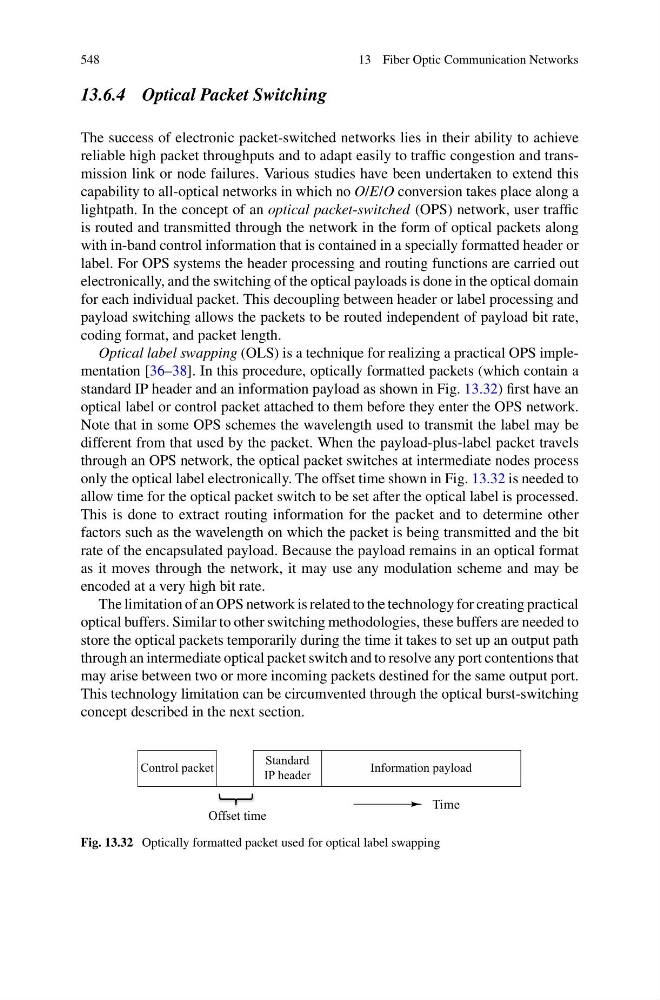
Optical label swapping (OLS) is a technique for realizing a practical OPS implementation [36–38]. In this procedure, optically formatted packets (which contain a
standard IP header and an information payload as shown in Fig. 13.32) first have an
optical label or control packet attached to them before they enter the OPS network.
Note that in some OPS schemes the wavelength used to transmit the label may be
different from that used by the packet. When the payload-plus-label packet travels
through an OPS network, the optical packet switches at intermediate nodes process
only the optical label electronically. The offset time shown in Fig. 13.32 is needed to
allow time for the optical packet switch to be set after the optical label is processed.
This is done to extract routing information for the packet and to determine other
factors such as the wavelength on which the packet is being transmitted and the bit
rate of the encapsulated payload. Because the payload remains in an optical format
as it moves through the network, it may use any modulation scheme and may be
encoded at a very high bit rate.
The limitation of an OPS network is related to the technology for creating practical
optical buffers. Similar to other switching methodologies, these buffers are needed to
store the optical packets temporarily during the time it takes to set up an output path
through an intermediate optical packet switch and to resolve any port contentions that
may arise between two or more incoming packets destined for the same output port.
This technology limitation can be circumvented through the optical burst-switching
concept described in the next section.
Fig. 13.32 Optically formatted packet used for optical label swapping