

500
12 Nonlinear Processes in Optical Fibers
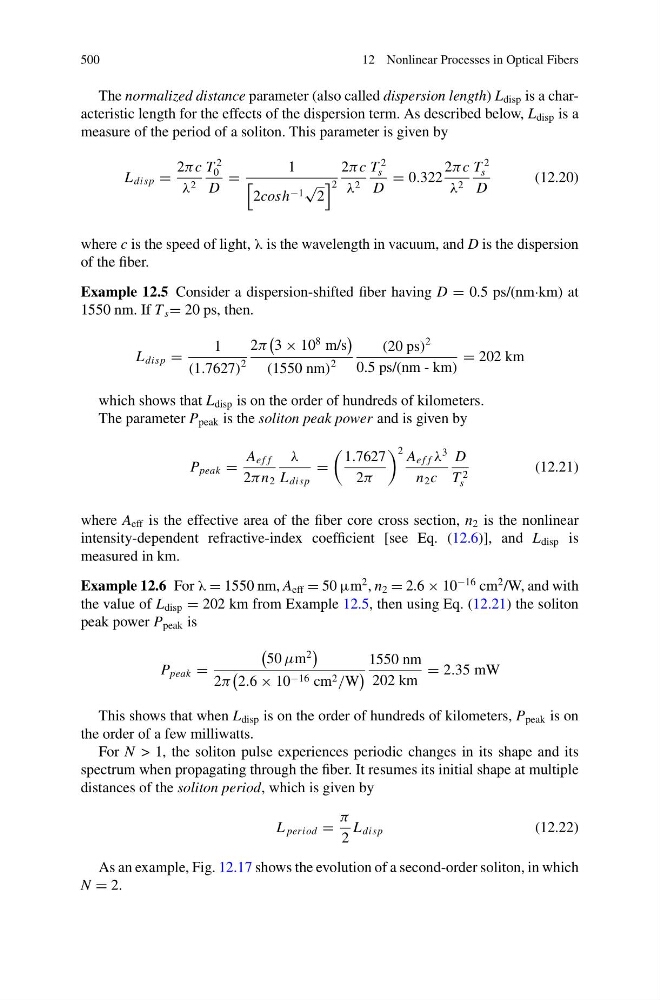
The normalized distance parameter (also called dispersion length) L disp is a characteristic length for the effects of the dispersion term. As described below, L disp is a
measure of the period of a soliton. This parameter is given by
L disp =
2π c
λ 2
T
2
0
D
=
1
2cosh −1
√
2
2
2π c
λ 2
T
2
s
D
= 0.322
2π c
λ 2
T
2
s
D
(12.20)
where c is the speed of light, λ is the wavelength in vacuum, and D is the dispersion
of the fiber.
Example 12.5 Consider a dispersion-shifted fiber having D = 0.5 ps/(nm·km) at
1550 nm. If T s = 20 ps, then.
L disp =
1
(1.7627)
2
2π
3 × 10
8 m/s
(1550 nm)
2
(20 ps)
2
0.5 ps/(nm - km)
= 202 km
which shows that L disp is on the order of hundreds of kilometers.
The parameter P peak is the soliton peak power and is given by
P peak =
A e f f
2π n 2
λ
L disp
=
1.7627
2π
2 A e f f λ
3
n 2 c
D
T 2
s
(12.21)
where A eff is the effective area of the fiber core cross section, n 2 is the nonlinear
intensity-dependent refractive-index coefficient [see Eq. (12.6)], and L disp is
measured in km.
Example 12.6 For λ = 1550 nm, A eff = 50 μm
2 , n 2 = 2.6 × 10
−16 cm
2 /W, and with
the value of L disp = 202 km from Example 12.5, then using Eq. (12.21) the soliton
peak power P peak is
P peak =
50 μm
2
2π
2.6 × 10 −16 cm 2 /W
1550 nm
202 km
= 2.35 mW
This shows that when L disp is on the order of hundreds of kilometers, P peak is on
the order of a few milliwatts.
For N > 1, the soliton pulse experiences periodic changes in its shape and its
spectrum when propagating through the fiber. It resumes its initial shape at multiple
distances of the soliton period, which is given by
L period =
π
2
L disp
(12.22)
As an example, Fig. 12.17 shows the evolution of a second-order soliton, in which
N = 2.
12 Nonlinear Processes in Optical Fibers
The normalized distance parameter (also called dispersion length) L disp is a characteristic length for the effects of the dispersion term. As described below, L disp is a
measure of the period of a soliton. This parameter is given by
L disp =
2π c
λ 2
T
2
0
D
=
1
2cosh −1
√
2
2
2π c
λ 2
T
2
s
D
= 0.322
2π c
λ 2
T
2
s
D
(12.20)
where c is the speed of light, λ is the wavelength in vacuum, and D is the dispersion
of the fiber.
Example 12.5 Consider a dispersion-shifted fiber having D = 0.5 ps/(nm·km) at
1550 nm. If T s = 20 ps, then.
L disp =
1
(1.7627)
2
2π
3 × 10
8 m/s
(1550 nm)
2
(20 ps)
2
0.5 ps/(nm - km)
= 202 km
which shows that L disp is on the order of hundreds of kilometers.
The parameter P peak is the soliton peak power and is given by
P peak =
A e f f
2π n 2
λ
L disp
=
1.7627
2π
2 A e f f λ
3
n 2 c
D
T 2
s
(12.21)
where A eff is the effective area of the fiber core cross section, n 2 is the nonlinear
intensity-dependent refractive-index coefficient [see Eq. (12.6)], and L disp is
measured in km.
Example 12.6 For λ = 1550 nm, A eff = 50 μm
2 , n 2 = 2.6 × 10
−16 cm
2 /W, and with
the value of L disp = 202 km from Example 12.5, then using Eq. (12.21) the soliton
peak power P peak is
P peak =
50 μm
2
2π
2.6 × 10 −16 cm 2 /W
1550 nm
202 km
= 2.35 mW
This shows that when L disp is on the order of hundreds of kilometers, P peak is on
the order of a few milliwatts.
For N > 1, the soliton pulse experiences periodic changes in its shape and its
spectrum when propagating through the fiber. It resumes its initial shape at multiple
distances of the soliton period, which is given by
L period =
π
2
L disp
(12.22)
As an example, Fig. 12.17 shows the evolution of a second-order soliton, in which
N = 2.